Making Prosthetic Eyes That Look Like the Real Thing
Patients and practitioners marvel at the craftsmanship of a Kellogg Eye Center ocularist, whose intricate pieces give recipients a new outlook on life.
7:00 AM
Author |
Two enormous bulletin boards take up much of the wall space in the tiny office and laboratory. Photos of children, some just a few months old, cover each panel.
Many of these children were born with sightless eyes; others lost their vision to disease or injury.
But you wouldn't know it by looking at their smiling faces.
Thanks to Greg Dootz, an ocularist at the University of Michigan's Kellogg Eye Center, more than 3,000 patients have received prosthetic eyes that are every bit as beautiful — and complex — as the real thing.
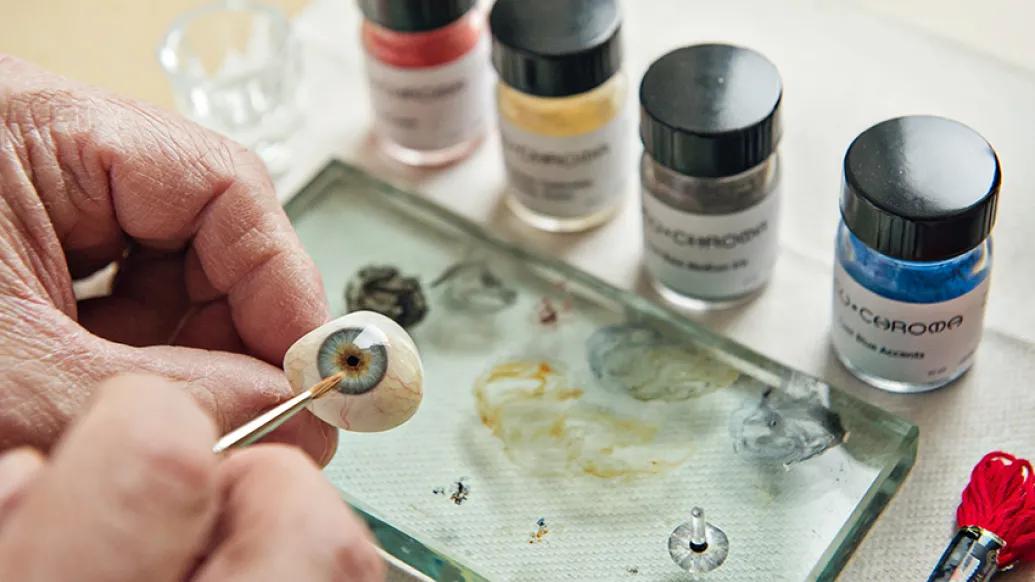
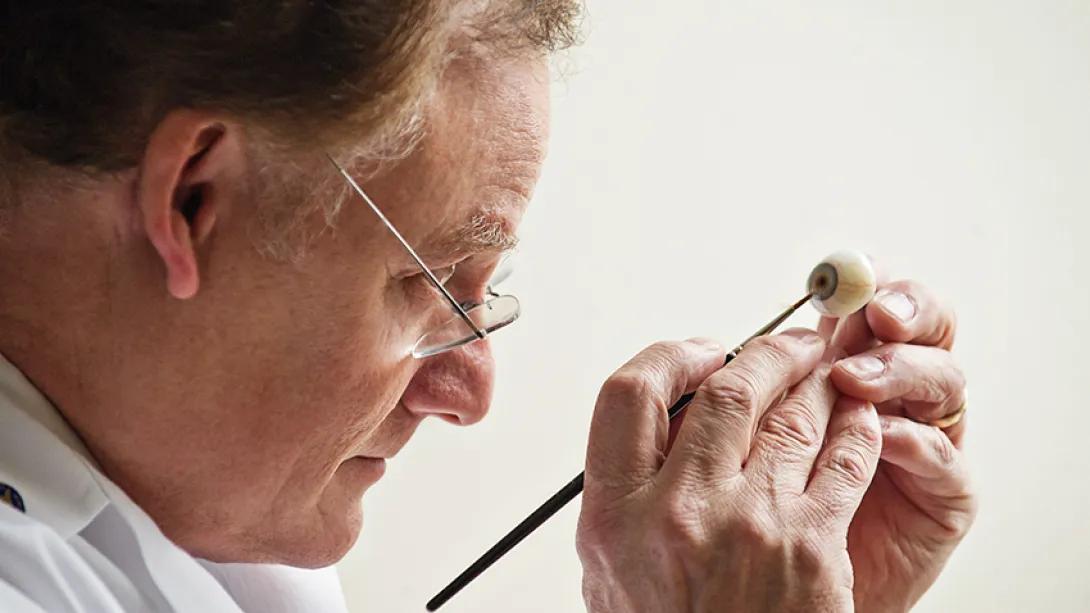
Each custom eye crafted by Dootz is a hand-painted, nearly exact polymer replica of the patient's original organ. His work is startlingly realistic, not only in the color and intricacy of the iris but also the appearance of the white. He even uses red thread to suggest tiny blood vessels.
A self-described perfectionist with artistic talent and an engineering background, the 60-year-old Dootz is well suited to his unique field.
He also knows the difference that a quality prosthesis can make for the recipient.
"We like to think people aren't judged by their appearance, but they are," says Dootz, who has been honored nationally for his work. "For those who have lost an eye, my job is to level the playing field."
A personal focus
While Dootz's bedside manner and fellowship training in ocular prostheses inspires confidence in his adult patients, his skill set also benefits the tiniest Kellogg patients and their families.
SEE ALSO: Rare Eye Condition Inspires Parents to Create Cool Glasses for Kids
Each year, 1 in 100,000 children is born with microphthalmus, a condition in which the eye is extremely small and has little or no vision. Soon after they are born, Dootz uses "expansion therapy" to slowly stretch the child's socket and lid until a full-sized prosthesis can be accommodated.
By fitting the prosthesis over the defective eye and its muscles, lifelike movement can be retained. The artificial eye encourages proper bone development and a more natural facial appearance as the child grows.
Kersten MacDonald Wade knows the potential firsthand. Born with microphthalmus, she visited Kellogg as a baby for monthly appointments with Dootz. Her mother and grandmother would drive her from their home in Battle Creek, Michigan, to meet with the ocularist and a compassionate care team.
Years later, the patient still marvels at her appearance.
"My eye is a work of art," Wade, 28, says of her artificial eye, which she describes as blue with flecks of gold.
Wade even invited Dootz to her wedding this summer. He has, after all, been a part of Wade's life since before she can remember.
It's a common story for the craftsman of nearly four decades.
Dootz is quick to downplay his gift and instead praises his clients' many accomplishments — whether an elementary school honor, a football trophy, a graduation or a wedding — as well as the relationships that continue long after his task is complete.
"We don't always get to see the end result in medicine, but I am fortunate to have the privilege not only of making a difference in someone's life but also of seeing where that life takes them," he says.
Looking forward and back
Dedication to service also drives him: Dootz once stayed up for nearly three days, working into the nights, to quickly create a new prosthesis for a bride who lost hers right before her wedding. In another memorable replacement, one of his artificial eyes was accidentally flushed down the drain.
His specialty operates on a spectrum. At Kellogg, Dootz joins a team that includes experts in pediatrics, vitreoretinal disease, orbital and oculoplastic surgery to provide complex ophthalmic care.
Yet, as timesaving techniques such as non-custom eyes and photo printing irises become more prevalent in ocular prostheses, he remains focused on the personalized mechanics of his longtime craft.
Says Dootz: "I've been at this for 38 years and I can honestly say I've enjoyed every day."

Health Lab
Explore thousands of health news & research stories by visiting the Health Lab homepage for more.
Media Contact

Public Relations
Department of Communication at Michigan Medicine
Stay Informed
Want top health & research news weekly? Sign up for Health Lab’s newsletters today!
Featured News & Stories
How LASIK surgery can help athletes perform at their best
LASIK vs. PRK: Which vision correction surgery is right for you?
Pros and cons of LASIK: Are the risks worth the cost?

How to protect your eyes during the total solar eclipse
7-Year-Old Receives New FDA-Approved Retina Gene Therapy