‘M-RISE’ Research Program Aims to Prevent Brain Damage Caused by Cardiac Arrest
American Heart Association funding will allow Michigan Medicine to establish a leading research and training program with a focus on preventing brain damage caused by out-of-hospital cardiac arrest.
3:16 PM
Author |

For the more than 350,000 Americans that experience an out-of-hospital cardiac arrest each year, less than 1 in 10 of those treated will survive with good neurologic function.
"Survival for these patients decreases with every minute there is a delay in therapy," says Robert Neumar, M.D., Ph.D., professor and chair of emergency medicine at Michigan Medicine. "Many patients who have their heart restarted will subsequently die from severe brain damage, and many who do survive to hospital discharge do not return to their pre-arrest function due to brain injury."
LISTEN UP: Add the new Michigan Medicine News Break to your Alexa-enabled device, or subscribe to our daily audio updates on iTunes, Google Play and Stitcher.
Neumar is the director of the Michigan Resuscitation Innovation and Science Enterprise (M-RISE), a new research program with the mission to discover, translate and implement innovative therapies focused on preventing brain damage caused by cardiac arrest.
M-RISE is funded by the American Heart Association and a part of its Arrhythmias and Sudden Cardiac Death Strategically Focused Research Network, which works to support researchers leading new approaches to studying arrhythmias and sudden cardiac death.
"M-RISE was designed to advance the AHA mission of being a relentless force for a world of longer, healthier lives," Neumar says.
M-RISE's strategy
M-RISE will be housed at Michigan Medicine under the Michigan Center for Integrative Research in Critical Care (MCIRCC), which works to transform critical care through innovation, integration and entrepreneurship.
"We're thrilled to have been able to leverage MCIRCC's infrastructure to successfully compete for this award and to add the M-RISE research program to our Center's work," says Kevin Ward, M.D., director of MCIRCC and a professor of emergency medicine and biomedical engineering at Michigan Medicine. "With such collaborative missions, strategies and researchers shared between the AHA, MCIRCC and now M-RISE, we believe we can make a difference in the lives of sudden cardiac arrest patients."
We are focusing on early treatments delivered by bystanders and first responders, which we believe will have the greatest therapeutic benefits for cardiac arrest patients.Robert Neumar, M.D., Ph.D.
M-RISE's strategy to achieving its objective of preventing brain damage caused by cardiac arrest is based on four guiding principles:
- Restoring blood flow as soon as possible following cardiac arrest with early CPR and defibrillation is the most effective strategy for preventing brain damage caused by cardiac arrest.
- Neuroprotective therapies are most effective when delivered within minutes after a cardiac arrest has occurred.
- Neuroprotective therapies that can be delivered by bystanders and first responders will have the greatest potential to prevent brain damage after an out-of-hospital cardiac arrest.
- Successful clinical trials demonstrating neuroprotective therapies that can be delivered by bystanders and first responders to out-of-hospital cardiac arrest patients can be implemented as safe and easy-to-use therapies with minimal to no prior training for bystanders.
"We are focusing on early treatments delivered by bystanders and first responders, which we believe will have the greatest therapeutic benefits for cardiac arrest patients," Neumar says. "By optimizing the timing of bystander intervention and the therapies they can provide, we hope to significantly increase the number of out-of-hospital cardiac arrest patients that survive to lead normal lives."
Projects and postdoctoral training program
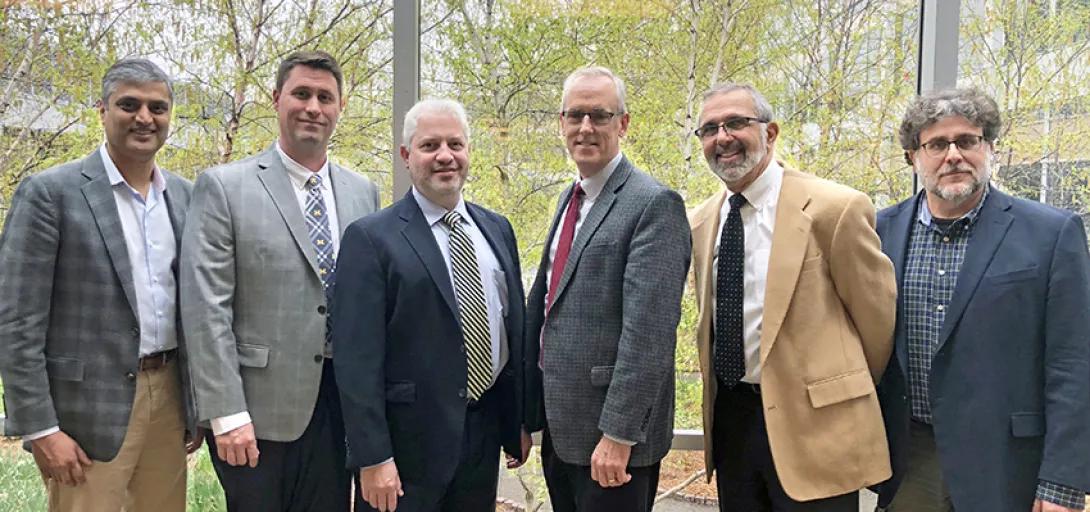
The M-RISE team from L to R: Brahmajee Nallamothu, M.D., M.P.H., professor of cardiovascular medicine at Michigan Medicine; Tom Sanderson, Ph.D., associate professor of emergency medicine and molecular and integrative physiology at Michigan Medicine; David J. Pinsky, M.D., division chief of cardiovascular medicine at Michigan Medicine and a director of the U-M Frankel Cardiovascular Center; Robert Neumar, M.D., Ph.D., professor and chair of emergency medicine at Michigan Medicine; Robert Swor, D.O., professor of emergency medicine at Oakland University; Robert Silbergleit, M.D., professor of emergency medicine at Michigan Medicine.
MORE FROM MICHIGAN: Sign up for our weekly newsletter
M-RISE includes three projects, a postdoctoral training program and an institution collaborator. The three research projects are divided into a basic, clinical and population science focus and build upon work performed in the previous project – a translation research model, according to the program.
The basic science project will be led by Tom Sanderson, Ph.D., an associate professor of emergency medicine and molecular and integrative physiology at Michigan Medicine. Sanderson and team will study neuroprotective agents that can be given intranasal and intramuscularly during cardiac arrest in animal models. They hope to determine the lowest doses that achieve the maximum treatment effect when given during CPR and how timing of the administration impacts neuroprotective effects.
Next, Robert Silbergleit, M.D., a professor of emergency medicine at Michigan Medicine, will work with the U.S. Food and Drug Administration to determine a regulatory pathway for a future trial of bystander and first responders administering intranasal neuroprotective agents to those suffering an out-of-hospital cardiac arrest. The team will work with Sanderson's team to use its preclinical data when developing an application for an investigational new drug.
The third project will be led by Brahmajee Nallamothu, M.D., M.P.H., a professor of cardiovascular medicine at Michigan Medicine, who will work with the University of Michigan Medical School Department of Learning Health Sciences, the U-M Clinical Simulation Center and the Washtenaw-Livingston County Learning Health System, and their stakeholders, to identify barriers and facilitators to shortening time to treatment during out-of-hospital cardiac arrest. The groups will first use a learning health system approach to optimize time to CPR and defibrillation and then use this infrastructure, along with simulation-based training and assessment, to inform implementation strategies for early intranasal and intramuscular therapies.
The research teams will also work with Oakland University, in a populous urban county in Michigan, to grow its medical research program focused on resuscitation science. Robert Swor, D.O., a professor of emergency medicine at Oakland University William Beaumont School of Medicine, will help foster collaboration between the universities within the research program.
A large component of M-RISE is its training program in resuscitation science.
Fellows will be able to work on each research project, as well as work with Oakland University faculty on clinical and educational experiences, such as ride along care with emergency medical service providers.
"As a learning training program, feedback will be bi-directional, in that not only will there be metrics for trainee engagement, such as presentations and publications, but ultimately, feedback to the program to enhance each of the research projects," says David J. Pinsky, M.D., division chief of cardiovascular medicine at Michigan Medicine and the M-RISE training director.
"This program will train an emerging cadre of leaders focused on research and improving systems of care to prevent cardiac arrest and to enhance chances of meaningful recovery," says Pinsky, a director of the U-M Frankel Cardiovascular Center.
M-RISE is actively recruiting qualified scholars and fellows from across the country for the training program with the trainees slated to begin July 1, when the grant begins.
Future results
This is the first time the University of Michigan has received research network funding from the AHA and the M-RISE team is eager to begin its work.
"An exciting part of being a member of the AHA strategically focused research network is the planned specific collaborative opportunities we have devised for each aspect of M-RISE," Neumar says. "This ensures we can seamlessly integrate with the other AHA research network centers and maximize the impact of this national AHA structure."
Neumar says the M-RISE team will provide their translation accelerator research platform to other centers that have new therapies and interventions they need to synergistically develop, test and implement. M-RISE will also work with the other AHA centers in each research project to share data and offer support and consult.
"We envision a future in which the AHA goal of doubling cardiac arrest survival is achieved, which could save 100,000 lives each year in the U.S. alone," Neumar says. "M-RISE will allow us to become one step closer to achieving that goal."

Health Lab
Explore thousands of health news & research stories by visiting the Health Lab homepage for more.
Media Contact

Public Relations
Department of Communication at Michigan Medicine
Stay Informed
Want top health & research news weekly? Sign up for Health Lab’s newsletters today!
Featured News & Stories

New heart, three medals and a shot at the world stage

From patient to artist: A project close to her heart
What’s changing in Medicaid and what can you do?

Missed feedings in 10-day-old infant led to rare infantile botulism diagnosis

Intermittent fasting can reverse diabetes in mice, study finds