
It’s Now OK to Perform CPR on People with Ventricular Assist Devices
New evidence shows CPR gives VAD patients in cardiac arrest a 50 percent chance of survival. Learn what to do if an emergency arises.
1:00 PM
Author |
Caty Johnson knows a lot about ventricular assist devices, or VADs.
As Michigan Medicine's VAD program manager, she educates patients, family members, caregivers and first responders about the devices — which are implanted in people with heart failure to assist the heart in pumping blood throughout the body.
LISTEN UP: Add the new Michigan Medicine News Break to your Alexa-enabled device, or subscribe to our daily audio updates on iTunes, Google Play and Stitcher.
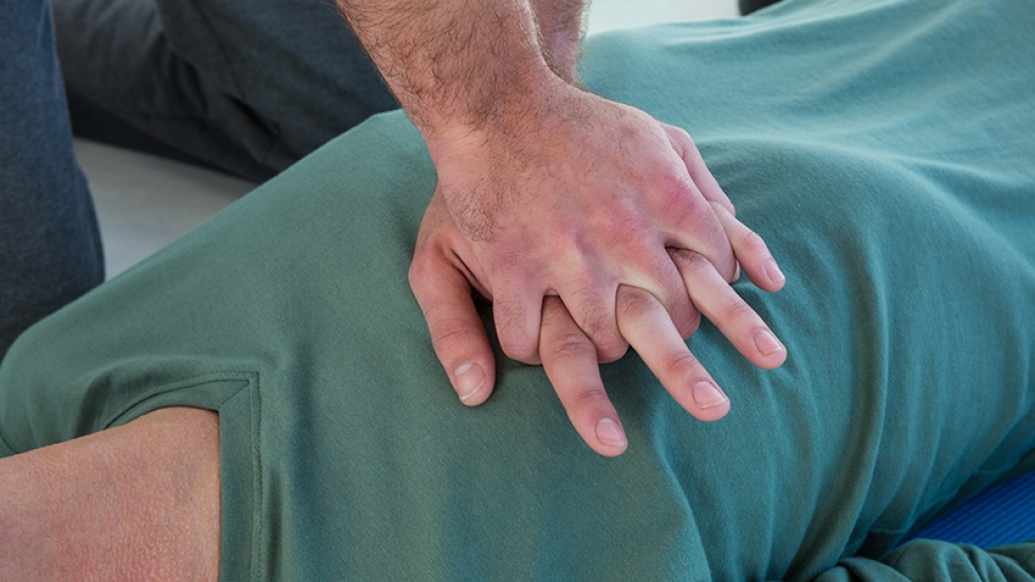
As the VAD patient population continues to grow and recipients are living longer, Johnson wants to spread a new announcement from the American Heart Association: It's OK to perform cardiopulmonary resuscitation on VAD patients in cardiac arrest.
Until recently, CPR was discouraged for VAD patients due to fear the device's pump might become dislodged during chest compressions.
No longer.
"There is no evidence of a VAD being dislodged by chest compressions," Johnson says, noting that the intervention can be lifesaving. "CPR gives a VAD patient in cardiac arrest a 50 percent chance of survival.
"Without CPR, VAD patients in cardiac arrest will die."
How a VAD operates
A VAD helps pump oxygen-rich blood from the left ventricle (the left lower chamber of the heart) into the aorta, the main vessel that carries blood from the heart to the rest of the body.
The device consists of a pump that is implanted in the heart's left ventricle. The pump is connected to a cord, or driveline, that exits the body through a small site in the abdomen and connects to a small computer known as a controller.
MORE FROM MICHIGAN: Subscribe to our weekly newsletter
A VAD can be used as a bridge to heart transplant for patients who meet the qualifications for a transplant but need temporary support to survive until a donor heart becomes available.
It may also be appropriate as destination therapy for patients with advanced heart failure who may not be eligible for a heart transplant.
When to perform CPR
Although VAD patients are typically in the company of a family member or caregiver, Johnson says a bystander also can initiate CPR to a VAD patient in cardiac arrest immediately after calling 911 and following several important guidelines.
The main one: Keep your ears open.
"Because most VAD patients don't have a traditional pulse, first listen for the hum of the pump to determine if it's working," says Johnson.
-
If no VAD hum is present and the individual is unresponsive: Perform CPR until first responders arrive.
-
If a VAD hum is present, but the individual is unresponsive and has blue or gray skin: Perform CPR until first responders arrive.
First responders will then take over using an automated external defibrillator (AED).

Health Lab
Explore a variety of health care news & stories by visiting the Health Lab home page for more articles.
Media Contact

Public Relations
Department of Communication at Michigan Medicine
Stay Informed
Want top health & research news weekly? Sign up for Health Lab’s newsletters today!
Featured News & Stories

Treating a rare coronary artery aneurysm without open heart surgery

A heart attack 9 days after giving birth: Mother of 4 shares her SCAD experience

Severe strokes linked to 5 times higher dementia risk

Fighting rejection antibodies to make heart transplant possible

A night of two national titles for U-M, as scientists and basketball players both triumph

