How Viruses and Bacteria Balance Each Other in the Gut Microbiome
A tiny arms race playing out inside the gut could eventually offer a new way to treat out-of-balance microbiomes.
11:05 AM
Author |

The adage "all things in moderation" applies not to just to food and drink, but also to the legions of bacteria inside our guts helping us digest that food and drink. It turns out the rule may also extend to the lesser understood bacteriophages, which are viruses that infect the bacteria living inside us. Like Russian nesting dolls, our bodies host close to 100 trillion bacterial cells that make up our microbiomes—and those bacterial cells have their own inhabitants.
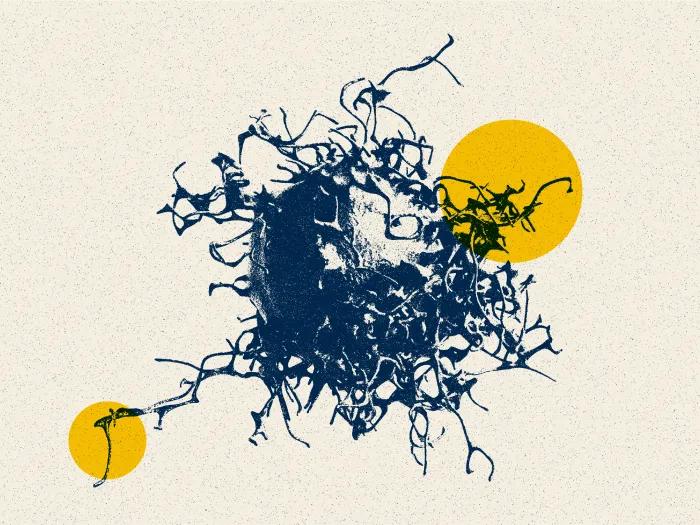
"We're appreciating more and more that the most abundant microbial entities in the human gut are actually viruses," says Eric Martens, Ph.D., associate professor of microbiology and immunology at the University of Michigan's Medical School. His team has been exploring the puzzling way bacteria and their viruses appear to coexist inside the human gut. The secret may lie in a hairy-looking sugar coating bacteria used to defend not only against attacks from the human immune system, but also from various viruses seeking a way in.
Using a common gut bacteria Bacteroides thetaiotaomicron, or BT for short, Martens' team began to look at the complex interaction between BT and viruses, by pitting them against each other in the lab.
When challenged with viruses, or phages, collected from waste water, some of the bacteria were able to resist infection while some were not. "When a particular phage comes along that can kill certain members of the population, it does so and the resistant bacteria quickly grow out," says Martens.
MORE FROM THE LAB: Subscribe to our weekly newsletter
However, instead of permanently altering the receptor that allowed the viral penetration, and potentially harming itself, some of the bacteria temporarily turn on a resistant state through a reversible process called a phase variation. But some of members of the bacterial population, unaware of the phage's continued presence, turn off this resistance switch, leaving them susceptible to infection…and on and on.
The team genetically engineered the BT strain to express just one of eight chemically-distinct capsules and a version with no coating at all. In all cases, infection could be blocked by some, but not all, of the capsules. Surprisingly, the researchers noted that the bald bacteria were also able to evade infection. "We were intrigued to see we could take away all of the capsules and still infect it with these phages and the bacteria could still survive, which necessitates that they have a backup mechanism in place," Martens says.
We're appreciating more and more that the most abundant microbial entities in the human gut are actually viruses.Eric Martens, Ph.D.
The interplay between the gut microbiome and their phages could have implications for human disease. "One of our hypotheses is that individuals carry different types of viral loads in their guts. Some could be more or less immunogenic, interacting with our immune system to cause inflammation. But they also might modify the physiology of the bacteria that are there by forcing them to express certain functions/capsules that we also know interact with the immune system," says Martens.
He says the study helps explain this age old observation that these bacteria coexist with their viruses. Notes Martens, "Neither side necessarily wins out over the other." As such, bacterial viruses could offer a way of beneficially altering the gut microbiome for the treatment of disease.
The paper's first authors are Nathan Porter and Andrew Hryckowian and is published in the journal Nature Microbiology.
Paper cited: "Phase-variable capsular polysaccharides and lipoproteins modify bacteriophage susceptibility in Bacteroides thetaiotaomicron," Nature Microbiology. DOI: 10.1038/s41564-020-0746-5
Like Podcasts? Add the Michigan Medicine News Break to your Alexa-enabled device or subscribe for updates on iTunes, Google Play and Stitcher.

Health Lab
Explore thousands of health news & research stories by visiting the Health Lab homepage for more.
Media Contact

Public Relations
Department of Communication at Michigan Medicine
Stay Informed
Want top health & research news weekly? Sign up for Health Lab’s newsletters today!
Featured News & Stories
Could the Cure for IBD Be Inside Your Mouth?
E. coli Gain Edge by Changing their Diets in Inflammatory Bowel Disease
The AI is listening: Implications of machine generated clinical notes on health care

Comprehensive DNA sequencing reveals hidden drivers of cancer

Many older adults make Medicare decisions quickly and most don’t change plans, poll finds