Higher Rates of Esophageal Cancer Mortality Found in the Great Lakes, New England
A new study suggests some Americans are more susceptible to esophageal cancer, and it’s linked to where they live. More research is needed to pinpoint the relationship.
1:30 PM
Author |
The rates of some cancers have fallen in the past 25 years, but the frequency of some esophageal cancers has grown — with the cause unknown.
MORE FROM THE LAB: Sign up for our weekly newsletter
"The incidence of esophageal adenocarcinoma has risen fivefold in the past three decades in the United States," says Joel Howard Rubenstein, M.D. "It's becoming more common, and we don't know why."
Rubenstein is an associate professor of gastroenterology at the University of Michigan and a research scientist at the Veterans Affairs Center of Excellence for Clinical Management Research.
The incidence of esophageal adenocarcinoma has risen fivefold in the past three decades in the United States.Joel Howard Rubenstein, M.D.
In a recent study, he examined fatal cases of esophageal cancer in the United States from 1999 to 2014. He sought to determine if there was geographical clustering of esophageal cancer, and if so, if known risk factors explain it.
What he found sparked even more questions.
"We found clusters of high and low mortality rates with esophageal cancer among white non-Hispanic men in the U.S. that could not be explained by the known common risk factors: age, obesity, smoking and alcohol consumption," he says.
The findings were presented at Digestive Disease Week, the largest international gathering of physicians, researchers and academics in the fields of gastroenterology, hepatology, endoscopy and gastrointestinal surgery, on May 6 in Chicago.
To identify the clustering, Rubenstein examined county death certificates. For the most accurate representation, Rubenstein narrowed his scope to only include white, non-Hispanic men, and limited his analysis to counties with at least 20 deaths associated with esophageal cancer in the 15-year period.
With data missing from an area predominantly in the central U.S., Rubenstein's cluster analysis showed an area of high mortality in New England and the Great Lakes, and an area of low mortality in the Southeast.
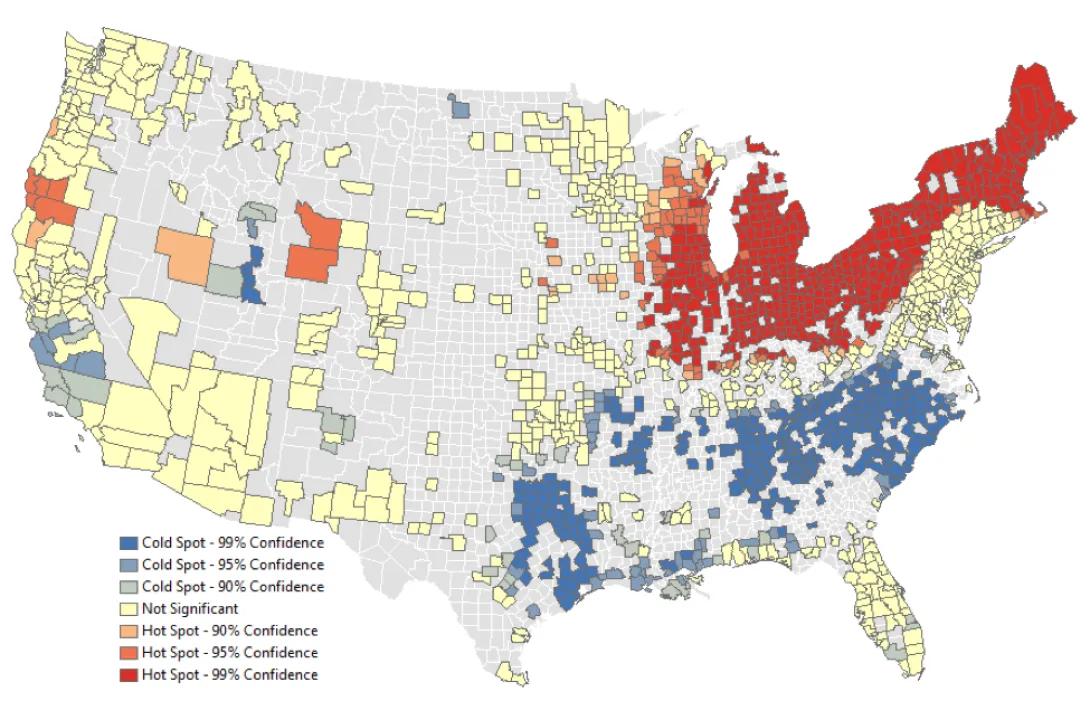
Those clusters remained significant after adjusting for the prevalence of obesity, smoking, alcohol use and education level in the individual counties. Rubenstein had hypothesized that ultraviolet radiation exposure might protect against the cancer, but the clusters remained significant after adjusting for local ultraviolet radiation exposure, as well.
A suggested link between UV exposure and reduced cancer risk has been proposed based on smaller studies from Europe and Australia.
Investigators in Australia, for example, analyzed the longitude and latitude coordinates of patients with esophageal cancer to estimate their ultraviolet radiation exposure over a lifetime. They found that patients who had higher exposure to ultraviolet radiation were at lower risk for esophageal cancer.
Although it seems like a possible hypothesis to follow, Rubenstein says the data are not strong enough.
SEE ALSO: African-American Men More Likely to Develop Rarer Type of Esophageal Cancer
"There might be additional unknown environmental factors that contribute to esophageal cancer mortality," he says. "Figuring out what that factor or factors are could improve our ability to screen the right individuals for esophageal cancer."
Takeaways and next steps
The signs and symptoms of esophageal cancer can vary and include difficulty swallowing, weight loss, chest pain or burning, worsening indigestion or heartburn, and coughing or hoarseness. Screenings occur via biopsy or endoscopy.
Rubenstein doesn't suggest everyone be screened for esophageal cancer — because in some cases it can do more harm than good — but that non-Hispanic white men living in the Midwest and Northeast should consider the idea.
He says he's found that gastroenterologists around the country are less concerned with esophageal adenocarcinoma when they practice in areas where there is no evidence of clustering.
"We're in the middle of a high-cluster area," says Rubenstein, who practices in Ann Arbor, Michigan. "Some gastroenterologists are saying there is nothing to worry about. But I see the cancer a lot more than, say, a gastroenterologist from Washington."
To continue to search for answers, Rubenstein is working with Hal Morgenstern, Ph.D., professor of epidemiology and environmental health science at U-M's School of Public Health.
He also hopes his presentation at Digestive Disease Week will get other gastroenterologists interested in his research, or spark a discussion that could produce useful information.
"I spend my free time just looking at maps trying to figure out potential linkages," says Rubenstein. "It's a real mystery."

Health Lab
Explore thousands of health news & research stories by visiting the Health Lab homepage for more.
Media Contact

Public Relations
Department of Communication at Michigan Medicine
Stay Informed
Want top health & research news weekly? Sign up for Health Lab’s newsletters today!
Featured News & Stories
Genome Offers Clues to Esophageal Cancer Disparity

African-American Men More Likely to Develop Rarer Type of Esophageal Cancer
Online resources and coaching helped people seek genetic testing for cancer

Liver cancer can be preventable. Do you know the treatable risk factors?

Prostate cancer and hereditary risk: A doctor explains the connection