Helping kids with congenital hand differences
A hand surgeon explains the importance of parents advocating for their child with hands that don’t look or function the same as others.
5:00 AM
Author |
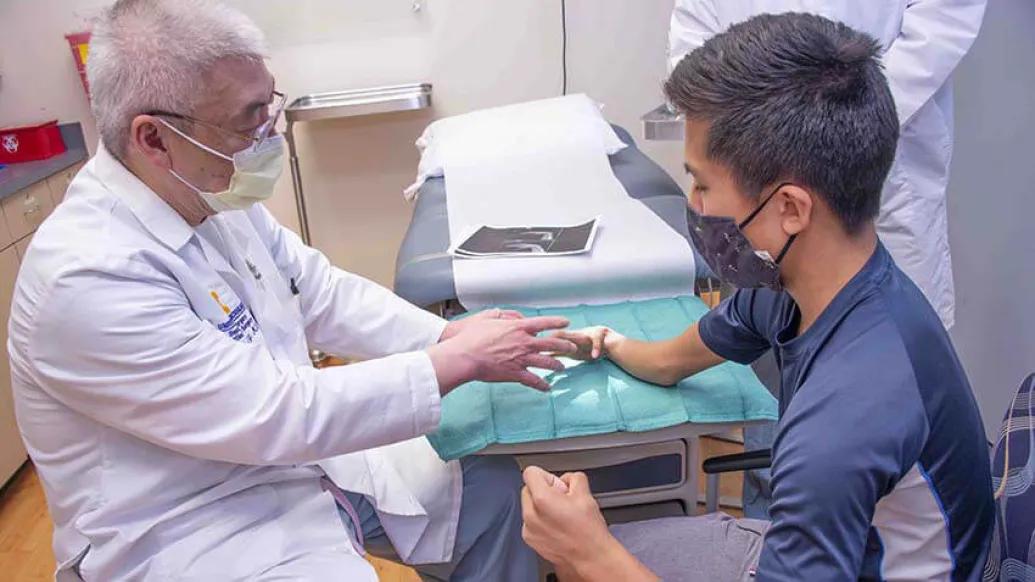
If your child was born with a hand condition, Kevin Chung, M.D., wants you to know there's help.
When the hand is "not functional or doesn't look like the hands of other kids," Chung urges parents to advocate for their child and seek treatment .
As chief of Hand Surgery and director of the Comprehensive Hand Center at University of Michigan Health, Chung is also quick to point out the terminology he and his team prefer to use.
"We are careful not to refer to any hand condition as a 'deformity'. We refer to it as being 'different'."
Congenital hand conditions — from fused fingers to other complex conditions such as an extra thumb or a missing bone — affect approximately 1 in 500 children. These conditions require expert training, says Chung, who treats the full range of conditions. He encourages parents to seek out experts who can offer recommendations for the best possible treatment option for their child.
"This is a specialized field that is done by a few select experts," said Chung.
He stresses the role of aesthetics when it comes to treating pediatric patients, noting that a person's hands are as important as their face.
"Our goal is to make the child's hand as aesthetically pleasing as possible while improving its function," said Chung, who travels to developing countries to help children who would not otherwise have access to the treatment they need.
What you should know about congenital hand differences
A child with any condition that makes their hands look different from others or function differently should be seen by an experienced hand surgeon at a leading center of excellence to ensure a positive outcome, says Chung.
Depending on the extent of the condition, a child may experience delayed motor skills and difficulties with daily activities as well as emotional and social challenges.
"A child needs fingers that move, or a thumb that functions. These are intricate operations that require an experienced team," he said, noting that striving for the best outcome too often entails redoing a failed surgery performed by an inexperienced surgeon.
Every condition is different and requires an individualized treatment plan.Kevin Chung, M.D. Photo
At the Comprehensive Hand Center, in conjunction with University of Michigan Health C.S. Mott Children's Hospital, Chung and his team care for all types of pediatric hand conditions, focusing on the nuances of each child.
"Every condition is different and requires an individualized treatment plan."
Chung says it's critical that parents seek out major academic medical hospitals with reputations as specialists in hand surgery for the best possible outcomes.
"The complexity of the operations and knowing what to do, how to do it and what not to do comes with experience," said Chung. As renowned experts in treating children with hand conditions, the Comprehensive Hand Center team offers more than 50 years of combined experience in this specialty field.
Types of pediatric hand conditions
Chung says one of the most common pediatric hand conditions is a connection of skin, or webbing, between two or more fingers, causing a fusing of fingers. Other conditions, which typically develop in the womb, include:
-
Problems with the formation of the hand, resulting in a missing finger or thumb
-
Duplication of the thumb or fingers, typically the little finger
-
A finger that is smaller than the others, or missing altogether
-
An abnormally large finger
-
Missing one of the two long bones that make up the forearm• Abnormal development of the middle part of the hand, resulting in one or more central fingers missing, known as cleft hand
-
A thumb that did not develop fully is missing altogether.
-
An abnormality of the tendon in the thumb that makes it difficult for it to bend, known as trigger thumb
-
Constriction ring syndrome in which a tissue forms around a finger or arm, affecting blood flow and normal growth
Advocating for your child
Chung underscores the importance of creating a solid relationship with your child's doctor from the very start.
"We feel privileged to consult with parents as we develop a cohesive, comprehensive plan for the benefit of your child. We feel we can offer the best treatment options to give your child a fighting chance."
MORE FROM MICHIGAN: Sign up for our weekly newsletter
Like Podcasts? Add the Michigan Medicine News Break on iTunes, Google Podcasts or anywhere you listen to podcasts.

Health Lab
Explore thousands of health news & research stories by visiting the Health Lab homepage for more.
Media Contact

Public Relations
Department of Communication at Michigan Medicine
Stay Informed
Want top health & research news weekly? Sign up for Health Lab’s newsletters today!
Featured News & Stories

A hand surgeon, a child and a brand new thumb

4 ways to teach your teen safe driving habits

U-M-led consortium to receive up to $52 million in NIH funding to study why viral respiratory infections affect children differently

E-Bikes are everywhere, but most parents say they don’t know enough about them
C.S. Mott Children’s Hospital named No.1 children’s hospital in Michigan by U.S. News & World Report