Dermatology resident’s China rotation highlights value of global training
The program enables trainees to pursue a clinical experience abroad during their final year at Michigan Medicine
3:00 PM
Author |

Leaders in Dermatology are expanding a program at Michigan Medicine that enables select residents to pursue a clinical experience abroad during the final year of training, with one resident having visited China late last year and three more expected to train abroad in the coming months.
Albert Yang, M.D., visited Peking Union Medical College Hospital last November, becoming the first Dermatology resident to travel to China as part of the initiative.
His four-week rotation offered an up-close look at dermatologic care at one of China’s premier hospitals.
Peking Union Medical College Hospital and its affiliated medical school are longtime University of Michigan Medical School partners.
His rotation included time in the busy outpatient setting as well as on the hospital’s dedicated dermatology inpatient wards—something that is uncommon in the United States health care model, where dermatology is more often practiced as an outpatient specialty.
“In our setting, if we’re in the hospital, we’re usually more of a consultant. But there, they were members of the primary team,” Yang said.
“It was interesting to watch them focus on blood pressure, blood sugar, labs, and other things. It felt like I was back in my intern year, rounding and doing a lot of non-dermatologic things.”
Key differences observed
Dermatology residents, while providing broad non-dermatologic care in the hospital wards, also tended to specialize in a particular area of the field. In the U.S., residents generally don't subspecialize during residency.
“It was one of the most common questions I got: what was my specialty?” Yang said.
“They tend to have a specialty—even as residents—maybe psoriasis or connective tissue disease. Here in the United States, you aren’t pushed to specialize as a resident.”
Additionally, to manage patient volumes, hospitals used a same-day registration system in which patients lined up early each morning to compete for a limited number of appointment slots with the specialist they want to see.
“You can tell patients are desperate. Some have traveled a long distance to see a specific provider and they aren’t able to get an appointment. It’s very hard.”
He noted that many biologic medications that might be prescribed indefinitely in the United States were used differently there, with treatment tapered and clear end dates established.
“The mentality seemed more like, ‘We’ll stop this medication, and if you flare up again, we’ll start it again.’ But in the U.S., I think there is a fear that if you stop a treatment, the insurance companies may not approve it again. Universal coverage might play into that difference.”
Yang was also struck by how Traditional Chinese Medicine is used alongside Western medicine in patient care.
The hospital’s dermatology department includes a designated TCM physician integrated into their care team, and all team members incorporate aspects of TCM into their care—from explaining diagnoses using TCM concepts, such as meridians, qi, and the five elements, to prescribing herbal medications.
“All providers can and do prescribe TCM medications, because they see many patients who want to begin a treatment plan with TCM because they are more comfortable with the concept,” Yang said.
“It was really ingrained into their practice.”
A flourishing program
Yang’s experience follows that of fellow resident Dan Nadelman, who spent time in India two years ago.
Additional resident experiences are planned in South Korea, Italy, the Dominican Republic, Rwanda, and Burundi.
The program was launched and continues to expand under Clinical Professor of Dermatology, Trilokraj Tejasvi, M.D., MBBS, with strong support from Department Chair, Christopher Bichakjian.
“There has been strong interest among our trainees in the program, and we are fortunate to have developed a network of potential host institutions around the world in a variety of settings,” said Tejasvi.
“Exposure to a different health care system can offer lessons and perspectives that enrich their training and strengthen their residency experience at UMMS.”

Health Lab
Explore thousands of health news & research stories by visiting the Health Lab homepage for more.
Media Contact

Public Relations
Department of Communication at Michigan Medicine
In This Story
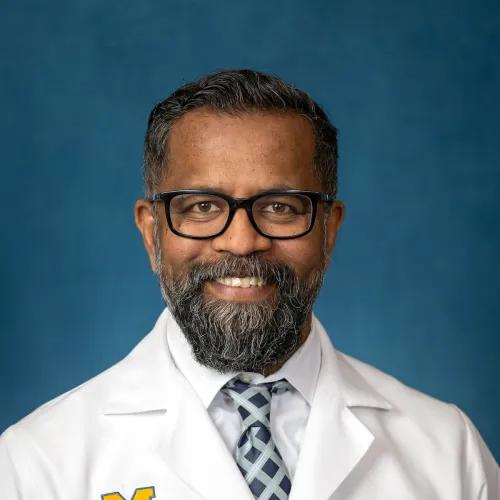
Trilokraj Tejasvi, MBBS, MD
Clinical Professor
Stay Informed
Want top health & research news weekly? Sign up for Health Lab’s newsletters today!
Featured News & Stories
Comprehensive DNA sequencing reveals hidden drivers of cancer
‘Molecular glue’ stabilizes protein that inhibits development of non-small cell lung cancer and uterine cancer

Many older adults make Medicare decisions quickly and most don’t change plans, poll finds

What’s the latest on 7-OH and kratom availability and addiction care?
A metabolic “switch” that could help reset scar-producing cells in scleroderma