A daughter’s lifesaving gift to her father
Emily Wenzel-Miles donated a portion of her liver to her father in 2017. Today, both are thriving
11:13 AM
Author |
This story was originally published on May 21, 2021 and was updated on June 11, 2025.
Growing up, when Emily Wenzel-Miles needed motivation to take on a challenge, she looked to her dad, David Wenzel.
"Dad was always super healthy and on the go," recalled Wenzel-Miles, a mom and third grade teacher in Lapeer, Michigan.
"He had a physically demanding job as a police officer, and was always stepping up to help someone else."
That energy and can-do attitude carried over into Wenzel's retirement. He stayed busy playing golf, taking on home improvement projects, and spending time with his children and grandchildren.
But things began to change in 2016. Wenzel grew extremely weak and fatigued.
He was suffering from cirrhosis, or scarring of the liver.
Wenzel was one of about 10% of cirrhosis patients for whom the cause of their disease is unknown – this condition is known as cryptogenic cirrhosis.
As his liver struggled to eliminate toxins from his body, it took a heavy toll on his physical and mental health.
"It's frightening to watch someone decline so rapidly," recalled Wenzel-Miles.
"Within months, he couldn't stand or walk without falling, and was having trouble concentrating, remembering and communicating."
Needing, and getting, a liver transplant
David Wenzel needed a liver transplant.
The family sought care at the University of Michigan Transplant Center, and his name was added to the 15,000 other names on the nationwide waiting list for a liver.
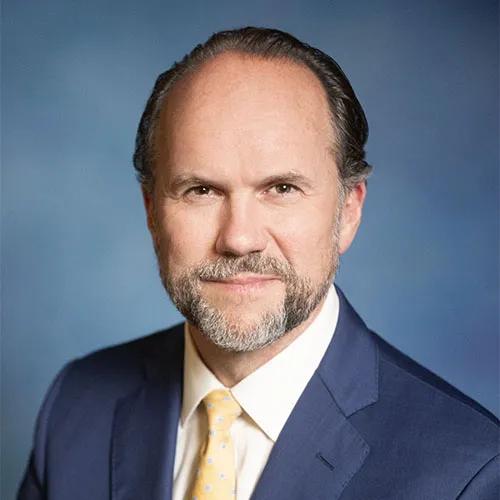
At Michigan Medicine, they met with transplant surgeon Christopher Sonnenday, M.D.
Along with traditional transplantation of a liver from a deceased donor, he also discussed the option of transplanting a portion of liver from a living donor.
"Like most people, the Wenzel's weren't familiar with the concept of living donor liver transplantation," said Sonnenday.
"It's still quite rare – fewer than one in 20 liver transplants are from a living donor – but it's an option that's on the rise at top transplant centers like Michigan Medicine."
Most of the human organs that are available for transplantation – such as hearts, lungs and corneas – come from people who arrange for their organs to be donated when they die.
But two organs, the kidney and the liver, can actually be transplanted from a donor who is alive.
Living donor kidney transplants are possible because humans are born with two kidneys, but can live healthy, active lives with only one.
But the liver is different.
"The liver is the only organ capable of regrowth," explained Sonnenday.
"When a portion of a person's liver is removed, the body can actually grow new, functioning liver in its place. In only about six weeks, a transplanted section of liver grows into a normal sized, fully functioning liver in the recipient, and the donor's remaining liver regenerates to replace the transplanted section."
At first, Wenzel was against the idea.
He would not even discuss an option that might put a loved one at risk.
But as her father's condition grew worse, Wenzel-Miles decided to explore living donor transplantation.
I see recipients like Mr. Wenzel a couple of months after their surgery and you can't even recognize them. To see that happen through the miracle and generosity of living donation is incredible.
Without her father's knowledge, she arranged to be evaluated as a potential donor.
"I was afraid he wasn't going to move up the list far enough, fast enough," she remembered.
"I thought we needed to understand this option in case he changed his mind."
The donor matching process is comprehensive, including a physical exam, blood work and imaging.
"I'm claustrophobic, so the MRI was tough," she recalled.
"But I kept telling myself that if the tables were turned, my dad would do it for me."
Wenzel-Miles had been frustrated with the lack of information online about living donor liver transplant.
But as luck would have it, there was a source of firsthand information right in her own backyard.
"I learned that a co-worker at my school has a sister who donated her liver to their mother," she explained.
The family was a great resource for Wenzel-Miles, and eventually, as her father's condition reached its lowest point, she persuaded him to speak with them as well.
"Talking with them about their experience made all the difference," she said.
In 2017, the two underwent the complex surgical process of liver transplantation.
Wenzel-Miles' procedure began first.
Sonnenday, and fellow transplant surgeon Benjamin Samstein, M.D., removed the right lobe of her liver.
About an hour later, Wenzel's surgery began. Surgeons Randall Sung, M.D., and Seth Waits, M.D., removed his liver, then Sonnenday and Waits implanted the transplanted lobe.
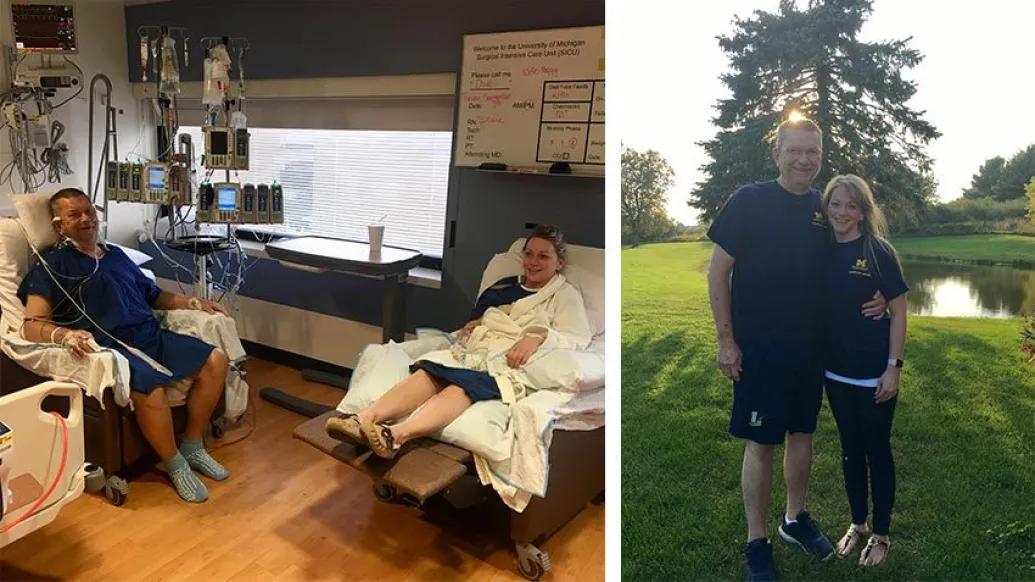
That same day, Wenzel-Miles and her father had a brief visit in the intensive care unit.
"It wasn't easy seeing him hooked up to so many things, but he was awake and it was amazing just to talk to him."
Once out of the ICU, the two shared a hospital room.
The amazing aftermath of living donor liver transplantation
Wenzel-Miles saw the first signs of improvement in her father almost immediately.
"Right away he looked better and his voice sounded clearer. From that point on, he grew stronger every day."
Sonnenday agrees.
"I see recipients like Mr. Wenzel a couple of months after their surgery and you can't even recognize them. They've added muscle mass, their color has returned, and they're vigorous and energetic. To see that happen through the miracle and generosity of living donation is incredible."
Now, more than three years after the transplant, both father and daughter are thriving. "We couldn't wait to get back to our active lives," Wenzel-Miles said.
"We're so grateful for the expertise and compassion of everyone on our transplant team," she adds. "They've been there for us every step of the way."
Whenever possible, Wenzel-Miles makes time to pay it forward, acting as a peer mentor for people considering living donor liver transplantation.
"I encourage people to ask questions and seek out as much information as they can on the physical and emotional risks and benefits. It is not an easy decision, and I'm always upfront that it is not right for everyone."
"As for me, I would do it again without hesitation," she continued.
"Living donation saved my dad, but I felt like it was also a gift to me – it changed my life in so many positive ways."
At the time of the transplant, Wenzel-Miles was focused on her father.
It was only afterward she realized the impact her choice had on her son, who was just nine.
"He wrote a school paper about the experience," she explained.
"The doctors and nurses at Michigan Medicine made a big impression on him, and he saw that his mom and his grandpa could be brave. It taught him that sometimes people do hard things and make sacrifices for others because it's the right thing to do."

Health Lab
Explore thousands of health news & research stories by visiting the Health Lab homepage for more.
Media Contact

Public Relations
Department of Communication at Michigan Medicine
In This Story
Christopher J Sonnenday, MD, MHS
Professor
Stay Informed
Want top health & research news weekly? Sign up for Health Lab’s newsletters today!
Featured News & Stories
Evolving causes, diagnosis of drug-induced liver injury

5 things to know about ALS
Advancements and trends in lung transplantation
University of Michigan Health Liver Transplant Program Earns Top Five National Ranking for Transplant Access
Lung transplant recipient stays active climbing stadium steps and more post-transplant