Critical and underutilized: fire and police responders associated with higher cardiac arrest survival rates
Non-medical responders are often the first to arrive at the scene.
5:00 AM
Author |
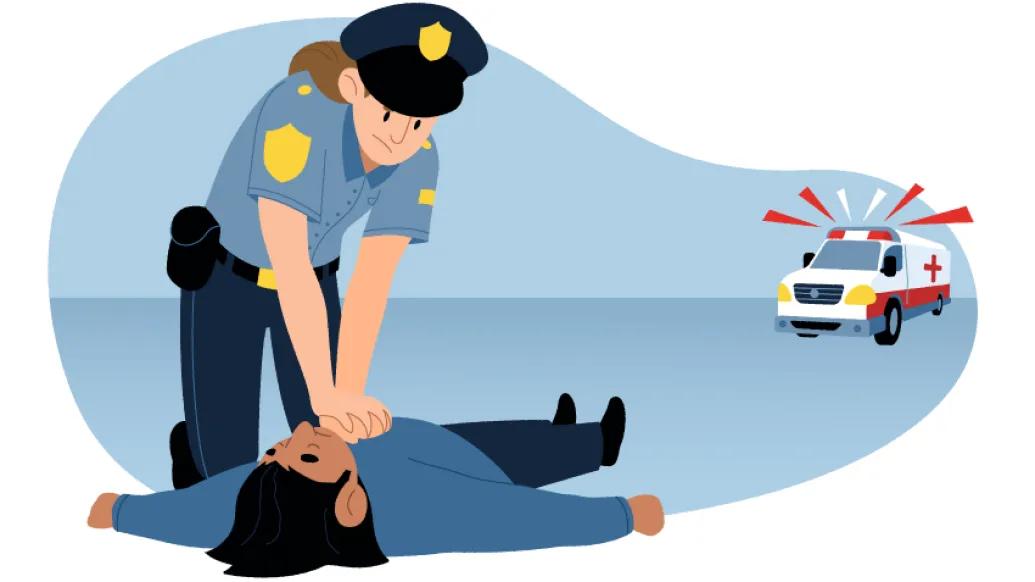
In a cardiac arrest, everything comes down to how quickly you "get on the chest."
Every minute CPR is not initiated or an automated external defibrillator, or AED, is not utilized, the chance of survival decreases by 7-10%.
A new study finds that survival rates increase when first responders in police and fire departments intervene in out-of-hospital cardiac arrests. However, the paper published in Resuscitation suggests these non-medical first responders are likely underutilized as lifesaving resources.
MORE FROM THE LAB: Subscribe to our weekly newsletter
Researchers from Michigan Medicine analyzed more than 25,000 cardiac arrest incidents in the state from 2014 to 2019. They found that police and fire first responders initiated CPR in 31.8% of out-of-hospital cardiac arrests, and police accounted for AED use in 6.1% of incidents. Those interventions were associated with significantly higher chances of survival and hospital discharge with good neurological outcomes.
"It is clear that these non-medical first responders play a critical role in time saved to chest compressions," said Mahshid Abir, M.D., M.Sc., senior author of the paper and an emergency physician at University of Michigan Health, Michigan Medicine. "In fact, in communities that were the highest performing in the state as far as survival is concerned, those responders work closely with emergency medical services to cross-train and debrief after incidents. When these agencies see their role as not just preventing crime or stopping fires, but also saving lives, it improves the overall chain of survival for cardiac events."
The likelihood of the return of a sustained heart rhythm for out-of-hospital cardiac arrest didn't change significantly when CPR or defibrillation was initiated by an EMS provider versus a non-medical first responder. However, the survival rate for initiation by non-medical first responders was significantly higher.
In fact, for patients who had CPR initiated by non-medical first responders, the odds of survival were 1.25 times higher. Similarly, patients who had an AED applied by police were 1.4 times more likely to survive.
"Our findings reinforce what we know: whoever can start CPR and utilize an AED first is the best person to do it," said Rama Salhi, M.D., M.H.S., M.Sc., lead author of the paper and national clinical scholar at the U-M Institute for Healthcare Policy and Innovation. "Sometimes, that's bystanders, but for a large percentage who have unwitnessed cardiac arrests, police and fire are on the scene first. Current evidence suggests this may be in upwards of 50% of cardiac arrest calls. In a disease where seconds and minutes matter, this can be lifechanging."
Our findings reinforce what we know: whoever can start CPR and utilize an AED first is the best person to do it.Rama Salhi, M.D., M.H.S.
Non-medical first responders can treat cardiac arrest similar to overdose, Abir says. When they receive an overdose call, law enforcement officials will often administer naloxone, or Narcan, which can reverse overdose and save lives.
"If we make it mission-oriented to begin with, because you want to get buy-in from folks, we can give them the training to optimize giving chest compressions," said Abir, who is also an associate professor of emergency medicine at University of Michigan Medical School. "Some people are just not comfortable doing this, so training them in these applications, including AEDs, and purchasing them for first responder vehicles would save more lives in the most effective way."
The research team recognizes that in some communities where there may be fractured or complicated relationships with law enforcement, people might not be comfortable with anything other than an ambulance arriving on scene.
"All of these responders can make a huge difference in the survival of a person's loved one, so we need to educate the communities around when and for what to call 9-1-1, and also who shows up and why they need to open the door," Abir said. "If we take this extra step to educate around the emergency response system overall, it will help improve the relationships and outcomes."
Michigan Medicine has partnered with first responders in Washtenaw and Livingston counties to create the Out-of-Hospital Cardiac Arrest Learning Community, which works to improve survival rates through awareness and implementation of lifesaving interventions in the region.
The learning community has several work groups focused on AED accessibility, community engagement and more.
"Ultimately the goal is to think creatively about how to get care to our patients in the least amount of time," said Salhi, an emergency physician at U-M Health. "This means empowering all members of our community to get involved and save someone's life."
Like Podcasts? Add the Michigan Medicine News Break on iTunes, Google Podcasts or anywhere you listen to podcasts.
Additional authors include Stuart Hammond, B.S., Jessica L. Lehrich, M.S., Michael O'Leary, B.S., Neil Kadmar, M.A., Christine Brent, M.D., Carlos F. Mendes de Leon, Ph.D., Robert Neumar, M.D., Ph.D., Brahmajee K. Nallamothu, M.D., all of Michigan Medicine, and Christopher Nelson, Ph.D., Peter Mendel, Ph.D., both of RAND Corporation, and Bill Forbush of the City of Alpena Fire Department, Alpena County EMS: Bill Forbush
This work is part of the National Heart, Lung, and Blood Institute-funded Enhancing Pre-hospital Outcomes for Cardiac Arrest (EPOC) project.
Paper cited: "The association of fire or police first responder initiated interventions with out of hospital cardiac arrest survival," Resuscitation. DOI: #10.1016/j.resuscitation.2022.02.026

Health Lab
Explore thousands of health news & research stories by visiting the Health Lab homepage for more.
Media Contact

Public Relations
Department of Communication at Michigan Medicine
Stay Informed
Want top health & research news weekly? Sign up for Health Lab’s newsletters today!
Featured News & Stories

Nerf gun accident causes retinal detachment in pediatric patient

Rabies is on the rise: Experts offer advice

E-Bikes are everywhere, but most parents say they don’t know enough about them

Have an MCAS diagnosis? Well, maybe not

Foundation gift inspires additional gifts to strengthen youth mental health care