Calming Essential Tremor with Deep Brain Stimulation
After years of troublesome hand tremors, an active retiree finally found relief. Learn about the procedure that helped him regain function.
7:00 AM
Author |
For two decades, Harry Hahn assumed his essential tremor (ET) was simply a part of life.
The most common movement disorder, ET can affect people of any age and run in families. It typically affects hands and arms but can surface elsewhere. Tremors are most noticeable when the affected area is moving.
MORE FROM MICHIGAN: Sign up for our weekly newsletter
"At first, it wasn't that bad," the 70-year-old Hahn remembers. "I was aware of some trembling in my nondominant hand, but it was barely noticeable, and I ignored it."
But in time, tremors developed in Hahn's dominant (right) hand and worsened until the retired transit industry professional "couldn't butter a slice of bread or cut a piece of meat on my plate."
His primary care physician prescribed a series of medications developed to treat ET. Hahn hoped for relief with each new medication; each time he was disappointed.
"Eventually," he says, "I realized I had to dig deeper for an answer."
Essential tremor treatment
Hahn's research led him to Michigan Medicine's Movement Disorders Clinic to determine whether he might be a candidate for deep brain stimulation, or DBS, which involves surgically implanting a pacemaker-like device to stimulate the brain.
SEE ALSO: Watch Treatment Transform Essential Tremor Symptoms
DBS is a proven therapy for Parkinson's disease and ET but is a far less common treatment for the latter condition — even though it's far more prevalent. About 10 million people in the U.S. have ET compared with approximately 1 million who have Parkinson's.
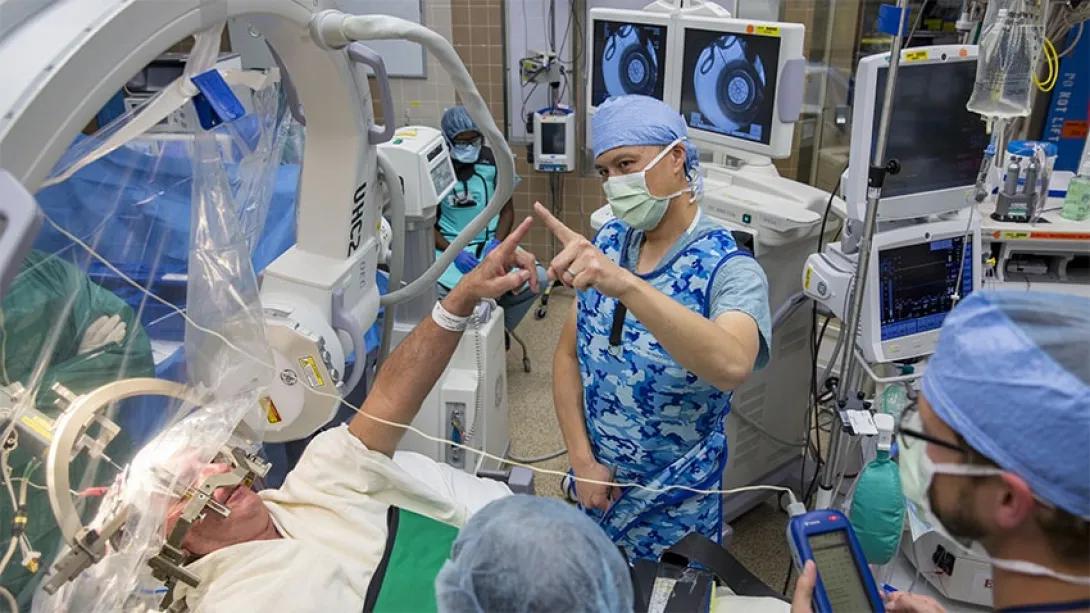
DBS involves a two-step surgical procedure. First, electrodes are implanted in the thalamus of the brain. A follow-up surgery implants a battery pack similar to a heart pacemaker in the chest. When this pacemaker is turned on, the battery pack sends signals to activate the electrodes, stimulating specific locations in the brain to change their activity.
Hahn underwent his first DBS procedure in 2016 to address the tremors in his right hand. "I had a virtually trouble-free experience," he says. A second DBS for his left hand was performed in September 2017.
"I experienced more pain and I was definitely more anxious that time — maybe because I was more aware of what they were doing."
Relief from essential tremor
Soon after the second procedure, though, Hahn found he could perform everyday tasks with both hands without a thought. "What a relief it has been to pick something up and not drop it," he says.
For Hahn and his wife, Carol, who is blind, such simple tasks are significant.
"We love to travel and have taken more than 20 cruises," he says. "Being able to handle documents or carry a glass or plate in each hand is something I will never take for granted."
Still, doctors note, DBS isn't a cure but a way to manage movement disorders like ET and Parkinson's more effectively, often with less medication and fewer medication side effects.
"I heartily encourage anyone with this condition to look into DBS," says Hahn. "It has changed my life."

Health Lab
Explore a variety of health care news & stories by visiting the Health Lab home page for more articles.
Media Contact

Public Relations
Department of Communication at Michigan Medicine
Stay Informed
Want top health & research news weekly? Sign up for Health Lab’s newsletters today!
Featured News & Stories
Helping an employee-turned-patient overcome a brain tumor
Timely treatment helps former baseball pro survive on-field stroke with no complications
Neighborhood Income and Cognitive Health
How a complex, 14-hour surgery saved a woman’s ‘hopeless’ spine
Brain cancer digital twin predicts treatment outcomes