Are robotic hernia repairs still in the “learning curve” phase?
Cutting edge technology may come with downsides
10:34 AM
Author |
For an abdominal wall hernia repair, also known as a ventral hernia repair, the most common surgical approaches have been laparoscopic and open techniques.
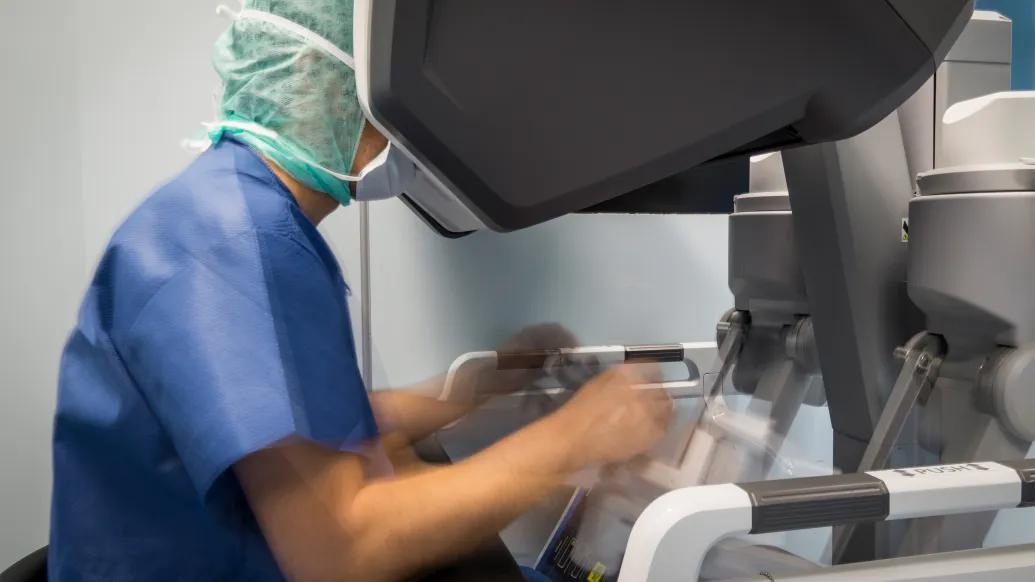
But a new approach for repairing hernias has been steadily growing in popularity: the surgical robot.
Supporters of using the robot method state multiple advantages over traditional laparoscopic and open approaches, including improved surgeon ergonomics.
But there may be downsides to the technology that are going undiscussed.
In a research article published in JAMA Surgery, Brian Fry, M.D., M.S., a general surgery resident at University of Michigan Health and colleagues compared hernia recurrence rates after undergoing robotic, laparoscopic and open repairs.
The study analyzed a large sample of Medicare-insured patients undergoing ventral hernia repairs and found that those undergoing repairs using a robotic approach had higher rates of their hernias recuring when compared to patients who underwent repair with a laparoscopic or open approach.
However, despite the higher recurrence rate for those undergoing robotic repairs, the rates were only 1.1% higher than laparoscopic repairs and 0.7% higher than open repairs at 10 years after surgery.
“Despite evidence for its benefit in certain surgical procedures such as prostate surgery, our data adds to the large body of work demonstrating no substantial clinical benefit when using the robot for ventral hernia repair on a large scale,” said Fry.
“We are undoubtedly capturing an element of the learning curve for robotics that was present when laparoscopy first hit the scene. We initially saw higher complication and hernia recurrence rates when laparoscopic hernia repairs were first introduced, but we still pushed to overcome the ‘learning curve’ of people picking up the procedure because it was a paradigm shift in hernia care.”
Robotic and laparoscopic hernia repairs use similarly small cuts in the skin, but the robot allows 3-dimensional vision and articulating wrist technology that makes it easier for a surgeon to see and sew.
But research has shown that robotic repairs take longer, and the technology of the robot costs much more than traditional laparoscopy.
Upon initial introduction of the robotic surgery for hernias, length of stay and postoperative recovery times were greatly reduced due to much smaller incisions, and the inferior initial outcomes as a surgeon worked through their learning curve were offset by clear benefits.
However, Fry states that it’s much harder to argue that robotics offers a similar paradigm-shifting advantage over laparoscopy that would justify potentially inferior outcomes.
Fry and his team of researchers believe the incremental benefit of the robot, particularly as it is currently being used nationwide within hernia repair, is worth questioning.
“More work needs to be done to understand which patients, hernias and specific operative techniques are best able to leverage the robot’s strengths and provide true clinical benefit to the patient,” said Fry.
“The robot may provide benefit for more advanced operative techniques used to repair very large or complex hernias, as these repairs are rarely attempted laparoscopically. However, most hernia repairs are performed by general surgeons out in the community, not by hernia specialists at large hospital systems.”
According to Fry, robotic surgical hernia repair is here to stay and it’s up to surgeons to figure out how we can best harness the technology to maximize its potential benefits.
“With the rapid uptake and popularity of robotic hernia repair, it is important that we figure out how to best train and credential surgeons on the platform as well as carefully select patients and techniques that leverage the true advantages of the technology.”
Additional authors: Ryan A. Howard, M.D., M.S. and Kyle H. Sheetz, M.D., M.S. from the Department of Surgery, University of Michigan, Ann Arbor and the Center for Health care Outcomes and Policy, University of Michigan, Ann Arbor; Jyothi R. Thumma, M.P.H from the Center for Healthcare Outcomes and Policy, University of Michigan, Ann Arbor; Edward C. Norton, Ph.D. from the Center for Healthcare Outcomes and Policy, University of Michigan, Ann Arbor, the Department of Health Management and Policy, University of Michigan, Ann Arbor, and the Department of Economics, University of Michigan, Ann Arbor; and Justin B. Dimick, M.D., M.P.H from the Department of Surgery, University of Michigan, Ann Arbor, the Center for Healthcare Outcomes and Policy, University of Michigan, Ann Arbor, and Surgical Innovation Editor, JAMA Surgery.
Sheetz, Howard, Norton and Dimick are members of the U-M Institute for Healthcare Policy and Innovation
Conflict of Interest: Fry reported receiving salary support from the National Institutes of Health (grant T32-AG062403) during the conduct of the study and funding from the Society of American Gastrointestinal and Endoscopic Surgeons. Dimick reported receiving personal fees from ArborMetrix outside the submitted work and being an equity owner of ArborMetrix.
Funding/disclosures: This work was supported by grant R01-DK131584-01 from the National Institute of Diabetes and Digestive and Kidney Diseases to Drs Sheetz and Dimick.
Paper cited: “Surgical Approach and Long-Term Recurrence After Ventral Hernia Repair,” JAMA Surgery. DOI: 10.1001/jamasurg.2024.1696

Health Lab
Explore thousands of health news & research stories by visiting the Health Lab homepage for more.
Media Contact

Public Relations
Department of Communication at Michigan Medicine
Stay Informed
Want top health & research news weekly? Sign up for Health Lab’s newsletters today!
Featured News & Stories

Medicare reimbursement codes for hernia procedures have small impact on patients

The AI is listening: Implications of machine generated clinical notes on health care

15 years of data will help uncover how flu spreads—and how to reduce its impact

$3.9 million NIH grant to fuel U-M effort to develop first targeted therapy for fatal childhood brain disorder

Bigger data reveals the second, third and fourth switches controlling a gene