AI reveals hidden features of a developing embryo model
Using an embryoid made of stem cells, researchers have uncovered important processes mimicking the first moments of human development
5:00 AM
Author |
Scientists have sought to capture the first days of how a person comes to be, by recreating those early moments in a lab via models made up of induced pluripotent stem cells, or IPSCs.
Induced pluripotent stem cells are cells that are modified to have the ability to become any cell in the body, much like the stem cells in a developing embryo.
Creating three-dimensional, realistic embryo models was the first hurdle; the next hurdle is examining them to figure out what happens as the embryo develops.
A paper from the lab of Jianping Fu, Ph.D. of the University of Michigan Medical School uses artificial intelligence, commonly referred to as AI, to uncover hidden features of this process.
Experimental systems, like the one Fu and his team developed originally in 2017 and generated by other teams since, are hard to study because they are heterogenous, meaning there are many different and random features, explains Fu.
“We see very different cell types and structures within the culture so it can be hard to make sense of what we’re seeing,” said Fu.
Traditionally, one way to overcome this is to examine the samples at specific points in time and average how they change over time.
Building from previous work, Fu’s former graduate student Kejie Chen, Ph.D., proposed using AI to analyze the culture data.
“I happened to see several papers about using AI models (i.e., physics-informed neural network) to analyze the images of plants. These papers showed very promising results about how to apply neural network models to study plant growth dynamics and factors that cause well-known plant diseases. Inspired by these works, I immediately thought that I should try these methods for my research,” said Chen.
Chen is first author of the paper describing the results in the journal Science Advances.
“The most is essential developmental features oftentimes can be masked because [the model] is so heterogeneous and what you're really looking for is embedded within that heterogeneity,” added Fu.
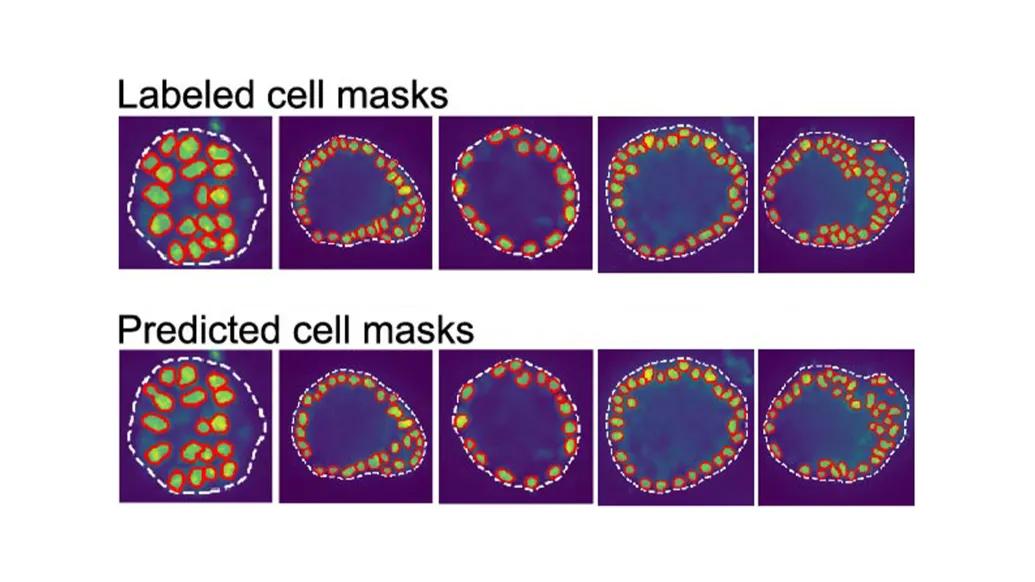
The team applied AI neural networks to thousands of images collected with confocal fluorescent microscopy at concrete time points.
The images record the size and shape of tissues as well as stained protein markers with each tissue.
The AI is able to detect features and protein marker expression data to determine tissue growth and cell differentiation during human development, says Fu.
“AI tools are very powerful and can extract fine features that oftentimes can be overlooked by human eyes,” he added.
Specifically, the AI tool provided a clearer understanding of bifurcation, the various decision points during development in which stem cells differentiate into different cell types.
The tool has powerful implications for future research, including high throughput screening applications and a better understanding of how the early developmental process can go awry, says Fu.
In the longer term, said Fu, AI could even be used to generate artificial but realistic embryoid images to understand, in an unbiased way, how a human embryo will develop under different conditions.
Additional authors: Kai-Rong Qin, Jing Na, Guanbin Gao, Chunxi Yang
Paper cited: “Deep manifold learning reveals hidden developmental dynamics of a human embryo model,” Science Advances. DOI: 10.1126/sciadv.adr8901
Sign up for Health Lab newsletters today. Get medical tips from top experts and learn about new scientific discoveries every week
Sign up for the Health Lab Podcast. Add us wherever you listen to your favorite shows

Health Lab
Explore thousands of health news & research stories by visiting the Health Lab homepage for more.
Media Contact

Public Relations
Department of Communication at Michigan Medicine
In This Story

Jianping Fu, PhD
Professor
Stay Informed
Want top health & research news weekly? Sign up for Health Lab’s newsletters today!
Featured News & Stories

The AI is listening: Implications of machine generated clinical notes on health care
Comprehensive DNA sequencing reveals hidden drivers of cancer
‘Molecular glue’ stabilizes protein that inhibits development of non-small cell lung cancer and uterine cancer

Many older adults make Medicare decisions quickly and most don’t change plans, poll finds

What’s the latest on 7-OH and kratom availability and addiction care?