After years of searching, woman finds help for idiopathic intracranial hypertension
Local specialists couldn’t diagnose her excruciating symptoms
1:24 PM
Author |
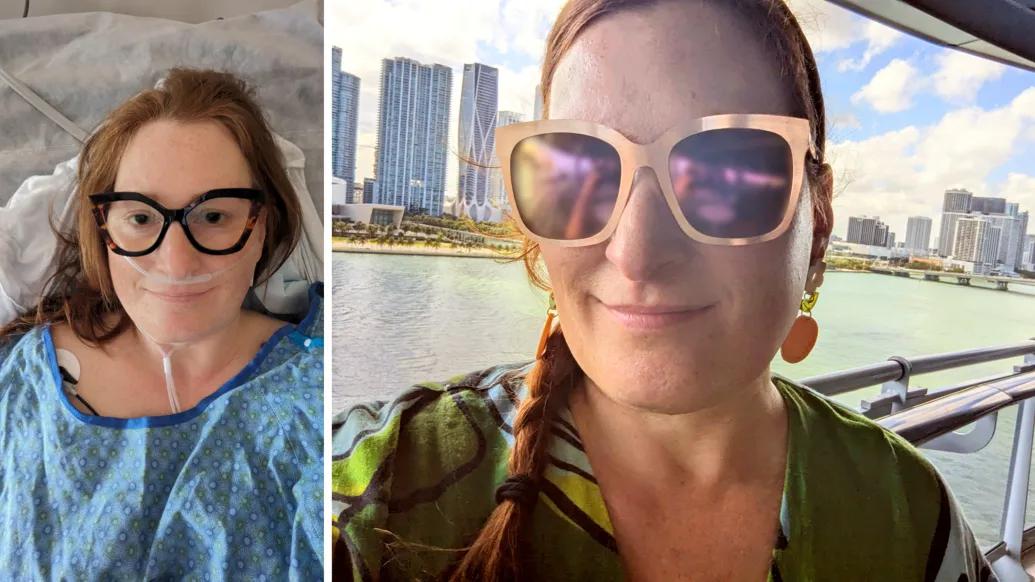
When Nicole Rodriguez began to hear a whooshing sound in her left ear in the summer of 2022, she figured she’d somehow gotten water in her ear.
But the sound, known as pulsatile tinnitus, didn’t go away.
“The whooshing sound started off gradually,” Rodriguez said.
“It was very irregular. I couldn’t tie it to anything, so that was very frustrating.”
She also began experiencing other issues that became concerning.
Eventually, her symptoms became debilitating, significantly impacting her quality of life. And while the symptoms didn’t point directly to a diagnosis, Rodriguez knew something was drastically wrong.
But doctors weren’t so sure.
It would take months and months of visits to various local neurologists before Rodriguez finally found answers from University of Michigan Health’s neuro-interventional team.
Searching for answers
“I was starting to feel pressure in my head that felt like more than just a sinus headache.”
The pressure was most noticeable when Rodriguez bent down, she recalls.
“It was just excruciating.”
Rodriguez was also experiencing changes in her vision.
“I suddenly needed bifocals because I couldn’t read small print, like text messages on my phone,” the 48-year-old said.
Rodriguez’s ophthalmologist advised her not to worry, but when her prescription needed to be changed again just months later, the Dearborn Heights, Mich., resident became more and more concerned.
“I had a headache that just wouldn't stop, and I still had the sound in my ear along with the vision issues.”
Treatment by her primary care physician included steroid injections and migraine medication for the headaches, neither of which helped.
“My headaches got to the point where I couldn’t do my job well and had to take a leave of absence. I couldn't do any of my usual activities — even lifting a laundry basket or tying my shoes was difficult,” said Rodriguez.
By the spring of 2023, Rodriguez had been seen at a local emergency room followed by appointments with three neurologists — but no one was able to provide a definitive diagnosis, she says.
A possible diagnosis
A potential cause of her symptoms, according to one local neurologist, was idiopathic intracranial hypertension, or IIH, with pulsatile tinnitus.
Idiopathic intracranial hypertension is a condition that causes increased pressure in the skull due to a buildup of cerebrospinal fluid in the brain. Idiopathic means there is no identifiable cause.
IIH happens when the body makes too much cerebrospinal fluid, causing pressure on the optic nerve and resulting in vision changes and headaches.
IIH is typically suspected when a patient presents with a swollen optic nerve, a condition known as papilledema.
Papilledema is the swelling of the optic nerve as it enters the back of the eye due to raised intracranial pressure.
The patient then undergoes brain imaging and a diagnostic test known as a spinal tap.
Our neuro-interventional team is a multidisciplinary group of neuro-interventional surgeons, neuro-interventional radiologists and neuro-ophthalmologists all working together to treat patients with idiopathic intracranial hypertension.”
-Neeraj Chaudhary, M.D.
If the pressure reading is above 20-30 cm of H2O, which is a measurement of pressure, and is accompanied by puffiness in the optic nerve at the back of the eye, idiopathic intracranial hypertension is often the cause, says U-M Health neuro-interventionalist Neeraj Chaudhary, M.D.
While a local neurologist finally confirmed IIH through a lumbar puncture, Rodriguez did not have a papilledema diagnosis.
“Medication support and management were about all that he had to offer me,” said Rodriguez.
But standard protocols — including weight loss and medication to reduce the production of CSF — did not work for her.
“My primary care physician said, ‘You can't work like this. You're not getting treatment that is helping you. Even though you haven’t been diagnosed with papilledema, you should consult with a neuro-ophthalmologist.’”
An evaluation by a neuro-ophthalmologist is generally the first step toward a diagnosis of idiopathic intracranial hypertension.
The Michigan difference
Rodriguez was referred to a neuro-ophthalmologist at U-M Health in June 2023, which then led her to their neuro-interventional team.
Her meeting with the team couldn’t have come soon enough as Rodriguez’s quality of life was rapidly declining.
What she discovered was a level of expertise at U-M Health that gave her answers and treatment that went beyond standard protocol practiced by other neurologists.
“I was relieved to know I still had options, and grateful for a care team of advocates,” she said.
“Our neuro-interventional team is a multidisciplinary group of neuro-interventional surgeons, neuro-interventional radiologists and neuro-ophthalmologists all working together to treat patients with idiopathic intracranial hypertension,” says Chaudhary.
“IIH patients usually present with positional headaches, congestion, feeling of heaviness in the head, and then vision disturbance.”
Patients suspected of having IIH typically undergo an MRI or CT scan of the brain.
If the MRI suggests there is increased pressure, a lumbar puncture is performed.
“If we find the pressures are increased on the lumbar puncture, and we’ve ruled out a tumor or blockage, we know there is increased CSF. The next step is to determine whether there is either too much fluid being produced or there's a problem with absorption of the fluid in the vein,” said Chaudhary.
“The patient may be given medication to reduce the production of CSF and see if that improves the condition. If that doesn't do the trick and if the headaches continue and the vision is still deteriorating, we then look at the venous sinuses — the large veins that return blood from the brain to the heart.”
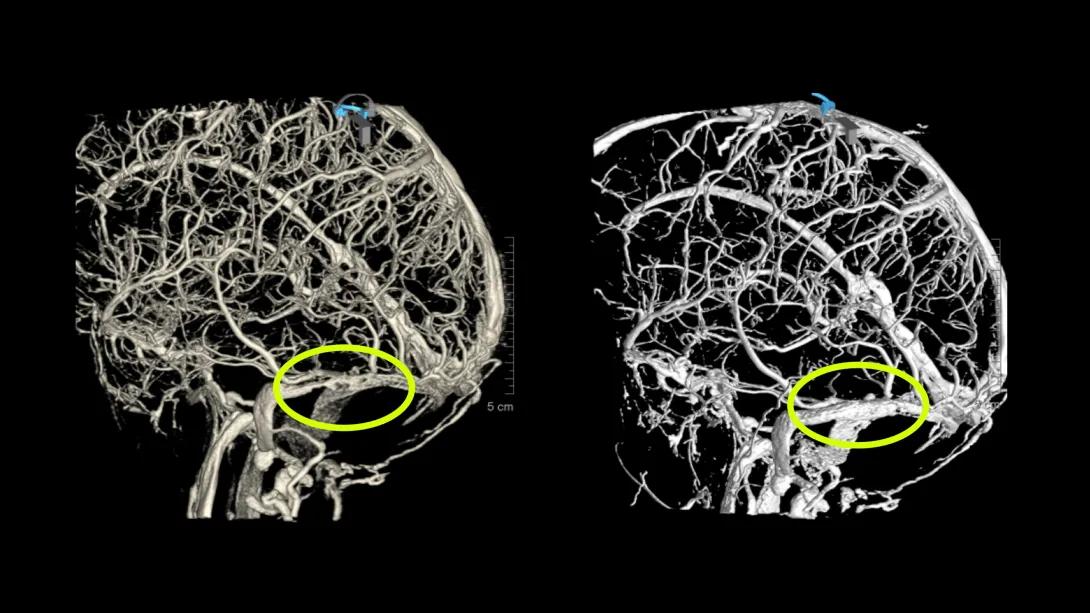
For IIH patients like Rodriguez, the team uses advanced imaging to further explore venous health when other methods fail.
As in her case, a vein can become narrowed, which increases the intravenous pressure, reducing blood flow.
This increased pressure in the veins prevents normal absorption of CSF into the veins.
The condition is known as venous sinus stenosis.
“When absorption of CSF is compromised, the fluid will dam up, and fluid pressure will increase,” said Chaudhary.
Traditional treatment has included surgical CSF diversion procedures. However, these carry the risk of infection, Chaudhary says.
More recently, minimally invasive endovascular stent placement within the venous sinuses has been the preferred procedure in normalizing pressure for some patients.
Advanced expertise for IIH treatment
Once venous sinus stenosis was confirmed, Rodriguez underwent endovascular surgery in May 2024 to place a stent in the affected vein.
Today, Rodriguez says the pressure in her head is gone and the pulsatile tinnitus has faded away.
She’s now able to do the things she loves, including gardening and socializing.
“I'm taking it easy and easing back into it, but there's nothing really stopping me from doing things. I'm able to go out for lunch or dinner for several hours and not be in pain and not have to cut it short. I also feel better about travel. It’s a big improvement — I was just so sick.”
Chaudhary believes more emphasis should be placed on advanced venous imaging for patients who present with classic IIH symptoms both with and without evidence of papilledema.
“The patient and their primary care physician should seek expert help from a neuro-ophthalmologist,” he advised.
“From an awareness point of view, this group of patients should have their veins observed to see if they might benefit from having a stent. The neuro-interventional team at U-M Health is here to help.”

Health Lab
Explore a variety of health care news & stories by visiting the Health Lab home page for more articles.
Media Contact

Public Relations
Department of Communication at Michigan Medicine
In This Story

Neeraj Chaudhary, MD, MBBS, MRCS (UK), FACR (USA), FRCR (UK), FAHA, FEBNI (EU)
Clinical Professor
Stay Informed
Want top health & research news weekly? Sign up for Health Lab’s newsletters today!
Featured News & Stories
Research may help better predict outcomes in kids with congenital cytomegalovirus

Michigan’s aging brains need more protection, poll shows
University of Michigan implants first-in-human Paradromics wireless brain-computer interface, designed to restore communication

Helping an employee-turned-patient overcome a brain tumor

Psychoactive substances and adverse side effects for patients with multiple sclerosis