
Advising China's first Olympic medevac program
How Beijing's emergency air services worked with the Survival Flight team before the games.
5:00 AM
Author |
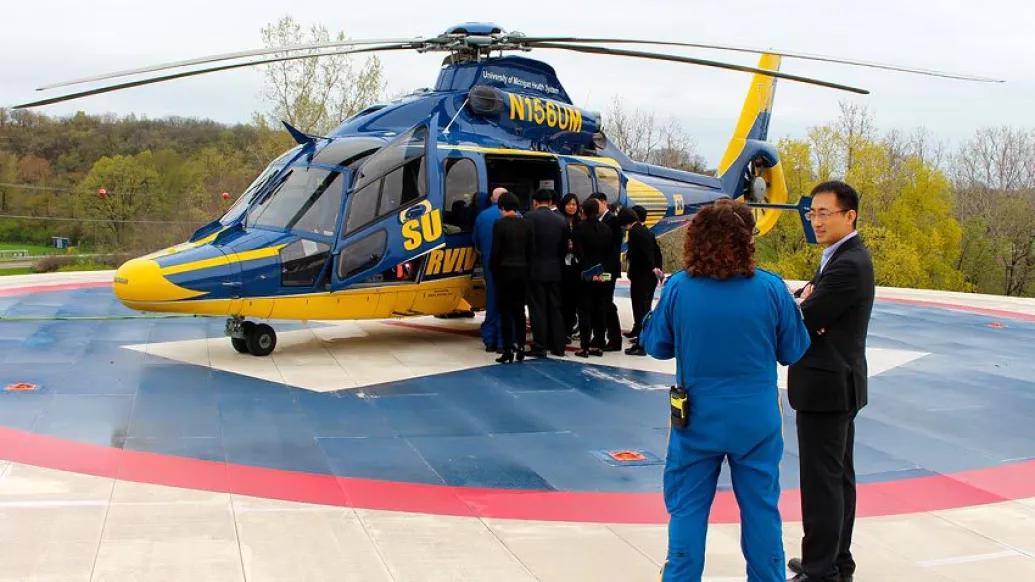
Members of the Chinese team behind the Winter Olympics' helicopter medical evacuation program consulted with Michigan Medicine's Survival Flight leaders in the run-up to the games.
Much of medical support for the Olympics, including standing up Beijing's first-ever air ambulance service, was tasked to Peking University Third Hospital, an affiliate of longtime University of Michigan institutional partner Peking University Health Science Center.
Getting Beijing's emergency transport team connected with Survival Flight leaders
When he was assigned to the medevac leadership team, sports medicine physician Yuping Yang, M.D., Ph.D., recalls his three-week visit to Ann Arbor, Michigan in 2019 for the Global Executive Education Program. The program, designed to empower Michigan Medicine's international partner institutions, included a behind-the-scenes look at the hospital's Survival Flight operations.
Yang, associate dean of the new Chongli Hospital, an affiliate of the Third Hospital built near Olympic snowboarding and ski jumping venues, reached out to his University of Michigan friends for help.
On a videoconference call in March 2021, Survival Flight physicians and administrative leaders offered advice and insights to Yang's team.
"Chongli Hospital was built with a helicopter pad on the roof just for the transfer of patients," Yang told his colleagues in the meeting. "We don't have enough experience with that. That's why we asked for this meeting. You have expertise in this area."
During their one-hour conversation, Yang and his team were able to ask about training scenarios; communications logistics between the ground, helicopter and hospital teams; patient transport protocols to and from the aircraft, and more.
"We have to be pioneers in helicopter emergency transport. Here, it is an experimental step," Yang said at the call's conclusion. He then thanked the Survival Flight crew for their hospitality and the time they spent together.
Medevac programs at the Olympics
The International Olympic Committee requires helicopter medevac services to transport injured athletes if needed. Launching shortly before the games, the program Yang's team established serviced both the Yanqing zone, about 70 kilometers north of Beijing, home to the alpine skiing, bobsled and luge runs, as well as the more distant Zhangjiakou zone, about 180 kilometers from Beijing, where Chongli Hospital is located.
The new service was put to the test February 7 when United States alpine skier Nina O'Brien required transport from the competition site to Beijing, a 20-minute flight. She'd suffered a compound fracture in her leg after a fall on the giant slalom course.
"Establishing a new program on such an aggressive timeline is an impressive achievement. We were happy to share our insights and experience," said associate professor of emergency medicine and Survival Flight medical director Mark Lowell, M.D., at Michigan Medicine who participated in the call. "Air transport services is a critical aspect of comprehensive emergency care, so any time we have the chance to help others get a new service off the ground, we welcome the opportunity."
MORE FROM THE LAB: Subscribe to our weekly newsletter
Like Podcasts? Add the Michigan Medicine News Break on iTunes, Google Podcasts or anywhere you listen to podcasts.

Health Lab
Explore thousands of health news & research stories by visiting the Health Lab homepage for more.
Media Contact

Public Relations
Department of Communication at Michigan Medicine
Stay Informed
Want top health & research news weekly? Sign up for Health Lab’s newsletters today!
Featured News & Stories

New questionnaire aims to improve understanding of demand avoidance in children, teens
Timing is of the essence for RNA during stress

New anti-cancer strategy shows promise in preclinical studies
More babies with hypoplastic left heart syndrome surviving critical period between surgeries

How U-M helped bring depression out of the darkness

