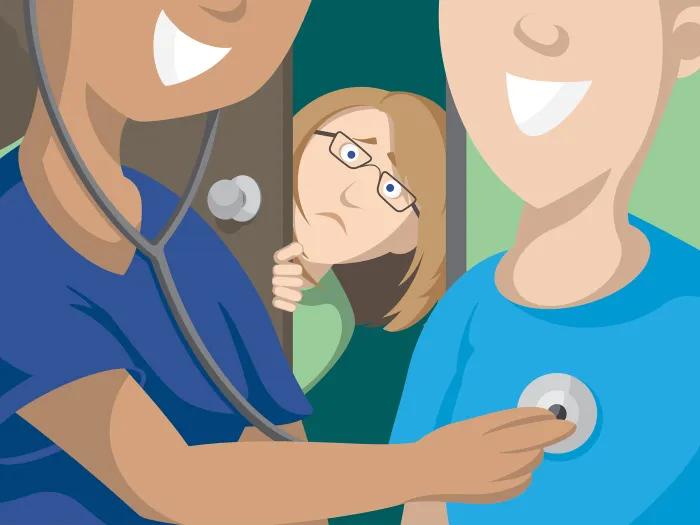
5 strategies to stop infertility from stressing your relationship
Struggling to conceive can strain even the tightest couple’s bond. These tips can help
11:07 AM
Author |

This article was originally published on April 28, 2017 and was updated on April 24, 2026.
Infertility can be heartbreaking for both men and women.
The resulting relationship stress that sometimes occurs only adds to a couple's woes.
"For many couples, trying to get pregnant can start to feel like work," said Lindsay Brennan, LMSW, CST, a clinical social worker with the University of Michigan Health Center for Reproductive Medicine.
"The process of getting pregnant can put incredible strain on your relationship."
Brennan offers tips for couples to help them weather the process together.
1. Don't isolate yourself.
Not everyone reacts to the trials of infertility the same way.
If you and your partner feel the challenges of infertility differently, it can be tempting to shut yourself off, which creates distance between each other.
"Sometimes one partner may feel like the other is bouncing back quicker after a disappointment, and you wonder if maybe your partner doesn't understand what you're going through or if they feel the same emotional pain," Brennan said.
Hiding feelings, though, can lead to deepening isolation. Brennan advises that couples be aware that everyone copes differently.
And, oftentimes, it can be beneficial to seek support from others that you feel close to, not just your partner.
"There's no right or wrong way, just different ways to process what's going on."
Try to understand how your partner copes, so each of you can meet the other's needs while not taking things personally if your reactions don't match up.
"Your partner can't give you the support you need if they don't know what you're feeling or how to help."
Another helpful tip is to set aside dedicated time with your partner to openly discuss your feelings, current treatments, appointments, etc.
It’s important to make space for other conversations so infertility doesn’t become the sole focus and feel overwhelming.
2. Keep the romance alive.
Fertility struggles can make sex feel like a chore.
"Many couples get to the point where they're having sex only during ovulation windows," Brennan said.
Add to that the fact that one partner may feel less "in the mood" outside designated fertility windows, and you have a situation that can further aggravate feelings of isolation and disconnection.
Every couple is different, and there's no manual on how to survive infertility."
Brennan suggests reserving time for intimacy that isn't focused on getting pregnant.
"The focus doesn't have to be on having sex but try to create windows of time where you can feel intimately connected together."
Hold hands, take walks together or cuddle on the couch, for example.
The most important thing is to make time for the two of you without distractions.
3. Relax together — or apart.
So much about the fertility journey is stressful.
Make a point to find ways to relax and recharge.
Schedule a couple's massage, go on an overnight getaway, enjoy a hike — make time for whatever is restorative to you. Doing something together is ideal, but it also helps to find ways to chill out on your own.
4. Be mindful.
It's easy to get carried away by the stress, medical appointments, body changes, anxiety and even shame associated with infertility.
Brennan says training yourself to be mindful of the signs of mounting anxiety can help.
"Mindfulness is a really helpful tool for couples affected by the tension of infertility," said Brennan.
"Pay attention to when the stress feels like it's piling up or starting to feel unmanageable and hit the pause button."
Brennan suggests patients use those moments to become mindful and present in their environment.
"Take a deep breath. Feel your feet in your shoes. Feel the air on your skin. Put yourself back in the moment," she recommended.
"There are a number of great apps such as Calm and Headspace that can help you get started."
5. Ask for support.
Just as your doctor helps you navigate the medical aspects of getting pregnant, fertility counselors are trained to help support your relationship through the fertility journey.
"Every couple is different, and there's no manual on how to survive infertility," said Brennan.
"I help couples get back on the same page and work through the emotions they're experiencing."
Even the strongest couples can struggle to stay connected while trying to conceive, she notes.
Fortunately, experiencing the trials of infertility together can lead many couples to come out on the other side stronger than ever.
Brennan advised, "Remember that you've chosen to do this together, and you'll get through this together."
The Center for Reproductive Medicine offers a monthly support group for individuals and couples struggling with infertility.

Health Lab
Explore thousands of health news & research stories by visiting the Health Lab homepage for more.
Media Contact

Public Relations
Department of Communication at Michigan Medicine
Stay Informed
Want top health & research news weekly? Sign up for Health Lab’s newsletters today!
Featured News & Stories
PCOS has a new name

Who’s at risk for painful periods?
A tragedy and a trial shine a spotlight on new moms’ mental health
Egg freezing: What women should know about fertility preservation

What to know about perimenopause and menopause