2/3 of Parents Cite Barriers in Recognizing Youth Depression
1 in 4 parents say their child knows a peer with depression and 1 in 10 say a child’s peer has committed suicide, a new poll finds.
5:00 AM
Author |

Telling the difference between a teen's normal ups and downs and something bigger is among the top challenges parents face in identifying youth depression, a new national poll suggests.
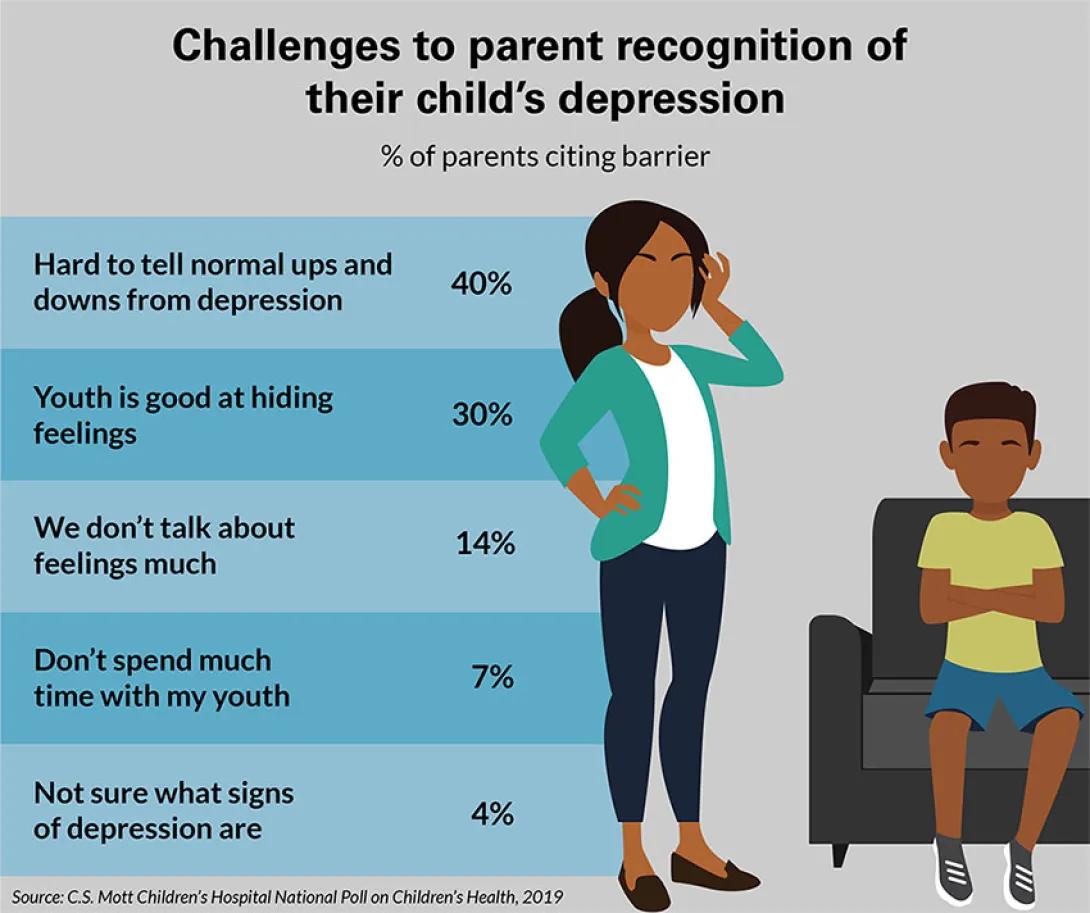
Though the majority of parents say they're confident they would recognize depression in their middle or high school aged child, two thirds acknowledge barriers to spotting specific signs and symptoms, according to the C.S. Mott Children's Hospital National Poll on Children's Health at the University of Michigan.
Forty percent of parents struggle to differentiate between normal mood swings and signs of depression, while 30% say their child is good at hiding feelings.
"In many families, the preteen and teen years bring dramatic changes both in youth behavior and in the dynamic between parents and children," says poll co-director Sarah Clark. "These transitions can make it particularly challenging to get a read on children's emotional state and whether there is possible depression."
Still, a third of parents polled said nothing would interfere with their ability to recognize signs of depression in their child.
MORE FROM MICHIGAN: Sign up for our weekly newsletter
"Some parents may be overestimating their ability to recognize depression in the mood and behavior of their own child," Clark says. "An overconfident parent may fail to pick up on the subtle signals that something is amiss."
The poll also suggests that the topic of depression is all too familiar for middle and high school students. One in four parents say their child knows a peer or classmate with depression, and 1 in 10 say their child knows a peer or classmate who has died by suicide.
Indeed, rates of youth suicide continue to rise. Among people ages 10 to 24 years old, the suicide rate climbed 56% between 2007 and 2017, according to the Centers for Disease Control and Prevention.
"Our report reinforces that depression is not an abstract concept for today's teens and preteens, or their parents," Clark says.
"This level of familiarity with depression and suicide is consistent with recent statistics showing a dramatic increase in suicide among U.S. youth over the past decade. Rising rates of suicide highlight the importance of recognizing depression in youth."
Compared to the ratings of their own ability, parents polled were also less confident that their preteens or teens would recognize depression in themselves.
Clark says parents should stay vigilant on spotting any signs of potential depression in kids, which may vary from sadness and isolation to anger, irritability and acting out. Parents might also talk with their preteen or teen about identifying a "go to" adult who can be a trusted source if they are feeling blue, Clark says.
Some parents may be overestimating their ability to recognize depression in the mood and behavior of their own child.Sarah Clark, M.P.H.
Most parents also believe schools should play a role in identifying potential depression, with seven in 10 supporting depression screening starting in middle school.
LISTEN UP: Add the new Michigan Medicine News Break to your Alexa-enabled device, or subscribe to our daily updates on iTunes, Google Play and Stitcher.
"The good news is that parents view schools as a valuable partner in recognizing youth depression," Clark says. "The bad news is that too few schools have adequate resources to screen students for depression, and to offer counseling to students who need it."
Clark encourages parents to learn whether depression screening is taking place at their child's school and whether counseling is available for students who screen positive. Given the limited resources in many school districts, parents can be advocates of such efforts by talking to school administrators and school board members about the importance of offering mental health services in schools.
The nationally representative Mott Poll report is based on responses from 819 parents with at least one child in middle school, junior high, or high school.
Our expert's guide for parents on how to talk to children and teens about depression and suicide.

Health Lab
Explore thousands of health news & research stories by visiting the Health Lab homepage for more.
Media Contact

Public Relations
Department of Communication at Michigan Medicine
Stay Informed
Want top health & research news weekly? Sign up for Health Lab’s newsletters today!
Featured News & Stories

Study: Hospitalizations for eating disorders spike among adolescents during COVID
National Poll: Pandemic Negatively Impacted Teens’ Mental Health

Many Parents Say Teens With Anxiety, Depression May Benefit From Peer Confidants at School

U-M-led consortium to receive up to $52 million in NIH funding to study why viral respiratory infections affect children differently
4 in 5 parents say having a baby is too expensive