Signs Your Child’s Snoring Should Be Taken Seriously
Get tips to spot sleep issues, plus learn about a new nationwide sleep study for which your child may be eligible.
7:00 AM
Author |
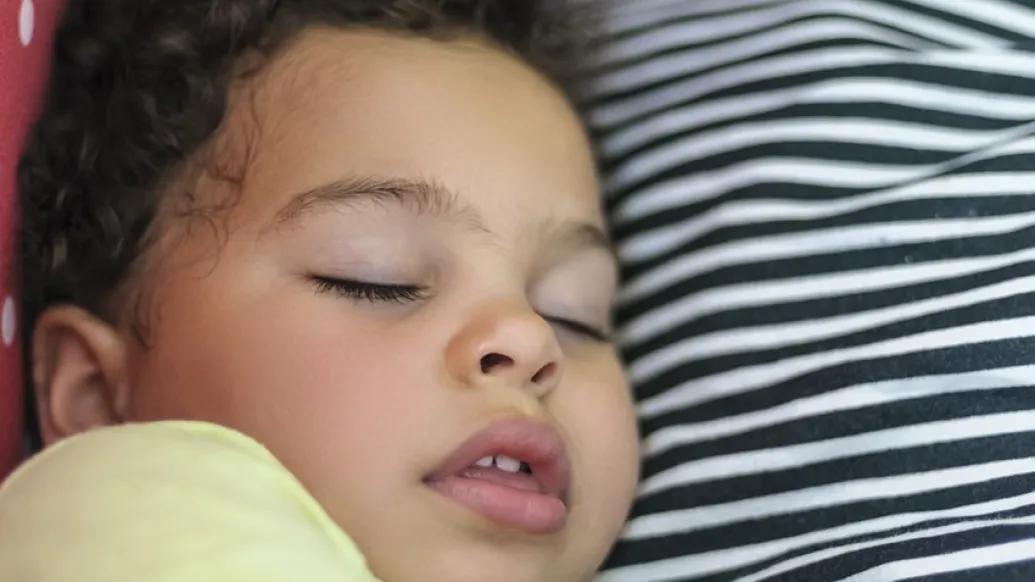
Many children may snore at some point in their lives, especially during bouts of colds or when their allergies are acting up. It's often a passing phase, but in some cases, it is a habitual problem that requires treatment.
LISTEN UP: Add the new Michigan Medicine News Break to your Alexa-enabled device, or subscribe to our daily audio updates on iTunes, Google Play and Stitcher.
So how do parents know when snoring is an issue?
C.S. Mott Children's Hospital pediatric sleep specialist Fauziya Hassan, MBBS, M.S., says the answer often lies in what happens when a child isn't sleeping.
"Problematic snoring can often cause poor quality of sleep that leads to daytime behavioral issues," Hassan says. "Since it's unlikely a parent is able to observe their child sleeping each night, these daytime symptoms may actually be the first noticeable signs. However, many parents don't think to associate them with problematic sleep."
Signs snoring is a problem
Otherwise, it's time to speak with a pediatrician if a child snores more than three nights a week and exhibits one of the following signs:
-
If they are "tired but wired," Hassan says. "Children are busybodies even when overtired."
-
If they are irritable, aggressive or cranky.
-
If they "zone out" or daydream frequently throughout the day.
-
If they are excessively sleepy during the day.
-
If they are difficult to wake up in the morning, even when they had a significant amount of time to sleep.
-
If they frequently wet the bed past age 9, or if they have not been wetting the bed and the problem suddenly reappears.
-
If they are struggling in school or have a hard time paying attention. "It's often that teachers are the first to raise red flags, as they notice a drop in grades or productivity," Hassan says.
If you decide it's time to see a pediatrician, be prepared to report what behaviors you've observed.
But it's important to trust your judgment even if your child doesn't fit these exact markers. "If you're concerned with your child's snoring or behavioral issues, don't hesitate to speak with your child's pediatrician," says Hassan.
If local Ann Arbor parents are concerned, their child may be eligible for a new research study about sleep.
The science of snoring
The most common cause of habitual, problematic snoring is obstructive sleep apnea (OSA), a condition in which airflow is obstructed, causing nighttime awakenings or drops in oxygen levels. Roughly 1 to 4 percent of children have OSA, noted more so after age 3 and in most cases caused by enlarged tonsils and adenoids.
MORE FROM MICHIGAN: Sign up for our weekly newsletter
This condition is typically identified during a physical exam and confirmed by a sleep study. Even more children have habitual snoring or mild sleep-disordered breathing.
Enlarged tonsils and adenoids causing obstruction of the airway at night can adversely affect a child's sleep and overall quality of life. Adenotonsillectomy (removal of the tonsils and adenoids) is commonly used for treating both OSA and milder forms of sleep-disordered breathing.
Studying the effects of tonsil and adenoid removal
Although adenotonsillectomy is commonly performed, more research is needed to determine the effect it has on a child's sleep, behavior and overall quality of life. Often, surgery is done without a sleep study being performed.
SEE ALSO: When Should a Child's Tonsils Come Out?
There also isn't much data to show just how effective surgery is for snoring and milder forms of sleep-disordered breathing, and whether delaying surgery may allow for other nonsurgical treatments to help first.
As part of a nationwide, NIH-funded study, Hassan and Michigan Medicine colleagues Ronald Chervin, M.D., and David Zopf, M.D., are tackling these questions. The study is currently recruiting children with snoring or mild breathing problems during sleep who are considered candidates for surgery.
Children enrolled in the study are randomized into one of two groups: One group of children will have their tonsils and adenoids removed within one month; the other group will be evaluated at baseline and again at a later date while receiving supportive care.
Both groups of children will be evaluated throughout to determine how their treatment affects their sleep, quality of life, school performance and behavior. All participants will receive two overnight sleep studies, behavioral testing, monthly questionnaires and more.
"The goal is to determine the effects of tonsil and adenoid removal on children's health and behavior," says Hassan. "This will ultimately empower physicians and parents to make an informed decision about whether surgery is likely to improve a child's sleep and behavior."
The study will also assess whether there is improvement in other related health conditions such as asthma and allergies.
Interested in the sleep study? Michigan Medicine researchers are seeking children between the ages of 3 and 12 who have a sleep disorder and are possible candidates for adenotonsillectomy. Learn more about it and whether your child is eligible.

Health Lab
Explore thousands of health news & research stories by visiting the Health Lab homepage for more.
Media Contact

Public Relations
Department of Communication at Michigan Medicine
Stay Informed
Want top health & research news weekly? Sign up for Health Lab’s newsletters today!
Featured News & Stories

From 20 seizures a day to more time for play: How personalized epilepsy care helped young patient

Type 1 diabetes does not mean sitting out for 10 year old

More babies with hypoplastic left heart syndrome surviving critical period between surgeries

Distance, insurance, social factors may hinder access to lifesaving heart monitoring for children

High dose oxytocin protocol linked to lower postpartum hemorrhage rates