Make Sure Your Teen Has Had These 4 Lifesaving Vaccines
Most parents know the value of vaccinations for their children, but some fail to keep up in later years. A Michigan Medicine physician offers a reminder.
7:00 AM
Author |
There's no doubt new parents know that babies and young children need vaccinations to stay healthy and prevent certain diseases.
But that mindset is less prevalent as their kids grow older, according to a new C.S. Mott Children's Hospital National Poll on Children's Health.
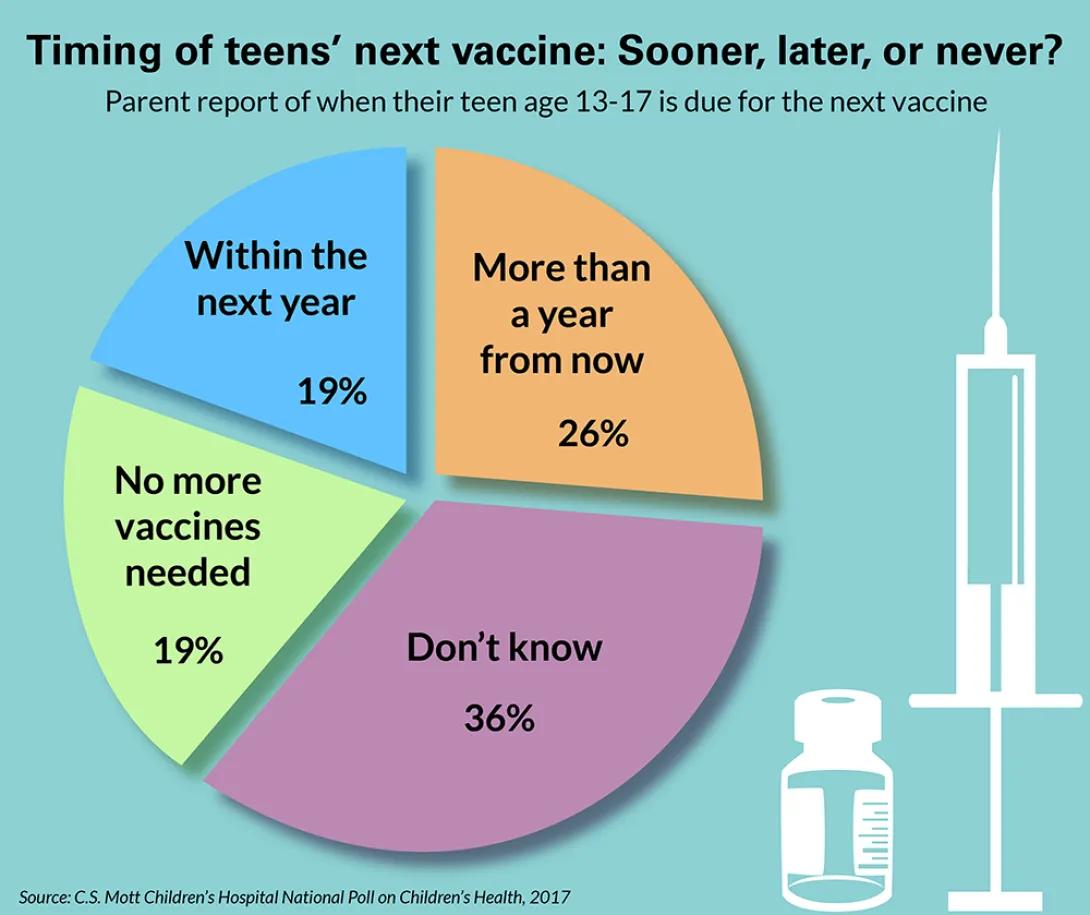
The poll, which surveyed 614 parents with at least one child ages 13 to 17, found that 1 in 5 respondents wasn't certain if their teenager had received all necessary shots.
Nearly 2 in 5 didn't know when the next vaccination was due.
Meanwhile, two recent reports from the American Academy of Pediatrics found that many teens aren't getting the vaccinations they need.
The divide doesn't surprise Terrill Bravender, M.D., M.P.H., an adolescent medicine physician at Mott.
"We put so much emphasis on vaccines for infants and toddlers that oftentimes the general public forgets that everyone — adults included — needs to continue to receive vaccines," says Bravender. "It's really a lifelong endeavor."
SEE ALSO: Should Teens Get an EKG?
The Centers for Disease Control and Prevention has a recommended immunization schedule for all ages. But some doctors may put more emphasis on certain inoculations over others.
Bravender, for one, says no shot should be skipped.
And while it's the duty of medical professionals to explain which immunizations are needed and when, parents also must make an effort to schedule and attend checkups with a teen's pediatrician.
Bravender, who wasn't involved with the Mott poll, spoke about key vaccines recommended during the preteen years and what he tells families beforehand.
4 important vaccines all teens need
Influenza
Teens should get this shot each year, most often in the fall. The reason: "The type of flu virus in the environment changes a bit every year," says Bravender. He notes that the CDC works to anticipate possible strains, but the annual preventive formula remains "a best guess."
Still, he adds, "the more flu vaccines you get over time, the more cross-immunity you're likely to get." That can help thwart the virus and transmitting it to vulnerable populations, too.
Human papillomavirus (HPV)
Spread over three doses beginning at age 11 or 12 (and with follow-ups about one and six months later), the vaccine shields against a common virus spread via sexual contact. The shots, now administered to boys and girls, must be given before a person is exposed to HPV — which is associated with cervical and penile cancers, among others, and genital warts.
"These are things nobody wants to talk about," says Bravender, "but this vaccine actually prevents cancer."
Meningococcal
Although rare in the United States, bacterial meningitis — which occurs when harmful bacteria infect the fluid and lining around the brain or spinal cord — can be deadly. "It's a devastating illness to have," says Bravender.
Children need a meningococcal vaccine at age 11 or 12. Because the bacteria can easily spread among young people living in close proximity (such as college students or military members), a second booster shot should occur at age 16.
Tdap (tetanus, diphtheria and pertussis)
This shot offers a triple dose of protection. Given to children at age 11 or 12, the vaccine must be repeated every eight to 10 years.
One of the key effects of this vaccine is preventing pertussis, or whooping cough. The contagious coughing fits are "incredibly dangerous for unvaccinated infants and the elderly," Bravender says. The vaccine also stops tetanus (a toxin from soil bacteria that can enter the body via cuts and scratches) and diphtheria (an infection affecting the nose and throat).

Health Lab
Explore thousands of health news & research stories by visiting the Health Lab homepage for more.
Media Contact

Public Relations
Department of Communication at Michigan Medicine
Stay Informed
Want top health & research news weekly? Sign up for Health Lab’s newsletters today!
Featured News & Stories

High dose oxytocin protocol linked to lower postpartum hemorrhage rates

Human Rabies Exposures Growing Across the Country

4 ways to teach your teen safe driving habits

U-M-led consortium to receive up to $52 million in NIH funding to study why viral respiratory infections affect children differently

4 in 5 parents say having a baby is too expensive