Keeping Kids Safe from Gun Accidents: 6 Strategies for Families
Firearms-related injuries are the second-leading cause of death among children — and they’re largely preventable. A researcher offers tips to prevent tragedy at home.
1:00 PM
Author |

Nearly 1.7 million children in the U.S. live in a home with a loaded, unlocked firearm. As a result, thousands of children are killed or injured by a firearm each year.
The common thread among these injuries? Many are preventable. Fortunately, parents and caregivers can take simple steps to reduce the likelihood of an accidental firearm-related injury at home.
Patrick Carter, M.D., a Michigan Medicine emergency physician and firearm injury prevention researcher, shares his tips for families:
How to prevent gun injuries at home
Eliminate access to guns: "This is the only proven method of preventing accidental firearm injuries is the absence of a firearm from the home," Carter says. Many firearm-related incidents occur simply because a child or group of children stumbled across an unlocked, loaded weapon.
If weapons are removed from the home, a child wouldn't have the opportunity to come into contact with one. Eliminating guns from your home is the only absolute method of preventing such accidents.
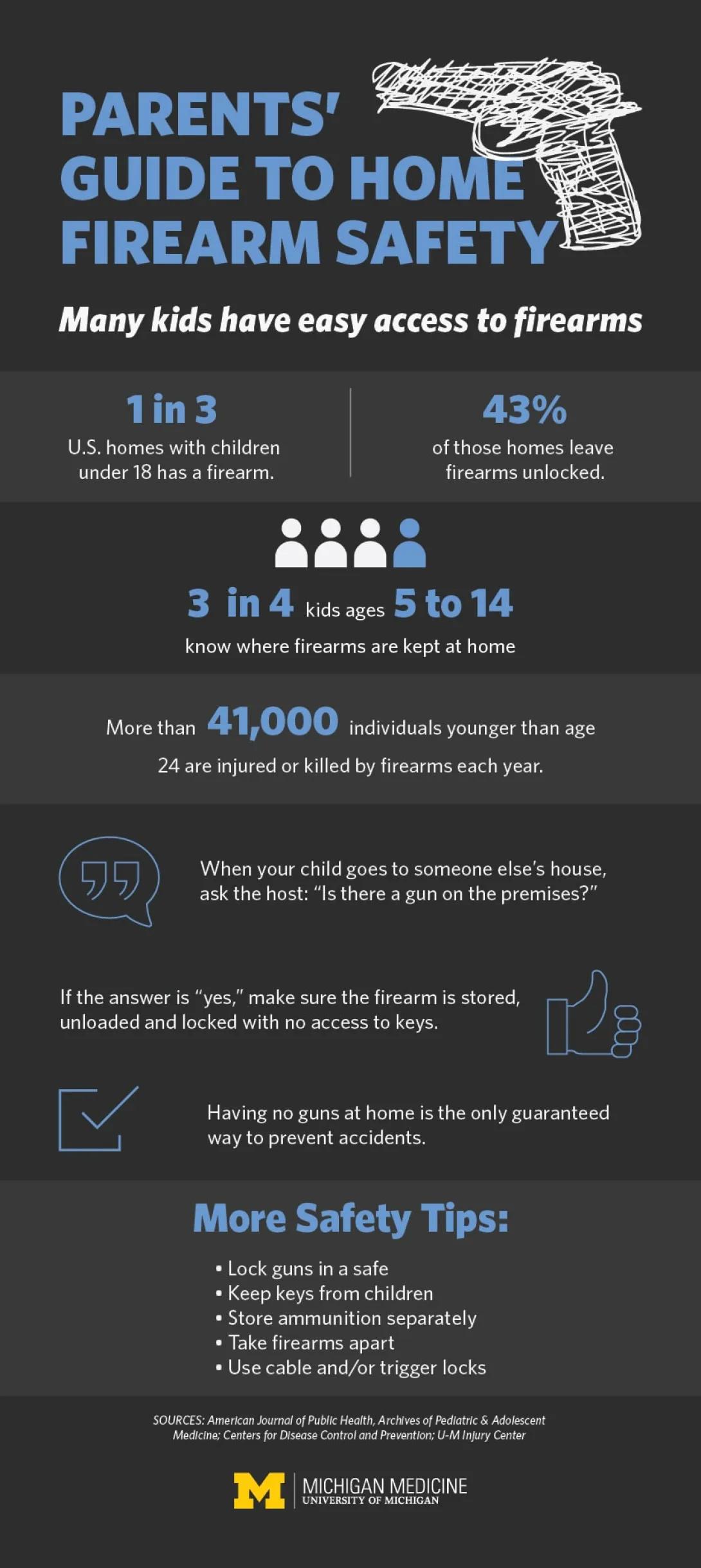
Properly store all firearms: If your family has decided to keep guns at home, it's critical they are stored properly. Firearms should be unloaded and secured in a locked gun cabinet. Ammunition should be stored in a separate locked cabinet. Keys to these cabinets should be kept in a place inaccessible to children.
SEE ALSO: Home Alone: Parents More Confident Tweens Could Deal with Fire and Storms Than Guns
Trigger locks or cable locks, which disable the firing mechanism, are an appropriate low-cost alternative. However, a locked firearm cabinet remains the best option for families that decide to keep a firearm at home.
Don't assume hiding your guns is enough: Research has shown that 3 out of 4 children ages 5 to 14 know where firearms are hidden in the home — and 1 in 3 have handled a firearm in the home, many without a parent's knowledge. Even if you think you've chosen a hiding spot your children don't know about, they probably know how to find the firearm.
In addition, one-quarter of children as young as 3 have been shown to be strong enough to pull the trigger on a firearm. No age, then, is too young to consider how and where to store firearms safely in the home.
Know the limits of gun-safety education: There are several programs intended to teach children how to safely handle a gun. While such programs may provide a framework for teaching young people about gun safety, research has shown they do little to prevent accidents.
"When a child comes across a gun, their curiosity is likely to overshadow the lessons learned through these programs, and the safety instructions provided in these programs can be hard for children to remember in the moment when faced with the opportunity to play with a loaded weapon," Carter says.
Ask other parents if they have a gun in their home: Before dropping your child off at another home, ask the parents if they have an unlocked gun on the premises. Many gun owners aren't likely to broadcast their ownership, so it's important that parents make a point to ask.
Parents often discuss allergies, pets in the home or other questions about supervision, and adding this question is encouraged. "Is there an unlocked gun in your house?" is a simple question with the power to save lives. The ASK (Asking Saves Kids) campaign offers parents tips to start the conversation.
Be cautious of guns marketed as "childproof": Firearm manufacturers have introduced new technology that is intended to make guns harder for children to operate. While these features have the potential to save lives, they are not foolproof.
Regardless of whether a gun has this technology, firearms should still be properly locked away to prevent child access.

Health Lab
Explore thousands of health news & research stories by visiting the Health Lab homepage for more.
Media Contact

Public Relations
Department of Communication at Michigan Medicine
Stay Informed
Want top health & research news weekly? Sign up for Health Lab’s newsletters today!
Featured News & Stories

7 Questions All Parents Should Ask Before a Playdate

Galens Tag Days celebrates 100 years of helping kids

From 20 seizures a day to more time for play: How personalized epilepsy care helped young patient

More babies with hypoplastic left heart syndrome surviving critical period between surgeries

Type 1 diabetes does not mean sitting out for 10 year old