Tackling Torn Tendons
You don’t have to be an elite athlete to be at risk for torn tendons, and rates of injury seem to be on the rise.
4:17 PM
Author |
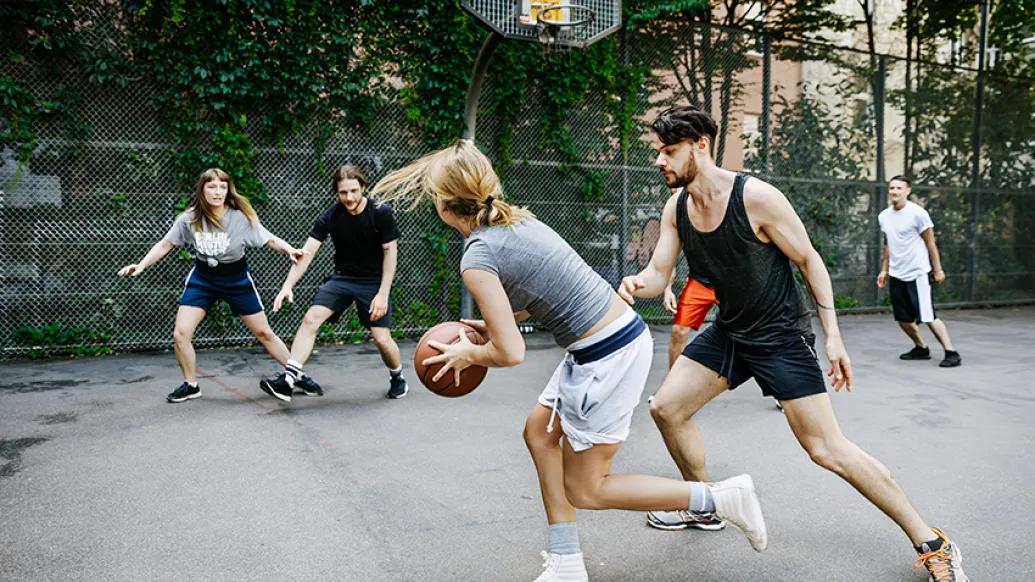
With more outdoor activities during summer months, the risk of a tendon injuries increases, and the rate of the injury seems to be on the rise, says James R. Holmes, M.D., associate professor of orthopaedic surgery at Michigan Medicine.
Tendons, the flexible but inelastic cord of fibrous collagen tissue, attach muscle to bone. Tendinitis is when the tendon's protective layer becomes inflamed or irritated, often due to strenuous physical activity.
LISTEN UP: Add the new Michigan Medicine News Break to your Alexa-enabled device, or subscribe to our daily audio updates on iTunes, Google Play and Stitcher.
You may expect that elite athletes are the ones who most commonly experience torn tendons, but we're all susceptible to these distressing strains.
"Actually, the most common scenario of a torn tendon is the 40-year-old 'weekend warrior,' playing tennis or a pick-up basketball game," Holmes says.
The Achilles tendon
Common in sports injuries, a torn Achilles tendon is dangerous in that you may not even know you tore it, and delayed medical attention means a delayed diagnosis.
When this maximal muscle effort strains the tendon, the tendon can fail and rupture.James Holmes, M.D.
The strongest tendon in the body, extending from the calf muscles to the heel bone, the Achilles allows the body to do things like rise on your toes or push off from the ground. According to Holmes, it's subject to many pathological problems, including tendinosis, the degenerative condition of the tendon that aids in its rupture.
"The classic description of an Achilles tendon tear is the patient feeling like someone kicked them from behind, and often turning to see who stepped on their ankle," Holmes says. "They're not particularly painful."
Holmes says those who experience an Achilles tear have some degree of chronic weakness in tendon strength in the legs and ankles during push off from the ground when muscle strength is carefully measured. This is particularly the case in athletes.
"Activities involving any explosive acceleration or maximal effort, like in basketball, tennis, baseball or football, puts strain on the tendon," Holmes says. "When this maximal muscle effort strains the tendon, the tendon can fail and rupture."
He adds that there are also factors that could put you at an increased risk for a torn Achilles, including using oral steroids, steroids injected near the tendon, or antibiotics like Ciprofloxacin or Levaquin (Levofloxacin).
Seeking treatment
While it makes sense that stretching before exercise would play a positive role in preventing a tendon tear, Holmes says there is no scientific evidence that this is the case.
His advice: be cautious when playing high-intensity sports and see an orthopaedic surgeon within the first few days after a suspected Achilles tear, since some treatment options are time-dependent.
Operatively or non-operatively, tendon tears can be treated. There's evidence to suggest that either option results in a similar recovery process but be mindful of treatment options, according to Holmes.
MORE FROM MICHIGAN: Sign up for our weekly newsletter
With your orthopaedic surgeon, consider the variables involved in making a shared treatment decision. Variables to be aware of are age, activity type and level, and any existing comorbidities.
Generally, recovery after an Achilles tendon injury isn't a quick process. According to Holmes, patients typically don't reach maximal medical improvement for at least 12-18 months after injury, regardless of the treatment option chosen.
The best way to assist the recovery process is to follow physician directions closely and carefully, so make sure to follow-up with your physician with questions or concerns if they arise.

Health Lab
Explore thousands of health news & research stories by visiting the Health Lab homepage for more.
Media Contact

Public Relations
Department of Communication at Michigan Medicine
Stay Informed
Want top health & research news weekly? Sign up for Health Lab’s newsletters today!
Featured News & Stories
4 in 5 parents say having a baby is too expensive
U-M Board of Regents approves construction of Nathan and Catherine Forbes Sports Medicine Institute

E-Bikes are everywhere, but most parents say they don’t know enough about them

A concussion expert and football father discusses why he values teamwork over zero-risk

Why tendons heal so poorly and how researchers hope to fix them