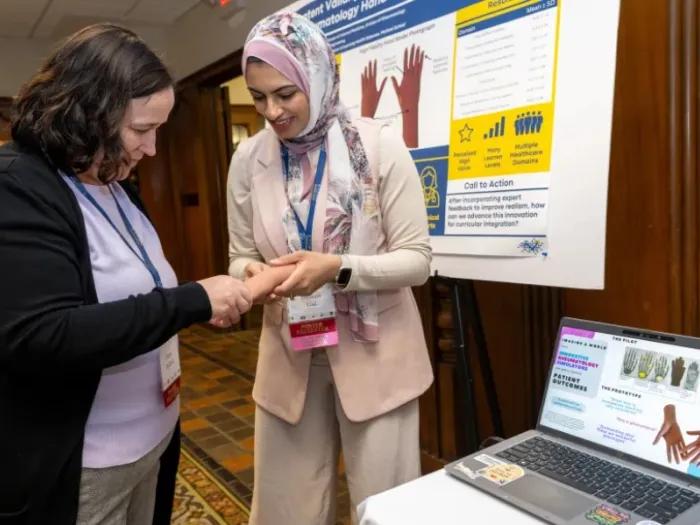
Purpose as a Foundation for Well-Being in Health Care
How purpose, attention and energy shape wellbeing in healthcare
4:00 PM
*Content warning: While well-being and purpose is the main topic, the following conversation does contain material related to the loss of a child and mental health that some might find distressing. Listener discretion is advised.
Dr. Vic Strecher of U-M Public Health joins host Dr. Elizabeth Harry to explore why purpose is a powerful driver of well-being, resilience and professional fulfillment. Strecher shares personal reflections, groundbreaking research and practical strategies—including the SPACE framework (sleep, presence, activity, creativity and eating)—to help clinicians and organizations reconnect with their “why.” From preventing burnout to managing energy and attention, this conversation highlights how aligning personal and organizational purpose can transform health care work and support lasting well-being.
Transcript
Hello and thank you for joining us. A quick content warning before we begin this episode: While well-being and purpose is the main topic, the following conversation does contain material related to the loss of a child and mental health that some might find distressing. Listener discretion is advised.
Dr. Elizabeth Harry:
Hello and welcome to Well-Being at Michigan Medicine's podcast. I'm your host, Dr. Elizabeth Harry. And today, we're honored to have Dr. Vic Strecher to join us. Dr. Strecher is a professor in the School of Public Health at the University of Michigan, a trailblazing innovator, author, and founder of companies that have elevated well-being for millions. From studies at the NIH, groundbreaking startups like HealthMedia and Kumanu, Vic's mission has been to catalyze personal and collective flourishing. Today, we'll explore well-being, why finding purpose is a game changer for well-being, and how organizations can lead by examples. So let's get started. First, Vic, thank you so much for joining us.
Dr. Vic Strecher:
Thank you, Liz. Really looking forward to this.
Dr. Elizabeth Harry:
We're really excited to have you here. And so just to get started, many of us want to feel healthier and happier, particularly in the workplace. We're doing a lot of work to try to create the environment for people to thrive and experience professional fulfillment. Tell me why purpose might be the missing linchpin to that equation.
Dr. Vic Strecher:
Thanks, Liz, for that question. I really see purpose at the root system of our lives, really. It's so fundamental. It's like our core values. It's like our identity. Our purpose is what leads to our behaviors. It leads to our emotions. It gives us resilience. So that's why I started studying this really existential concept called purpose in life.
Dr. Elizabeth Harry:
Yeah. And I love that because, to your point, we can do so much to create environments where people can do the work that they want to do and really come in and be effective at that. But if there isn't that connection to why, why am I here? Why am I wanting to do this work? It seems that people can be potentially adrift a little bit and maybe more vulnerable to the ebb and flow of the waves around us rather than anchored to a core purpose.
Dr. Vic Strecher:
We're so used to helping people with the how. How do I change? How do I improve my health? But not the why. So many people come to me and say, "Well, how can I calm down, reduce my stress, become more resilient? How can I lose weight? How can I manage my diabetes?" Any of those things. And I can give them lots and lots of hows. I mean, we're all certainly well-trained to do the hows. But once you start by asking the why, it creates a little emotion in that person. In fact, maybe an initial why might be, "What's on your smartphone? What's on the wallpaper when you open up your smartphone? What's the first thing you see?" And if it's, "Well, this is my granddaughter." Okay, wow. And you're a newly diagnosed diabetic. I can help you with what to do to manage your diabetes, but let's talk about the why. Is it maybe in part because of your granddaughter?
Dr. Elizabeth Harry:
Yeah.
Dr. Vic Strecher:
And then suddenly, you might even see a tear coming down because it becomes emotional, it becomes deeper, it becomes purposeful. And suddenly, you are not trying to motivate the person, you are appealing to their motives, which is a very different approach.
Dr. Elizabeth Harry:
Yeah. And it's such an important piece in health care, I think, because our North Star really is caring for others. And that's why so many of us came into health care, whether it's to deliver care, to educate the next generation of people who will be delivering care, or to have breakthroughs and discoveries that will help advance care. That North Star is the same. And when we anchor into that, I think it can be so protective against burnout and against some of the other consequences of the day-to-day frictions that we experience.
Dr. Vic Strecher:
When we talk to clinicians who are suffering burnout, one of the things that we might want to ask is, "Are you in medicine or nursing or pharmacy or whatever you're in for the same reason you got into it in the first place?" And that becomes emotional as well. Suddenly, people are going, "No, not really. I mean, I was so motivated to get into this space for a certain reason, and I've lost that reason." Maybe regaining some of the reasons people got into these health professions in the first place can be helpful.
Dr. Elizabeth Harry:
I love that. So for our listeners that may be new to your work, was there a pivotal moment that set you on this path towards thinking about well-being and purpose for you?
Dr. Vic Strecher:
Well, I've been a behavioral scientist now for 40 years. So I've been doing this for a long time. I was initially really attracted to a concept called self-efficacy, which is our confidence. Can we do something? And that's so different than what we also call outcome expectations. So outcome expectations are, "If I get this COVID shot, what's the likelihood I'll get COVID then and what's the likelihood that it'll be real severe?" Things like that. And those are outcome expectations. But there are also self-efficacy expectations. "Can I do this in the first place? Can I quit smoking? Can I manage my diabetes? Can I manage my job?"
So I was very interested in self-efficacy. And that's really powerful, very powerful concept. But then I kept thinking over time, over the years, like, what is it that is deeper? What's deeper in this system? What is it about our identities? How do you even measure identity? How do you measure things like core values? And I started thinking about that more because I just thought we're dealing with surface level issues when we're trying to help people manage their lives better or manage ourselves better. And then a very personal thing happened 15 years ago. My 19-year-old daughter died very suddenly of a heart attack.
Dr. Elizabeth Harry:
I'm so sorry. Oh my goodness.
Dr. Vic Strecher:
And she was a heart transplant recipient. In fact, when she was nine, she received a new heart right here at Mott Children's Hospital. But when she was 19, she was in nursing school. And during spring break, we were all in the Caribbean to basically celebrate her life, our lives. And she, very suddenly and unexpectedly, passed away. And when that happened, I lost my own purpose. Our daughter had caught a chickenpox virus when she was six months old and that virus attacked her heart. It destroyed her heart. She needed a new heart, a new heart transplant. And she was one of the first children to get a heart transplant in 1990. And she needed a second one, which she got at Mott Children's Hospital.
And when she died, I lost my purpose. I found myself, a couple months later, two miles out on Lake Michigan. And I was in Northern Michigan by myself, actually. My wife was still here in Ann Arbor. And she's a gardener and a sculptor. And she was gardening and sculpting. And that was her way of dealing with grief. I was up in Northern Michigan and I was basically drinking and eating myself to death. I was just watching mindless TV all the time. I didn't care, basically. The university had let me off of teaching and said, "You don't have to teach this semester, Vic. You lost your daughter. That's a big thing. And in fact, if you can't teach next semester, we'd understand that too."
I found myself two miles out in Lake Michigan in a kayak at 5:15 in the morning. It was beautiful. It was still very dark and it was very cold. It was spring. And if I'd fallen in, I would have died for sure. I was in my boxers and t-shirt, which is too much information. But I'd simply just woken up and looked out and it was very smooth. I jumped into my kayak. And two miles out, I was thinking, "It's so beautiful this morning. Maybe I'll just keep going to Wisconsin," which was 84 miles.
Dr. Elizabeth Harry:
Right.
Dr. Vic Strecher:
I never would have made it, of course. And I knew that. I knew I was at a crossroads of my life right there. And at that very moment, when I was thinking about this, the sun peaked up. And when the sun came up, suddenly all the water started just sparkling around me. And the sun just kept coming up and I felt the warmth and the light, and I felt my daughter in me. And I don't know how to explain this as a scientist, but I felt my daughter telling me, "You have to get over this, dad." And it wasn't like, "You have to get over this." It was like, "You have to get over yourself. You have to get over your ego. You have to get over your grief."
And I almost tipped over. It was so shocking to feel this. And I turned around, of course, or I wouldn't be talking to you. And still in my boxers and t-shirt, I just sat down at the kitchen table up in Northern Michigan in the Leelanau Peninsula, if you're familiar with Northern Michigan. And I started looking down on myself. I can't quite explain what that means either, but I was looking down from the ceiling on myself and saying, "Vic, you're a behavioral scientist. If you can't fix yourself, what are you worth? You need to fix yourself." And it was almost like I became my own therapist and I started talking to myself and I said, "You're in big trouble. Very, very big trouble. Get a sheet of paper out." Which I did. "Write down the things that matter most in your life." And I simply started writing, "My family. My wife, Jerry. Our older daughter, Rachel."
And then I started thinking about my work. What matters most in my work? Well, I'm a researcher, but I also am a teacher. And I wrote right away my students. And it just dawned on me. I circled that and I thought, "Wow, I'm ignoring my students. I'm ignoring everything that matters to me right now. I'm not with my wife. I'm not with my older daughter. I'm not with my students." So I called the university that morning and said, "I really appreciate you giving me all this time. But quite honestly, it's not helping me." In fact, it was really hurting me, just being by myself. And I said, "I would like to go ahead and teach as soon as possible, and I'm going to teach every one of my students as if they're Julia, my daughter."
Dr. Elizabeth Harry:
Oh, wow.
Dr. Vic Strecher:
And it created this new purpose in my life and it completely changed my life. It completely turned my grief around. I was able to start pouring myself into teaching and these students who are all the same age as when my daughter passed away. Oddly enough, it was Father's Day. And I hadn't even been monitoring this at all, but I looked on the calendar, it said Father's Day. I thought, "This is Julia's gift to me." And with that, I started realizing that having a purpose is healing. It may actually even rebuild my life. And so I started teaching again right away. And when I was teaching, I would walk to work. I started meditating again every single day. I tried to be present. I started trying to sleep better. I tried to innovate and be more creative and I tried to eat better. And I put that into a little moniker called SPACE: sleep, presence, activity, creativity, and eating.
It turns out all five of those things in randomized trials have been shown to give you more energy and vitality. And those things are so relevant to being purposeful. I had a purpose now, teaching my students as if they're my own daughter.
Dr. Elizabeth Harry:
Wow.
Dr. Vic Strecher:
I had other elements, other domains of my purpose as well that became really important, supporting local arts, a number of different things. But I needed more energy and vitality to do that. So every day, I try to give myself SPACE. And even 15 years later, I still do that. And I realized, wow, as a behavioral scientist, trying to help people sleep better or eat better or work out more, this may be a much more fundamental way to help people do that so that they can become purposeful, as opposed to saying, "If you don't work out, you could have a heart disease or something."
Dr. Elizabeth Harry:
Yeah.
Dr. Vic Strecher:
Those things, always talking about disease and death is not an approach that really works that well. You can scare a person into making a change. But typically, those don't last, that kind of change doesn't last very long. If I tell a diabetic, for example, "If you don't change your lifestyle, you may lose your legs." That's not going to be as important as saying, "I see that you have your granddaughter on your smartphone."
Dr. Elizabeth Harry:
Yeah. I mean, what an incredible story. And thank you so much for sharing it, and just this two really powerful moments that you had. One, being in that kayak and really feeling your daughter's presence. And then the second at the kitchen table, feeling your own presence and being able to separate the observer from the rest of you and being able to guide yourself through this experience, and to have them in really short order with one another is incredible. And I wonder what you would say for folks listening that may be struggling with their purpose, but they're not sure. They're just listening to this and they're sort of saying, "Well, maybe that's happening to me," but they don't have something that's as powerful or as clear of a moment as you had to be able to really take a right turn in things.
How would you cue people to notice that maybe they might be in a similar space where they've lost connection to that purpose a little bit?
Dr. Vic Strecher:
Yeah, great point. Great question. Thank you. First of all, I like to encourage people to think about what matters most in their lives. Philosophers often talk about caring about what we care about. So we can all say we care about certain things, right? We could write a list of those things. Now, could you actually circle those things and say, "I actually am caring about that. I'm spending time on that. And also I'm not spending time on things I don't care about." Maybe we don't really care so much about what's on social media, but we spend a lot of time-
Dr. Elizabeth Harry:
Sure. Yeah.
Dr. Vic Strecher:
... involved in it, or what an influencer might be telling us and what to do. When you start caring about what you care about and devoting energy, this limited resource we all have toward the things that matter most, that's important. So you need to understand what matters most. Now, I use this little story of a smartphone. Well, we look at our smartphones and open them up literally over 60 times a day on average. So we're self-affirming something that maybe is valuable to us. Maybe it's our dog or our cat or a work of nature or a quote or saying or work of art. Whatever's on your smartphone may be a starting point. But just write down the things that matter most.
The other thing that you might do, and this sounds kind of morbid, but when I do workshops around helping people find purpose, I often have them draw a headstone and put their name on the headstone. And that's not something we like to think about in the West, is it? We don't think about our death.
Dr. Elizabeth Harry:
Right. Right.
Dr. Vic Strecher:
We don't want to. We don't want to see a movie where the good guy dies, things like that. We don't want to think about death. But if we have on this headstone our name and we said died today, what would we want on the headstone? What would we want people to say at our memorial service? Those are really powerful things. A good friend of mine, Tim Johnson, passed away recently. He is an OB/GYN doctor. And tonight, there will be an amazing celebration of his life. And he is such a powerful person. And I start thinking, when I attend a celebration like that or a memorial service, I think what would people say at my memorial service? I think that's one of the powerful reasons to attend memorial services or to walk through a cemetery, to look at what was carved into that headstone, or to listen to what people have to say about that person.
I wrote a book called Life on Purpose. And the editor for HarperCollins said, "Before you write this, write your own New York Times book review." And I said, "What are you talking about? I haven't written the book." I said, "No, I want you to understand, before you even start writing the book, and then certainly while you're writing the book, what you want people to think and what you want people to feel while they're reading your book." And it was the best advice I ever could have gotten. But one could say that about a life as well. "What do you want people to say about you?" Jonas Salk once said, "We should all be good ancestors."
Dr. Elizabeth Harry:
Yeah. Yeah.
Dr. Vic Strecher:
So that's like the book review.
Dr. Elizabeth Harry:
Yeah. I love that. And it's a very stoic philosophy, right? They do-
Dr. Vic Strecher:
Very stoic philosophy.
Dr. Elizabeth Harry:
... meditations on death quite a bit. Yeah.
Dr. Vic Strecher:
Well done. Well done.
Dr. Elizabeth Harry:
And then the other piece that I... I think about things a lot in terms of attention. And it's kind of like, an attentional audit is what you're saying. Where do you pay your attention, which is also a finite resource,-
Dr. Vic Strecher:
Exactly.
Dr. Elizabeth Harry:
... throughout the day. What are you allowing to-
Dr. Vic Strecher:
I love that.
Dr. Elizabeth Harry:
... grab your attention? And one of the things that I often hear people in the clinical space and in the health care space, both clinical and research really struggle with is this idea that our attention is being pulled in so many ways. And sometimes, the loudest and the most urgent are not the things that we would say are the most important to us, are not the things that we would say are anchored with our purpose. And so I'm curious, as you've done work in this space and you've thought about helping people anchor to their purpose and keep their attention on things that are important to them, but maybe quieter, maybe not quite as loud, maybe not quite as demanding as some of the other things are, how do you see this play out in the workplace and how do you advise people to navigate that when there are all these external pressures pulling in different directions?
Dr. Vic Strecher:
Yeah. And it's a really complicated question, and I don't want to trivialize an answer here either. Because clinicians are, in many ways, astronauts. They're amazing people. They're among the smartest people in our society. They're among the most humane, giving people in our society. And respecting that, we need to think about really good answers to help them. And one is really environmental. I do think that administrations who work with clinicians need to understand that these are amazing people who have come in this. They are the best and brightest. And abusing them to simply increase revenues is toxic. So you can put amazing people in a toxic environment and what do you expect then when you're overwhelming them with number of patients or overwhelming them with committee meetings and other demands on their time.
So I don't want to trivialize that. I think that's an incredibly important part. Now, at the same time, I've noticed that many clinicians who are in the health field are not healthy and are not thinking about their own energy and their own behaviors that might give them more energy, more vitality by focusing a little bit more carefully on the things that do matter most. Because, well, we spend an awful lot of time on things that don't matter, and also we don't spend enough time really taking care of ourselves. So if you think about these SPACE behaviors, "Do I sleep well?" Maybe meditation. For me, I meditate every day. I also, by the way, am not a guru. I am no special person. I love craft cocktails and I love making craft cocktails at the end of the day. But I don't allow myself a craft cocktail until I've meditated. So I am the best meditator you've ever seen. So I don't miss that.
Dr. Elizabeth Harry:
It's like a force function.
Dr. Vic Strecher:
Well, it's a habit link.
Dr. Elizabeth Harry:
Yeah.
Dr. Vic Strecher:
So this morning, I brewed coffee and I did 25 pushups. When I get home at the end of the day, I will meditate. And then I actually won't have the same need for a cocktail afterwards. I may go, "Okay, maybe I'll have one. Maybe I won't." But also I'm not going to have two or three because I'm calmer. And also I'll take a walk with my wife. And so there's certain things that I try to engage in that help give me more energy, vitality, and become purposeful. It's not just about having a purpose in your life. It's actually about taking care of yourself and being a good researcher of yourself so that you become more purposeful.
So for me, sleep, presence, mindfulness, meditation in this case, activity, physical activity. It's very important to engage in physical activity, I think, especially at the end of the day, frankly. When you're tired and you just don't feel like it, just start walking. You will be amazed. I mean, it really can help a lot. Creativity is something people don't think about, but creativity doesn't mean you're painting a painting all the time. It means that you're solving a problem, solving an issue. Maybe it's solving a Wordle puzzle. Maybe it's listening to some music. Whatever that is, whatever is creative for you, really think about being creative every day. It turns out, that gives you more vitality and energy.
And then finally, eating well, eating carefully so you don't eat monstrous meals. Three meals a day. Don't listen to what your mother said. Don't clean your plate and snack. Make sure that you have small snacks through the day to maintain a level of glucose so that you have that energy throughout the day.
Dr. Elizabeth Harry:
Right. Not too much, and mostly plants, is the recommendation. Yeah. Yeah.
Dr. Vic Strecher:
Yes. Yeah. So in other words, be a researcher of yourself. Learn what gives you more energy. And it may not be these SPACE behaviors, but think about those behaviors maybe as a starting point.
Dr. Elizabeth Harry:
Well, and I love this creativity piece because it's a different energy to approach things with, and it's a fun... I find. I'm biased, I think. But I think it's a very fun energy to approach things with. And I love when we can bring design thinking to things and we can really say, how can we redesign this system or think about it differently? It's a different way to look at it than the firefighter, putting out fires approach that often we can get stuck in. And as you're speaking about caring for yourself, I can hear the voices of many of our faculty saying, "I just don't have time." And I love that quote that says sort of, "Meditate for 10 minutes a day. And if you don't have time to do that, meditate for 20." And the idea there being that it really does help put things in perspective and help you prioritize and decide what's important.
And to your point, to not trivialize the experience that people are having, one of my worries is that this connection to purpose has been a really important protective buffer for a lot of our faculty, both clinical and research. And if they get to the point that they feel like, "I can't do these SPACE activities. I can't do these other things because I'm so extended by these other things." And I mean this nationally. This is in the water in health care right now. And we have an aging population. We have more need for health care than we've ever had before. I worry that our next generation is going to look at this field and say, "There's no purpose I could be connected to enough that would make me sacrifice myself to be able to do that."
And so I'm curious how you think about that relationship and how we might be able to bring some creative energy to thinking about solving this so that we create a job and a workforce and a career that is sustainable.
Dr. Vic Strecher:
Yeah.
Dr. Elizabeth Harry:
Not an easy question.
Dr. Vic Strecher:
No, no. And I appreciate the question though, because I think you've really nailed it. A lot of my students now are saying, "Med school isn't right for me because I've just seen how hard people are working and they have to ignore everything else." So we do have to find a way in our environment, what we're doing administratively to help people, to help people have family lives, to have personal lives, to have community lives. Because all of us want that as well. We can't just become workaholics working for some big health care system until we die. I mean, frankly, it's just unsustainable and it is toxic. So that needs to change. It needs to improve. Because it's not about time management. I know people will argue with me about that. But I work with CEOs. I work with people around the world who are busier than you are. I can guarantee it.
Dr. Elizabeth Harry:
Yeah.
Dr. Vic Strecher:
And yet they manage amazing lives and they manage great families and they manage their communities, the interactions very well, and they're great givers. And it's because they think about energy management and not time management. I think time management is just, it's misused in a way. It's an excuse. So I'm not saying that people are not busy. They are certainly busy. But they also can manage their energy better.
Dr. Elizabeth Harry:
Well, and it's what we think of as an asset. And we in our culture have very much put value on time. And I would argue and do often that attention is our most valuable asset because you can't do anything without it.
Dr. Vic Strecher:
I love that.
Dr. Elizabeth Harry:
Right?
Dr. Vic Strecher:
You're so right. I love this idea of attention. The other thing you mentioned that I thought was really cool is the design aspect. So designers often use this strategy that was developed in the 1950s in the United Kingdom called the Double Diamond approach. And this approach says, initially, let's say we're building a new coffee cup. And we might try many, many different styles of coffee cups. Tall coffee cups, skinny coffee cups, thick coffee cups, thin ones, whatever, tiny ones, giant ones. We'll try a bunch. And that's called divergence. So we may diverge with a lot of different ideas. Then we gradually converge with some prototypes that we try out.
Once we have tested some of those prototypes, then we engage in another Double Diamond where we diverge in the way we're going to make that and then converge on a final product. Think about that with your life. Think about how you might try different approaches in your life. So I love the idea of designing your life. And designing it in this way of let's try a couple of different things. Now, this is really good for students because students are going, "Where do I go? What are my possible selves?" Well, let's try three or four different possible selves. Let's diverge. Now, let's converge on two of those possible selves. Now, once we have decided on some, let's build a prototype, test prototypes, diverging, and then converge to that final product called your life. And that's important.
Dr. Elizabeth Harry:
I love that. And there's actually a fun book, Designing Your Life, I think, based on a Stanford undergraduate course.
Dr. Vic Strecher:
Yeah. Bill and Dave. Yeah.
Dr. Elizabeth Harry:
Yeah. And part of sometimes what I hear from people is that they feel like they converged too early. This idea, and I think Brené Brown calls it like the smart people escalator, but it's like, they got on the smart people escalator and they're like, "Oh, this is..."
Dr. Vic Strecher:
Hard to get off.
Dr. Elizabeth Harry:
It's hard to get off.
Dr. Vic Strecher:
Yeah.
Dr. Elizabeth Harry:
And then sometimes, they're not able to connect with that purpose because maybe it isn't actually the thing that lights them up. And so I love this idea of intentionally creating space to try on different things before converging down and saying, "Okay, this is the thing that I'm going to spend my life doing."
Dr. Vic Strecher:
Tomorrow, I'll be going to Asia for two weeks to talk to different groups in Thailand and Philippines and then India about building greater purpose. But it's also converging with artificial intelligence. So how do we think about AI? We're all using AI now. AI is influencing our lives, whether we know it or not. And AI may go in many directions. And quite honestly, I don't think anyone really knows where it's going. It could become the terminator and we have a singularity of AI and it destroys us. It could hurt our jobs potentially. But I also see AI potentially as a force multiplier.
If we start thinking about the specific jobs that we have, the roles that we have, and thinking about the right type of AI... We always think about one AI, generative AI, ChatGPT or Claude or something. But if we start thinking about the different AIs that could really improve our lives and learning those and learning how to be more efficient through the right type of AI, I think that'd be helpful. And I do think that health care systems could, if they had a group that said, "What are the AIs that are relevant for our health care system?" And we could train people with the right type of AIs. I think that could be useful.
I mean, a good example is the electronic medical record. And then being able to take interactions that you have with patients, and not only record them, but start categorizing them in certain ways. Now, that's being worked out now. That could make people more efficient, giving them more time to do the things that they enjoy and are good at. We need to find the right kind of tools. And clinicians are very good tool users.
Dr. Elizabeth Harry:
Yeah.
Dr. Vic Strecher:
Very good. That's what they do extremely well. So giving them the right AI driven tools may, and I don't want to be too much of a techno optimist here, but this may help us in becoming more purposeful and aligning more strongly with a purpose, with an identity, to give ourselves more fulfilling lives.
Dr. Elizabeth Harry:
Well, I mean, you hit the nail on the head. We've actually rolled out ambient documentation where there is a draft note of an interaction generated. And I was just in clinic yesterday. And what I always tell my patients is, "This is so I can pay more attention to you." And again, I think a lot in terms of attention.
Dr. Vic Strecher:
You got it.
Dr. Elizabeth Harry:
And we studied it. And we found it did reduce burnout among our providers. It also reduced their perception of work-home conflict, which I think is really important.
Dr. Vic Strecher:
Wow.
Dr. Elizabeth Harry:
Right.
Dr. Vic Strecher:
I'm so glad you measured that. Way to go, Liz.
Dr. Elizabeth Harry:
Yeah. Yeah.
Dr. Vic Strecher:
Oh my gosh.
Dr. Elizabeth Harry:
So I think it's exciting. I am optimistic. I am a techno optimist, so I'm very optimistic. So we've talked some about your work and your teaching. I'm curious if there's a discovery from your research that genuinely surprised you.
Dr. Vic Strecher:
Well, one of the things that has surprised me is just how broad this concept of purpose is in relating to important outcomes. So in our research and looking at other people's research, we found that purposeful people live longer. And we can control for age, race, gender, income, education, health status, health behaviors, psychological statuses, and we can't make that go away. I mean, that's one thing you try to do. Longitudinal studies like the health and retirement study, you follow people who are purposeful versus those who are not, they end up making more money. Controlling for baseline income and net worth. They end up with higher net worth, higher incomes, 10 years later.
We've done work now looking at the neuroscience of purpose and core values. We find there's a part of the brain called the ventromedial prefrontal cortex that is related to future orientation, which is important in anything wellness. Future orientation is critical. It relates to executive functioning. But it also governs down the amygdala, our fear center, our very ancient part of our brain. And so if we can think about this ventromedial prefrontal cortex, which is just a half an inch in between our eyebrows... Just go back half an inch. There's our VMPFC. If we treated it almost as a muscle that could be worked out every day, I think that'd be important.
So it's surprising that there's such a powerful effect on the brain when you start thinking about your own purposeful core values. We've found that people with a strong purpose have longer epigenetic clocks. So in other words, our epigenome... Which some parts may well be inheritable, which is amazing. We didn't know that when I was in high school or college for that matter. But we know that this patterning of our epigenome can be turned into clocks using artificial intelligence. And we know that more purposeful people have longer clocks. I in fact took my own, had an epigenetic test with one of the clocks called PhenoAge out of Yale, sent my spit into Yale University and they said, "Wow, your epigenetic clock is 10 years younger than your actual chronological clock," which is nice. Good to know.
Dr. Elizabeth Harry:
And is this a fixed thing or is this something that people can modify for themselves?
Dr. Vic Strecher:
Well, that's a big question. And there's a study in nature that suggested you can indeed modify it. But that's really at the cutting edge. Can you actually modify this? Could you improve your purpose in life? And in doing so, could you improve that? We also know through eight studies that people with a strong purpose at retirement are between 1.5 and two times less likely to develop Alzheimer's disease or dementia. Now, they've controlled for the kitchen sink there too. But what if we had a purpose pill? What if we had a way to actually help enhance one's purpose and then run a randomized trial and follow up and see whether it indeed does reduce the risk of dementia and Alzheimer's.
Talk to any aging person and they'll say, "Oh yeah, purpose is essential and I lost..." Many people will say, "I lost mine at retirement. Or I've regained mine through volunteer work, or with my grandkids, or through X, Y, or Z." But it's important to be able to do that. And the question is, can you build some type of intervention that improves one's purpose and helps people become more purposeful and then see some of these amazing outcomes?
Dr. Elizabeth Harry:
Yeah.
Dr. Vic Strecher:
That would be cool.
Dr. Elizabeth Harry:
That would be amazing.
Dr. Vic Strecher:
Yeah.
Dr. Elizabeth Harry:
So if you were to be talking to a leader who is listening and they want to improve well-being, and let's say they don't have a large budget or they can't implement a lot of interventions, what would you tell them is one thing they could do for themselves or their teams tomorrow?
Dr. Vic Strecher:
Well, one thing we do at Kumanu is, we do two things basically. We help leaders through workshops in considering and thinking about their own purpose, about the purpose of their organization. Because it does turn out that revenue transcending purpose organizations end up making more revenue on average. There's really good data on this. Longitudinal data. Whereas companies that are just focused on revenue, they make less revenue. So thinking about revenue transcending purpose. Making sure that purpose is conveyed to their organization. Think back in NASA, 1961, John F. Kennedy is walking through, runs into a maintenance worker. "Hi, I'm John Kennedy. What do you do?" "Well, sir, I'm putting a man on the Moon." I mean, that's a purpose.
So can you craft purpose from any type of job? I think that's very important. And then helping people find purpose. The other thing Kumanu does, we have an application, an app called Purposeful, which does actually use a lot of AI in helping a person develop a purpose statement, a statement of, "Here is my purpose," and then helps them become more purposeful. Every single day. More intentional. Helps them bring their best self to work, to life, to different domains, to work on anything that they might want, in many different ways. Through checklists, because some people are checklisters like I am, and put little boxes on, little sticky notes. And when I get that finished, I get to check it off and somehow my endorphins go popping in my brain.
There are other people who are journalers, and we have journaling in it. There are other people who like short courses and we have many of those. And we have literally thousands of tips and strategies. We connect. For me, like I said, I do 25 pushups when I brew the coffee in the morning. That's something that I learned from Purposeful. So we call that habit linking. So many elements of what we do that are very strongly based in the behavioral sciences. So we understand how to help people make changes. But more fundamentally, it's very oriented toward this root system, through our purpose. And trying to build that first. And from that, then we can build healthier behaviors.
And that's very inexpensive. So you'd ask for inexpensive ways to do this. Moving electrons around is not expensive. So it's something. And AI can really help people. It's helped us a lot in building a much stronger application.
Dr. Elizabeth Harry:
Yeah. And what I hear you saying is getting super clear on what the purpose is, both for yourself, for your team, for your organization.
Dr. Vic Strecher:
Yes.
Dr. Elizabeth Harry:
And then small steps to move in that direction every day. Small steps that can become sustainable, that can become-
Dr. Vic Strecher:
Very much.
Dr. Elizabeth Harry:
... part of your day-to-day.
Dr. Vic Strecher:
One of the most important predictors we found of retention and engagement is a simple question that managers could ask their employees, "Why do you work here?" It's such an interesting question. Everybody, all managers typically assume, "Well, it's money." Well, money might be one step. And that's important, of course. But at the same time, people work for many different reasons. Understanding why they work is really critical, I think, for a manager. And I've run into some mid-level managers who say, "Well, that's not my business." Well, it is exactly your business. As a manager, it is your business to know why your employees are working there.
One person may be working because she's a single mom and she wants her daughter to go to college. Another person may be working because they're bored in their regular lives and want to meet other people so they're social. They really want to interact socially with people. Others want to master something and get really good at something. Others simply want to give to their customers, in which case, it's our patients. Many, many reasons for working. Some people, it's surprising... Steve Gradwell used to tell me... This primary care physician, super popular guy, he said, "I could be doubling my salary outside of the University of Michigan, but I am so attached to the University of Michigan." That's why he worked here.
Now, if you just ask Steve, "Why do you work here?" He goes, "Because I love the University of Michigan." Maybe he gets some football tickets.
Dr. Elizabeth Harry:
Right. Right. Right. Well, I love this idea though about a very powerful question. So if you were to leave listeners with one reflective question they could ask themselves this week around purpose, what would it be?
Dr. Vic Strecher:
I would ask, why do I work here? In terms of your work, I'd want to make sure that I have that written down. And when I wrote this down after my daughter had passed away and I said, "My students," it somehow engaged a catalytic mechanism in me that has not stopped for 15 years. I just taught yesterday, I just taught the day before. And every time before I start my class, I'm opening my computer, I'm connecting it to a screen, blah, blah, blah. I take a big breath, I look out and I think, I don't say this, but I say, "You're all my child. You're all my children." And of course, if they knew that, they'd go, "You're not my father."
Dr. Elizabeth Harry:
Right.
Dr. Vic Strecher:
But at the same time, for me, I want to treat them with a respect, dignity, and support that they might need. Now, that's an aspiration. Purposes are aspirations. They're not like goals. Purposes help us organize our goals. And we set goals with the intention of achieving those goals, right? Goals should be achievable. But a purpose is aspirational. We may or may not ever achieve it. Typically, we won't. I'll never be able to treat all of my students as if they're my own daughter. But working in that direction, creating goals around that purpose helps me engage in life much more deeply and passionately than I ever have been before. So that's something I'd recommend people at least consider and maybe try out in their own lives.
Dr. Elizabeth Harry:
Well, this has been incredibly powerful and motivating to me. Thank you so much to Dr. Vic Strecher for generously sharing your insights, your stories, your very powerful story, and your expertise with us today. This conversation reminded us that well-being isn't just an individual journey. It's about creating environments, both in our personal lives and within organizations, where people feel truly valued, supported, and empowered to pursue a greater sense and connect with that purpose. And we talked about how aligning personal and organizational purpose can lead to lasting and positive change. And so thank you so much, Dr. Strecher, for joining us today.
Dr. Vic Strecher:
Thank you, Liz. Really enjoyed the conversation.
Well-Being at Michigan Medicine
Listen to more Well-Being at Michigan Medicine podcasts - a part of the Michigan Medicine Podcast Network.
Featured News & Stories
Is the United States Lagging Behind Europe in Memory Improvement?
The Care Ecosystem: Supporting People Living with Dementia and Their Families
Beyond the White Coat: The Med Student Tradition Behind Michigan’s Smoker

U-M Regents approve Michigan Medicine leadership changes
What’s the latest on 7-OH and kratom availability and addiction care?