Path to Medicine: Stories from the Med School Finish Line
Meet three fourth-year medical students as they discuss their paths to different specialties, the challenges they overcame and tips for thriving in medical school
2:35 PM
In this episode of the UMich Med Mosaic podcast, M1 host Mackenzie Kay chats with a trio of incredible M4 students, Julian Neshewat, Charlotte Jackson and Gabriela Ashenafi, just days before their medical school commencement ceremony. The conversation explores their paths and experiences at the University of Michigan Medical School with a particular focus on choosing a specialty. Gabriela talks about her journey to OBGYN, driven by her personal and family background. Julian shares the story of his late switch from a focus on Surgery to Radiology, sparked by his year off pursuing an MBA. Charlotte explains how she started out wary of Surgery, only to realize her passion for it after some reflection and experience. The group also shares advice for staying grounded and finding good mentors, while emphasizing the importance of following your own path in the world of medicine.
More Resources
Learn more about UMich Med Mosaic
Learn more about the programs at University of Michigan Medical School
Transcript
Mackenzie Kay:
Hi everyone, and welcome to Umich Med Mosaic, a medical student-run podcast we've created to shine a light on the diverse backgrounds and experiences of our students here in Ann Arbor. I'm Mackenzie Kay, a first-year student at the University of Michigan Medical School. I wanted to start this podcast to build community through hearing the stories and experiences of my peers. And as an avid podcast listener, I feel passionately about podcasts as a medium. I'm so happy and grateful to be here at Michigan. Through these conversations, we hope to show that there is no, one size fits all definition of a medical student. Whether you're a current or prospective medical student, we hope that you feel inspired by these narratives. Hi everyone. In this special episode, we're joined by a group of incredible M4s who are just 10 days away from graduation and the start of their residency journeys.
As they prepare to cross the finish line, we'll be asking them to reflect on their four years at UMMS, the highs, the challenges, and everything in between, and share their final pearls of wisdom for the classes following in their footsteps and prospective medical students. With us today, we have Gabriela Ashinafi, Julian Nashwa, and Charlotte Jackson. So let's dive in. So let's start with some intros. Can each of you introduce yourself? Let's go with name, where you're from and what specialty you matched into.
Julian Nashwa:
My name is Julian. I'm from Michigan. My family lives in Bloomfield, like an hour away. I went to undergrad at U of M, so I've been in Ann Arbor for almost a decade now. I matched into diagnostic radiology at Cedars-Sinai in LA so sticking around here for my transition year and then we'll be moving out there next summer.
Charlotte Jackson:
I am Charlotte Jackson. I'm originally from Rhode Island, did undergrad at Harvard and then took some time off, came here for med school and I matched into general surgery at Brown. So going back home, which I'm really excited about.
Gabriela Ashinafi:
Hi, I'm Gabby. I'm from San Diego, California. Went to Northwestern for undergrad, took two years off in between starting med school here and matched into OB-GYN at NYU. So I'm moving to New York.
Mackenzie Kay:
So exciting. All right, so Julian, let's start with you. I think maybe some people out there are unfamiliar with what a transition year, do you think you can explain what that is?
Julian Nashwa:
Yeah, so for certain advanced programs is what they call them, like radiology, dermatology, radiation oncology, PMNR. Don't want to forget that one. They do a separate intern year from the advanced program, and you can choose if you want to do a prelim medicine year, prelim surgery year. And then there's also an option of a transition year, which combines internal medicine months with electives and things. So they say it offers more flexibility and sometimes a little more chill maybe depending on the program. So yeah, you're still an intern, you're still learning all the things, but it's just not related to your advanced program.
Mackenzie Kay:
Okay. And then will you do an intern year afterwards or is that instead of an intern year?
Julian Nashwa:
Instead of an intern year. So I'll be doing my TY here at Trinity in Ann Arbor, and then when I move to LA it'll just be radiology from the get-go.
Mackenzie Kay:
Great. That's awesome. Thank you for clarifying that. So now let's talk about bringing you back all the way to the beginning. I wanted to hear what maybe drew you to medicine in the first place?
Charlotte Jackson:
So I took actually five years off between college and med school. I kind of was always on the pre-med journey, but really wanted to make sure I explored other opportunities before making this enormous commitment. And so I spent a good amount of time before med school working in the policy space and working for the state of Rhode Island on behavioral health and substance use policies, which I thought was a really incredible experience, but I missed one-on-one patient interaction. In the policy space, we often talk about populations and kind of patients as consumers and people as kind of these nebulous groups of people. So I wanted to work one-on-one with people, and I'm a huge people person, so I was like, I don't want to be on these meetings all the time. I want to be talking with people and learning about them and learning more every day. So then I applied to med school and I have zero regrets.
Mackenzie Kay:
That's awesome.
Gabriela Ashinafi:
I think my answer is more related to family. I am more of a classic example of someone who was 10 years old, what I really wanted to be when I was younger was a pop star and my family told me really quickly that I didn't have what it takes. And so then I said, fine, I'll be a doctor. And I think I had that growing up as a kid, but what began to affirm it more and more throughout high school and undergrad and very much as I was beginning to apply was, recognizing that I grew up in an immigrant family. My parents came from Ethiopia and also growing up in a black family and seeing how each member of my family interacted with medicine and with the healthcare space and thinking that they didn't know as much as others and didn't feel as comfortable in those spaces and wanting to be someone who could advocate for them and being someone who was advocating for them in those spaces regardless. And so thinking that I could better equip myself as a doctor was kind of one of the main reasons.
Mackenzie Kay:
It's amazing.
Gabriela Ashinafi:
Thank you.
Julian Nashwa:
Yeah, I kind of resonate with a few of similar things from both of you guys, but so my dad is a primary care physician in the downriver area and growing up he actually told me and my siblings not to go into medicine because he would say it was too challenging and not worth it and all these things, but I still saw kind of how rewarding it was to him and the way he interacted with his patients and the relationships that he developed with them then. So that was always in the back of my mind growing up as an option. And then when I got to college, I thought I wanted to do architecture. I was very spatially minded into math and science and all those things. And then I think it just happened to be at U of M that I met a lot more senior students who were on the pre-med track and I think they just influenced me.
And then I took a year off after college, before med school I was doing cardiology research and then I think, yeah, I was still just very open whether it was going to be doing cardiology or surgery or anything, but it was kind of a combination of my family influence and meeting a lot of awesome people in undergrad that made me realize it was a good fit.
Mackenzie Kay:
And since we've been talking kind of at a bird's eye view of your journeys and what has drawn you into medicine, I guess at what point did you decide on your specialty? Did you always know that your specialty was what your passion was or did you go on your own little journey while you were here at UMMS?
Gabriela Ashinafi:
Related to my original answer, I really like to believe that I chose medicine for my family, but I chose OB-GYN for me, it's something that is not necessarily the most helpful thing I could do for my family. I have only one sibling and it's a brother, and I still think that it is certainly what I want to do. I in between undergrad and med school, worked in an OB-GYN research lab studying period pain, and it was around then that I realized very slowly that that's what I wanted to go into because I would leave work and get really excited talking about what I was doing. I would be at a party and someone would ask me very casually, what do you do?
And then little did they know, they were now trapped into a conversation about period pain and menstrual effluent and the pathways that are causing period pain and why no one talks about it and this and that. And I would get so energized and I recognize that I want to continue feeling that way about my work for as long as possible. And so that was one of the starting points that affirmed me wanting to go into OB-GYN.
Charlotte Jackson:
I actually came into med school and said, I'm open to anything but surgery. People, the surgeons are too mean and the training is too long. That was kind of the line. I also used on every interview when they asked why surgery, which I always get a laugh. I do remember going to one of the career panels and one year for plastic surgery and was like, whoa, what is this? I thought plastics was only nose jobs and boob jobs. So that kind of got me thinking about, oh, clearly I don't know everything which I already knew. So then M2 year, I was like, so psyched, soaked everything up, started an ob-gyn, thought I was going to be OB-GYN, went to peds, thought I was going to be peds. There were only a couple that I was like, okay, no. But basically everything else I was like, I can see myself doing this.
So it did take a decent amount of self-reflection to figure out what I wanted, more exploration and branches to ensure that surgery was for me. I kind of had this gut feeling that I was following and knew surgery was definitely something I was super interested in because on my clerkship I couldn't get enough of it and loved all of my residents and my attendings and really felt like that was my place. But then I feel like when you're applying to surgery, you're also talked out of surgery basically as many times as you're encouraged to do it. Especially for me because I'm like further on in my age and I was married and I was pregnant, and so I definitely wanted to make sure I was making the right decision. So I pursued other things. I did a rotation on anesthesia, I did a peds rotation, I did radiology, and then I was doing my sub-I in surgery and it was kind of my, all right, if I can survive this with a four-month-old who's not sleeping through the night, then I can do anything.
Mackenzie Kay:
And do what kind of surgeon you want to be or are you just waiting to explore?
Charlotte Jackson:
Again, I don't know. That's the other thing. I was basically deciding between gen surgeon and IM because I was like, I want to keep delaying my final decision of exactly the type of doctor I want to be because I was like, I could do GI or cards or with surgery can do so many things. So I have no idea. I like colorectal, I like [inaudible 00:10:02], I like breast, but I haven't seen so many things.
Mackenzie Kay:
And I know that there's some people who apply both and just see where the cards lie. Yeah, they do apply. Was that your journey or?
Charlotte Jackson:
I was interested in plastics and then did a plastics rotation M2 year, had a blast, but then did colorectal after and was like, oh no, I love the open abdomen. I like general surgery. Plastics is really cool and they do amazing things, but I did not dual apply, but some people do. You can dual apply into plastics. There's also, they call them integrated programs. So previously you would do five years at least of general surgery training and then a fellowship in plastics or a fellowship in cardiothoracic or vascular, which those fellowships still exist, but there are new programs where you can just go directly in.
Mackenzie Kay:
Thank you for explaining that.
Charlotte Jackson:
Yeah, it's confusing.
Mackenzie Kay:
It is. There's so many pathways to get to where you want.
Charlotte Jackson:
Yeah.
Julian Nashwa:
Yeah. So I think similar themes here, but kind of the opposite of Charlotte where I came in really thinking I wanted to be a surgeon. I do art as a hobby. I do ceramics and woodworking, sculpture, all those things. So I was like, oh, being a surgeon and working with my hands is the best option for me. And then it wasn't actually until I was, and for my most of my M3 year, I was pretty set on ENT versus plastics. That was the big decision for me. And I did sub-I'S and rotations and I took a year off between my M3 and M4 year to get my MBA. And it wasn't until halfway through that year that I actually started to reconsider all of those things. And I think it was just being exposed to a lot of the aspects of healthcare outside of delivering med healthcare where I was like, oh yeah, I want a more flexible career. I don't want to just dedicate all of these years to just mastering surgery. So I started to explore other things.
I was meeting with different anesthesiologists, radiologists, all these lifestyle specialties that you might hear of. Yeah, so then when I spoke to some radiologists, they just had really cool experiences with, after they practiced radiology for 10, 15 years, they branched out into some sort of entrepreneurship or tech innovation and a lot of really cool things like that that piqued my interest. And as I thought about it, radiology was one of those things I brushed off very easily. In M2 year, we just do a week of it on our surgery rotation. So I kind of gave it a new, tried to look at it with a fresh perspective. I was like, oh, this does cover a lot of the things I like in terms of anatomy and 3D thinking. And then there was also this whole other path of interventional radiology that's still in the OR, working with your hands, working with patients.
So when I came, came back early from my MBA to do a month on peds radiology and a month on interventional radiology. Loved both of the months. And then, yeah, I was like, that was right when I had to start applying and I was like, am I going to switch what I'm applying into two months before I need to write a personal statement and submit everything? And I was like, why not? So I met with a bunch of mentors and I met with some mentors. I spoke to friends and family and just processed it a lot with a lot of people. And I think I ended up making the right decision hopefully.
But similar to what Charlotte was saying about kind of deferring, what you want to do is I like for diagnostic radiology your second year you can apply into what's called ESIR, which is early specialization in interventional radiology. So if I do decide that I miss patients and being in an operating suite and all of those things, I can apply into interventional radiology and it wouldn't really add any more time as versus if I had just applied IR from the get-go.
Mackenzie Kay:
I'm so curious about that moment where you made this big switch just so late in the game. Other than your family, what persons at the medical school did you turn to and yeah, what did you need to do in order to prepare your application? Was there much?
Julian Nashwa:
I think, yeah. So the first people I reached out to, I have a friend who's an intern now, he's doing IR. And I get when you're in IR, you also are very familiar with the diagnostics department. So he helped connect me with a couple of people in the radiology department. And also just after doing my rotations the summer prior, I had some faculty people, faculty members that I met. And then I had a couple, there was two other students in the MBA program with me who were applying radiology, speaking to them, just getting their take on the whole situation and all the advice they've gotten. I had been doing mostly ENT related research before that. It was nice to hear, oh yeah, for radiology you don't have to have a ton of radiology specific research.
But then after I met with Dr. Champagne and Dr. Klein who are both in the radiology department, they helped get me connected with research projects and just some things to put on my application to indicate that I'm interested in radiology because that seems to be the consensus is that when you're interviewing, they just want to know that you actually want to be a radiologist. And that it seemed a little less intense than what I was preparing for applying for ENT. But yeah, it was a fun self-reflection journey and I was very fortunate to have done the MBA, which is, I hope there's no MBAs listening to this, but there's a lot of free time in your MBA and I was much less busy, so I had time to reflect on that and do the things I needed to make sure I was making the right decision.
Mackenzie Kay:
Thank you for sharing this story because I think the people and the mentors that you have, I think are super important in terms of shaping your journey here at University of Michigan. Were there people along the way who helped shape your decision towards your specialty, who you leaned on, mentors and how did you find them?
Gabriela Ashinafi:
I honestly commend the University of Michigan because I do think they try pretty hard to create that space for you, whether it's doctoring, whether it's the faculty people, I forget what they're called, but there's like a faculty person for each specialty that you can, faculty-
Julian Nashwa:
Career advisors.
Gabriela Ashinafi:
Yeah, exactly. There are all these different things. Even when you go into the branches, you get another advisor and so there were all these opportunities, but it just never quite clicked the way it needed to. So I don't think that I had many until the very end of my time here. I think the person that comes to mind the most is Dr. Hope Hefner. She's an OB-GYN in the vulvar clinic and she is outstanding and really took on a challenge with me when it was probably May of my, I always say junior year, I think that thing's still from that perspective, but I guess third year of med school. And I wanted to have something that was a first author publication by the time I applied, which is September, and I was going abroad for July. And yet it's not an easy thing to get done.
And I think many people wouldn't have been able or wouldn't have tried as hard to do that for me. But she completely committed in a way that felt so special and so genuine. And from that, it really did shape a lot of my application because I did get that publication and it also turned into a larger project and it's shaped the direction that I think my career will go. There's a very high chance that I could become a vulvar specialist, which is a very niche thing that could only really happen at a place like University of Michigan and a handful of other schools that have a vulvar clinic. So I feel really lucky to have had that opportunity to meet her, connect with her and build that relationship. Didn't necessarily, I was always going to be an OB-GYN in the sense that I made that decision prior to meeting her. But what type of OB-GYN I would be and also how my application would go, I do think really was impacted by her.
Charlotte Jackson:
I was blessed with incredible doctoring faculty, Kate Klein and Dr. Paul Fine. They're amazing.
Julian Nashwa:
Wow, that's a great duo.
Charlotte Jackson:
It's an iconic duo. So I think from the get go, I just have had people that I can rely on. I mean neither of them are surgeons, but even and one year when I didn't know anything, they have just always been really wonderful people to rely on and I ended up finding a really wonderful mentor through just cold emailing faculty, career advisors. But I think that was once I decided I was going to do surgery, I think when you are slightly undecided, you don't want to take up someone's time and waste their time. They're a busy attending and then attendings are like, well, how much am I going to commit to this person? Because are they even going into my specialty? I mean, I didn't actually feel that from someone, but you kind of think that that's what they're thinking. So I cold emailed people on the faculty career advisor list, and this was when I was considering surgery.
I was studying for step one, finished M2, I was six months pregnant. I was worried about, I need to talk to someone about what is it going to be being in the ICU or being on a sub-I when I'm pumping or when I'm like, I don't know what I'm going to be feeling. So I ended up meeting with HPB surgeon, Dr. Ferguson, and I just went into his office, had never met him before and I hadn't really told anyone at the med school that I was pregnant. And I was really, really nervous. My friends knew, my family, but I just had been in my step one kind of study bubble and hadn't been on a clinical rotation in a while because I had been doing step studying. So I went in there and I was so nervous. I remember I was like shaking because I was like, I don't want to tell. I don't know how to talk about this. This seems kind of weird.
I don't know this guy. And he was truly the most empowering person I had ever in that moment, he was basically like, "You are going to be great. If this is what you want to do, you'll figure it out. The best residents I know are the ones who are moms like you are going to kick butt, don't worry about it." And so that was just really empowering to me to then go into my sub-I and he actually wasn't attending on the service I was on. So that was kind of good kismet. And then also residents have been really, really helpful. And throughout my med school career, but especially during residency application, actually one of my chiefs when I was on my sub-I, she had had a baby three months prior. So even before I started we would go on walks with our babies and then talk. And so we would tap each other out and be like, you have to go pump now you have to.
Then now she's a really awesome colorectal fellow at Wash U, Alicia Lucier, shout out. So I think just seeing people and realizing that kind of what Julian was saying, surgery, you get scared because it's not a lifestyle specialty and they say if the only place in the hospital you want to be in the OR, then be an anesthesiologist. If the OR is the only place you want to be in the world, then be a surgeon. And which I think is true to an extent. I also want to be a lot of other places, but I do love the OR and I'm really psyched to be a surgeon, but I think you get scared because people say you're not going to have a life, you can't have a family. You can't do all of these things.
And so being inspired by people who were doing what I want to do and who had a family and who had a really great support system and who had kids and could go on these walks and were pumping while they were operating basically, that just was really enlightening and I think just speaks to the way that surgery is evolving as a specialty, especially with more women and just more diverse surgeons, which I think is really important. So that was really helpful for me and that all was born out of a cold email to a faculty career advisor. So it's really variable, but I definitely looked out with that one.
Julian Nashwa:
Yeah, that's really cool. I feel like that's been the theme of what I try to tell junior students is, they always have their reservations for why they may or may not want to do something. I'm just like, there probably is someone currently who is doing the thing that you're worried about and if they can make it happen, if that's really what you want, you can make it happen. So you're another tally on that list. I guess for me, the only thing I would add coming from a specialty that's not like a core clerkship you could say is I feel like a lot of people I know who are doing ophthalmology or dermatology, things like that, it almost seemed as if they came into med school knowing that they wanted to do those things. And I feel like it's harder to come in very undecided and fall into one of those specialties.
So the only thing I would say is even if you do feel a certain type of way towards or against a specialty is during your clerkship's at least trying very hard to network and talk to people outside of just the thing that you're on. And I feel like for a lot of students who face choice paralysis, they might just be like, oh, it's easier to not explore these things because that would just make the decision harder. But at the same time, you never know if that is the thing that you would kind of mesh with most. So for me, I was kind of ignoring radiology for most of my M2, M3 year, like I said. And then it wasn't until I was doing this reflecting that I was like, oh yeah, I really enjoyed on OB-GYN, being able to see and hear a baby before it was born and on neurology, I don't know what I'm looking at as we're scrolling through this brain scan, but that's a really cool thing that we can do as doctors is look at every tiny vessel in this person's brain.
So I guess all I'm saying is yeah, be open-minded as you're navigating each specialty and everyone says don't be too tunnel visioned and try to look for the things on each specialty. Even if you know want to be a surgeon, for example, and you're on peds, they're like find things on peds that you would tell yourself like, oh, I could be a pediatrician and be happy doing this. At the end of the day, most people could be happy doing most specialties. It's not a soulmate situation with your career where there's only one that's like the best fit.
Charlotte Jackson:
M1 year is a great time to just really low stakes explore some things. So I think M2 year, you're also very focused on performing academically and it feels difficult to truly explore because you have all these other competing priorities. So M1 year is an awesome opportunity and I think when you come into med school you're like, oh, I used to email doctors all the time to shadow and they ignored me, but once you're a med student, they want you, they know you're interested, you're already here. And I have the number of people I cold emailed M1 year and always got a response. I'm from the East Coast and I know people always talk about Midwest kindness and I came here, I was like, oh my gosh, they are all so nice. Everyone wants me to hang out with them in clinic. So definitely M1 year is a great time to just explore, especially those other even or niche clinics or literally anything.
Julian Nashwa:
Yeah, because a lot of these faculty and residents, they don't have a constant monthly influx of med students rotating with them. So if they hear from med student, they're like, oh my god, someone's interested in radiation oncology. Yeah, please. So yeah, I would mirror that.
Gabriela Ashinafi:
This is reminding me of the thing I told myself I would do in my M4 year but ultimately did not get to as it comes to a swift end is I wanted to go and see all the surgeries that I'm never going to see in my life. I was like, I've never really seen open brain surgery and this could be my one shot because it's going to be way harder as an OB-GYN to be like, do you guys mind if I just take a quick five hours off or I've never seen open heart surgery. I feel like there were, I don't want to see ophthalmology surgery. I think I am scared of that, but I think then there was a breadth of surgeries that I wanted to just poke my head into before I graduated and in a different way just for the sake of knowing what it looks like.
Julian Nashwa:
Those are honestly my favorite surgeries to be in with the drills and a lot of 3D printed things.
Mackenzie Kay:
It gives your architecture background.
Julian Nashwa:
Oh yeah. I'm just like, oh yeah, let's read. Because a lot of, I was on a hand surgery rotation and it was like you're literally hammering a pole into the radius.
Mackenzie Kay:
That's crazy. So I just want to take us back, if you can remember all the way back to M1 year, Charlotte, you were alluding to it and giving some advice. I was wondering if you guys could talk about the ways that you got involved at UMMS, maybe the student orgs or research, advocacy. What were some of the most meaningful ways that you got involved here?
Julian Nashwa:
So my M1 year was 2020, so we started in the peak pandemic and everything was virtual, except for anatomy we had in person. I heard about a few orgs that I was interested in. So M-Home was one of them, Doctors of Tomorrow, I was thinking the Succeed Program specifically is what I worked with, so the undergrads here, it was fun to be able to just meet, have a little more repetitive face time with some of my classmates and then I live off campus. I don't live in the white coat area, so I was also like maybe if I just go study at Taubman instead of on my sofa, I'll meet people. So that was another way I just met other students and things got more positive for me after doing all those things.
But yeah, like Charlotte was saying too, is you do have, even though it feels very busy, M1 year you have a lot of flexibility and free time, so whatever that looks like to you, whether it's just hobbies or extracurriculars, I would honestly say hobbies. That's something I regret not focusing more on M1 year because you feel like you have to sacrifice a lot of that to perform well, but I think that is the best time to solidify those things into your daily routine or even weekly routine. You don't have to do it every day.
Gabriela Ashinafi:
University of Michigan feels like an extracurricular school very much so, and I think I was overwhelmed by that as an M1 because it felt like at the very beginning of med school, everyone in my class was gunning to be president of some sort of organization. Everybody was because M1's run most of the organizations because of the way that our curriculum is structured. But I was very flustered by that. I felt like I was trying to understand how to study, how to build a community because I didn't come in really knowing anybody, and I think I did struggle to find my community of friends and I didn't want to jump into being the president of something that I didn't feel connected to. I didn't immediately feel connected to an organization. And so I think I really went slow and I remember the only thing that I really got into was Care Partners.
I didn't want to be on leadership. I wanted to just be a member of the club and start there and I really value that. I never actually went for leadership in that group. I really love that group. I think I love what they do and Care Partners is an organization that is related to the student run free clinic where you get to partner with one of the patients there because they have such a shift in who they see people volunteer. And so you never really see the same doctor, you never see the same med student. So you begin the constant in their life and you call them once a month, have these long conversations, get to understand how they're managing their diabetes, their chronic conditions and build relationships. And so that's what I did, I was in the fall of our M1 year, I got a patient, we became very close and I felt like that was how I started to get my foot into the door of all the other organizations that existed.
Charlotte Jackson:
I kind of did the opposite of Gabby.
Gabriela Ashinafi:
She's president of five [inaudible 00:29:34].
Charlotte Jackson:
Yeah, I came into med school and it was 2021 post vaccine. We were all kind of emerging. I had taken years off, so I was new in this, back in school and really kind of leaned into like, oh, I want to do everything. Also, I think just coming from already having a job and a career, I wasn't that worried about how am I going to study and what am I going? I was like, oh, I've already had a nine to five job. I know how to figure out my life on my own. And I came with my then boyfriend, so I already had this little home we were building, so I knew that I needed to make friends in a certain way and my way was just joining every club that I could find basically that I wanted to and felt a connection to. So I really got involved with camp. I was the camp captain M1 year, so that was great and I made incredible friends.
And then I love camping and backpacking, so that was just kind of also a hobby. Our e-board meetings we would do at York or homes or what and just hang out. I also previously had, as I mentioned, worked in the policy space, so I did a lot of work with the AMA and was the president of the Michigan chapter of AMA, and those were kind of my, and I did a lot of other things, but reflecting those were the ones that probably had the biggest impact on me in M1 year. And then after M3, after M2 year, I was like, okay, what extracurriculars do I want to get back into and what really matters to me? And so I also joined the First In Family interest group. I'm a first gen low income student and that's something that's really important to me in helping other students and mentoring undergrads and high schoolers and all of that. So I joined that and that's also been a really important aspect of my time here in Michigan.
Mackenzie Kay:
You guys have alluded to this a little bit in terms of M1 being a time where you have the most flexibility to be able to participate in orgs and maybe M3, Charlotte, you came back to some orgs a little bit across the four years. At what points did you find most rewarding or most challenging?
Gabriela Ashinafi:
I think my most challenging was step studying. For me, it was an interesting thing because it was also a beautiful time. Since I love being in my house, I have really built a home in my eyes. It's very cozy to me. And so I spent all that time there and I really came into my friend group during that time where we got very close. We would FaceTime study every single day because we recognized that in-person studying would be distracted for us. And then we got very close. I think that was really formative. But at the same time, I think I put a lot of pressure on myself with boards exams, partly because society puts a lot of pressure on ourselves for these boards exams.
So I think that I've historically hit my lowest points, whether it was the MCAT, whether it was step one, a little bit less with step two, those are the moments when I really sink because I can get into a lot of negative self-talk when you're not getting the scores that you want. And so that was the moment that I felt like I sunk back into that, that I hadn't really experienced in med school yet. So I think that was my most challenging time. My most rewarding time, I don't know that I have one in particular. I think that M2 year was rewarding because you're growing into yourself and you're creating a stride in the hospital and you feel like you're meeting patients and you're connecting with them and that feels really special and it really brings you back to why you went into medicine.
But M3 and M4 year have been very rewarding because that is when I felt like the hardest parts are now over. I survived them and I felt my most confident having done the board's exams, having applied, having matched where I wanted to match and all these things. I think that that has felt really rewarding to be on the other side of it all and say it worked out and I'm a very grateful.
Julian Nashwa:
For me, I feel like almost the opposite, but I feel like M1 year wasn't easy by any means, but it wasn't. I was just like, oh yeah, med school is not as bad as people make it seem. And then my very first rotation, I was on peds for my first thing and I was on peds hem onc as my first assignment. I was like, one, I don't know anything about peds. Two, I especially don't know anything about hematology oncology and the pediatric population and three, I don't know how to navigate this hospital and all these things.
So for me, just those three weeks of having to drive to the hospital at 5:45 and that entire three week period, I think I just dissociated and I was like, this is a challenge, but it's only three weeks and I can get through it. And then it got better as you build confidence throughout med school and by the time I was doing emergency medicine and IR and these things, my M4 year, even though you still feel like you don't know things, you kind of just navigate better and seem more confident to the residents and faculty and I think just how you present yourself makes them also think like, oh yeah, this guy knows what he's doing even if you really don't.
So building that over the few years was a nice thing to notice. And then the most rewarding part is also just match day. I think, I've never felt like that surprised, honestly. And I was just like, oh, wow. I was fully prepared to get my fifth or sixth choice. And it was just one of those things where you're constantly debating if you did enough or what you could have done differently and all these things, but then kind of finding out that you match in a place you want to match at in a specialty you want to match into. Those things make you feel like what you did was not for nothing.
Mackenzie Kay:
You deserve it. You worked hard.
Charlotte Jackson:
For me personally, and this is also a very personal thing, I had a horrible morning sickness. So I was on my IM rotation and I remember I was inpatient cards and thankfully my senior was, she had been my, she was my peds, so she was my senior on inpatient peds too, so we knew each other. Dr. Zanthea Tucker, also shout out, she's incredible. I came in and I was telling no one, I was four weeks pregnant and I was barfing every single hour on the hour and I was like, had my pockets full of ginger chews and ginger everything. And I was like, "Zanthea, I have to tell you something." And she was like, "Oh my gosh. I also took a pregnancy test this morning and I'm pregnant too."
Mackenzie Kay:
That's so beautiful.
Charlotte Jackson:
It was really beautiful feature, OB-GYN. So while it was very challenging of just being on inpatient cards and doing your IM, which I feel like IM actually low-key is the hardest M2 rotation, which people talk a big talk about surgery, but IM is like six days a week, a lot of hours, a lot of studying. It was really, really, really hard for me. And I remember being, I did it last, so it was July and I was in the cards workroom and you look right over onto the fuller public pool. And I remember just seeing, watching everyone out in the summer, swimming in the pool and I'm like, oh, I'm just barfing every day.
Then it obviously got better, but I think the most challenging also just becomes the most rewarding because at the end you look back, like my sub-I, when it was really hard with a new baby, but then you look back and you're like, dang, yeah, I did that. I can do really hard things and succeed and even do well and feel like a really capable person and feel like, oh my gosh, I do know things and I can be a doctor and I can take care of patients.
Gabriela Ashinafi:
I think we've spoken a lot about time and how M1 year has a lot of time. I think that I felt more like I had time after finishing. I took step two at the spring of my third year and it was after that, I think that's why it felt like the most rewarding era when we felt like we knew how to operate the hospital and whatnot. But it was also a time when I felt like I had more time to focus on what do I care about, what do I want to do? What organizations do I like? I'm now a lot more comfortable in this setting and I can prioritize what orgs I want to work with. I started working with ESAP, which is the Equitable Surgery Access Program.
It's really similar to Care Partners and they try to create access for surgeries that otherwise you wouldn't be able to afford, whether you're underinsured or uninsured entirely. And so being able to kind of work in those spaces and feel like you're not balancing, also studying for whether it's a board exam or even just studying for your shelf exams, all those other things, that felt like a time when you could kind of do that a bit more, focus on your CFI, which can be something you really care about. And it was something I really cared about, so.
Mackenzie Kay:
I can totally see the confidence in all three of you. On the other side, just the accumulation of the knowledge and the experiences that you've had. If you have any advice for the people behind you for staying grounded in medical school, what advice do you have?
Gabriela Ashinafi:
I think my answer is find friends who inspire you. I think it is my friends more than anyone else who have kept me grounded in medical school, whether that is friends outside of medical school who are doing things unrelated to medicine. And I could call in the midst of step studying and feel taken out of this world for a moment, which was really necessary at times, but it was mostly the friends that I made here who I am so deeply inspired by.
Charlotte Jackson:
Yeah, I think that's really important and really well said. I think staying grounded in med school can sometimes feel hard because you're surrounded. I remember coming here and people being like, oh, it feels like high school again. Like 160, 70 people we're all doing the same thing. We're all working, taking the same tests. And so I struggled a lot M1 year in the beginning of finding good friends and finding my people. And I think to stay grounded is just kind of what Gabby was mentioning. Just stay true to your values and pursue things that you really care about and that fill your cup. And don't just do things because you think you need to do them, especially M1 year. And also, I have a lot of wonderful friends who are not in medicine. And so staying in touch with my friends and family, and I have a really wonderful now husband who is not in medicine, and that really keeps me grounded.
You can really stay grounded if you have a baby in med school. Just kidding. But I think it's really just have some perspective. I think it's really, really easy to get wound up and all of a sudden it's Friday and you have a block exam and you're like, this is the only thing that matters right now. But taking a step back and realizing, first of all, how lucky we are to be here, to be pursuing something that we're all really passionate about. And if you fail something, it's not the end of the world. And to be at a place like Michigan that has a wonderful curriculum and also has a lot of people that you can turn to if something doesn't go right. So yeah, just have fun M1 year. That's always my advice for M1's. Have fun, make friends, enjoy Ann Arbor, enjoy the summer, summers in Ann Arbor are second to none. And then just be psyched that you're doing what you want to be doing.
Julian Nashwa:
I love that. I think for me, the advice I would tell anyone from med school is the same thing that I'm telling myself now and is the same thing that I hope to remind myself for life pretty much is, it's very easy to fall into this trap of, oh, I just have to get through this neuro block. Oh, I just have to get through this surgery rotation. Oh, I just have to get through intern year. Oh, I just have to get through residency. You can keep blocking off X amount of time and feel like you just have to get through that. But then it ends up being your entire youth and your entire career and you're kind of like, oh, I was putting most of my mental energy only onto this thing. And it requires a lot out of you.
It's not something you can kind of have in the back burner of like, oh yeah, I do all these things and also I go to med school. It's like, no, it's probably going to take most of your time and energy. But you do need to just constantly remind yourself that, I mean they kind of already touched upon too, is making friends, talking to your family, still exercising and doing your skincare before you go to bed and flossing. All these things are very important for you to just be a human being. And it's very easy to lose yourself in the medical field. And I think they also kind of touched upon how we're at a high tier medical school, surrounded by the best of the best. It's very easy to feel nonstop comparison and you're not doing enough. But I think the thing I learned just this past year is the things that I did were enough. And if you feel happy and if you feel like you're not getting burnt out, that is ultimately I think what matters the most.
Mackenzie Kay:
Thank you guys so much for being here. We're going to miss you all when you go off into the world. And with that, I want to sincerely thank all three of you for taking the time out of your busy lives, balancing family, studies, life. You're probably relaxing and vacationing right now, to be here today. Charlotte, Gabby, Julian, it was truly a pleasure having you all join me for the conversation about your time here at UMMS. And to our listeners, thank you for tuning in. We will see you next time. If you love today's conversation, share it with a friend. If you are a Michigan medical student and are interested in being a future guest, check out the class pages on Slack for open calls for episodes. Umich Med Mosaic is produced by the Michigan Medicine Department of Communication, in partnership with the University of Michigan Medical School. Find us and subscribe wherever you listen to podcasts. Thanks for listening, and we hope to see you soon.
UMich Med Mosaic
Listen to more UMich Med Mosaic podcasts - a part of the Michigan Medicine Podcast Network.
Featured News & Stories
Rethinking how clinicians learn to feel disease
College of Pharmacy alum advances U-M Medical School addiction research
Rethinking care: How ‘de-implementation’ can improve quality and reduce burnout
The Questions That Shape the Future of Medicine
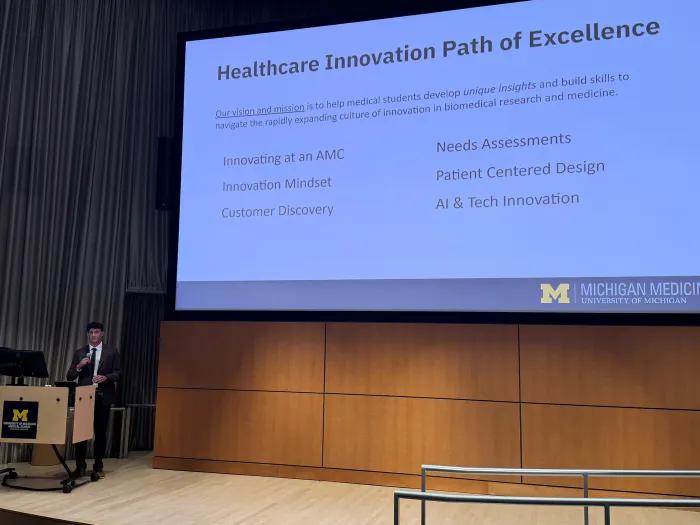
Medical students develop novel technological solutions for unmet patient needs