Path to Medicine: All Gas, No Breaks
Join three University of Michigan medical students who took the direct path from college to medical school as they share their journeys and perspectives
5:00 AM
In this episode of the UMich Med Mosaic podcast, M3 host Mohika Nagpal sits down with a group of dedicated "marathoners"—students who transitioned directly from college to medical school without taking any gap years. She talks with Mary Falstin, an M1 student; Kayla Blaise, an M3 student; and Kallen Schwark, an MSTP student rejoining the medical class.
More Resources
American Medical Association – Medical Student Section (AMA-MSS)
Students for a National Health Program (SNAHP)
U-M Medical Scientist Training Program (MSTP)
Learn more about UMich Med Mosaic and the programs at University of Michigan Medical School
Transcript
Mohika Nagpal:
Hi everyone, and welcome to UMich Med Mosaic, a medical student-run podcast we've created to shine a light on the diverse backgrounds and experiences of our students here in Ann Arbor. I'm Mohika Nagpal, a third-year student here at the University of Michigan Medical School. As one of the social media interns, I'm on this podcast team to help highlight the stories and experiences of my peers. I hope this podcast helps bring our voices together as a student body so that wherever our journeys take us, we're still connected. So whether you've got us on your walk home from clinic, or while you're catching up on the weekend, we're delighted you're here.
Hello everyone and welcome to episode three of UMich Med Mosaic, a podcast by medical students for medical students. This is Mohika, your M3 co-host, and today we're talking to our marathoners, not the running kind, but the kind of people who ran straight through from undergrad to med school, all gas, no breaks. Now I'm not a marathoner, neither the running kind, nor the one who ran straight through from college to medical school, but my guests here today sure are. With me I have Mary Falstin, M1, Kayla Blaise, M3, and Kallen Schwark, MSTP, joining the medical class again. These people went straight through from college to medical school. On the topic of marathoning, I'm curious, have you all hit your marathoning phase yet?
Kayla Blaise:
So I actually will be running the Detroit International Half Marathon this October. So I'm training for it and I want everyone to know I'm not really a runner. Other med students got me involved and here I am.
Mohika Nagpal:
Love that.
Mary Falstin:
I'm also training for the same one, but I'm also kind of on a different marathoning gig. I'm doing the High Rocks too in Chicago, which is a different race that people are now signing up for. Wow. Yeah,
Kallen Schwark:
So I'm not a marathoner, nor will I ever be. As was said in medical school, there is this weird social pressure to start doing marathons, and so when I hear people talking about it, I slowly back away out of the room, out of the conversation. So really not for me.
Mohika Nagpal:
You know what, me too. I feel like I get the urge to run maybe four times a year and half of those are when I'm running late to something. So kudos to you guys, but I'm curious, can you guys start by telling us where you went for undergrad and what college was like?
Mary Falstin:
Yeah, so I went to Washington University in St. Louis, Missouri. College was honestly I think very fun, but also going straight through it took a little bit of the fun away and just made it a little bit more challenging and academically driven. WashU was the kind of school that it's like a feeder school, so a lot of my friends all went straight through. So honestly taking a gap year wasn't something I was exposed to much because most people at my school went straight through. But it was honestly really, it was a good time. I mean, I made some really good friends. I was just in St. Louis two weeks ago, but yeah, a very good time.
Kayla Blaise:
I went to Northwestern University for undergrad outside of Chicago and I thought college was amazing. It was a great experience and I'm from the Midwest, so it was easy for me to come here and stay close by. I'm from Michigan. From what I can remember from a lot of my pre-med friends, a lot of people ended up taking a year or two, and so they weren't really the same marathoners that we're talking about today. So I was different from a lot of them in that respect.
Kallen Schwark:
So I've been in Ann Arbor for 11 years now. I did undergrad at University of Michigan, continued on into the MD-PhD program, so finishing 12 years next year. I remember from high school I was kind of from that academically gifted, but didn't really do much population. So coming into undergrad I was like, okay, I want to be as involved as possible and sign up for a bajillion different things. And then when it came to applying into medical school, I guess I did hear a lot about people taking gap years or not, and it was just like something, it almost felt like I was motivated to just be the best by not taking time off and just keep going. So I was like, no, I'm going to keep going, finish as fast as possible 'cause that's the best option for me right now.
Mohika Nagpal:
Yeah, I hear that. Did you always know that you wanted to go to medical school after college?
Kallen Schwark:
No, I was interested coming in the research aspect of science and life. So I joined the research living community at Michigan. I was pretty invested on doing grad school, like a PhD, and then I don't remember what specifically triggered it, but at some point around the beginning of my sophomore year, I was entertaining the idea of being a doctor more, and then I was mentally having a hard time deciding between the two until someone told me, "Hey, you can do both." And from the moment I heard that I was like, "Oh, that's so much better than deciding." And then as I've matriculated and almost finished the MD-PhD program, it's really about like, I mean, entertaining both in your future career, being both a physician and a scientist and having those two interweave with each other, which was something I was always very excited about.
Mohika Nagpal:
Kayla, what about you?
Kayla Blaise:
I feel like I had a similar thing about the decision-making process, and this is going to sound really weird, but I feel like going to medical school in a way was my second choice. I was thinking that I would decide on something else, and I was like, if I don't decide on anything else, then I guess I'll go to medical school. And then I started thinking if I choose to apply, I don't really have to make any other decisions. You apply to medical school, then you go to medical school. It's four years, the path is laid out, and then you go to residency, that path is laid out and the end of college was approaching, and I had done all of my pre-reqs because I thought there was a chance I might choose to apply to medical school, like I said, as this backup second choice, and I couldn't find anything else that I wanted to do more. And so I sent off that application and now I'm on that same path that I just described.
Mohika Nagpal:
There you go. Sometimes it's nice just to let the natural consequence of things decide. Right. Mary, what was senior year for you?
Mary Falstin:
Oh, undergrad?
Mohika Nagpal:
Yeah.
Mary Falstin:
Honestly, my senior year was pretty laid back, I feel like because when you go straight through, so your first two years are, at least for me, were my hardcore years. And then the summer after my sophomore year, I studied for the MCAT, took the MCAT, and so junior year was just finishing all of the mandatory things I needed to do before applying to medical school. And then the summer after my junior year, I applied to medical school. So my senior year was, honestly, I applied to a lot of medical schools, so I was doing between secondaries, interviews, all that stuff, it was a lot of time, but other than that course load wise, I was chilling. I was having a good time my senior year. So honestly, sometimes I consider that to be my gap year because I feel like I took 12 credits. I was chilling for the majority of my senior year, and it was a good time.
Mohika Nagpal:
Nice. Kallen, what about you? What was senior year of college?
Kallen Schwark:
So I was in the college of engineering here and the senior year of engineering requires the senior design class and then other fourth year courses that you can't do sooner. On top of that, this was me matriculating or interviewing in 2017 to matriculate in 2018, which was pre-COVID, which means that all interviews were in person. And then on top of that, MSTP interviews are typically two days as opposed to the one day of medical school. So applying to MSTPs means that I had to block off two-day blocks for every single interview, which was taking me out of a pretty intensive senior year course load that I couldn't get out of. So senior year was pretty bad, I'm not going to lie.
And as I was going through it, I was like, oh my god, this was maybe not the best choice for me in my specific life situation, but I couldn't have predicted that until going through it. So there were some classes that were pretty attendance heavy, like grades too. I mean the grade senior year didn't really matter, assuming we got in, but there were some grades that dropped heavily because of how many days of classes I was missing. And I'm like, how do you explain that?
Mohika Nagpal:
You live and you learn. Kayla, a question that we get asked a lot, and I know that was on our minds probably is scheduling the MCAT for someone who's going straight through. When did you take your MCAT and had you taken all of your prerequisites by the time you sat for the test?
Kayla Blaise:
Yeah, this is a great question. So Northwestern is on the quarter system, so we get the opportunity to take a couple more classes than I think is typically offered at other universities. So at that point in time, I had finished all of my required courses, however, I was a COVID kid, and so biochemistry I took the first quarter, I took it, it started in March 2020, and my professor, he tried his best, but he didn't know how to use Zoom yet. He didn't know how to click his slide. So I technically took the course, but I don't feel like I really had a great understanding of it or as much as I wanted to. So I had to do a lot of self-studying in terms of preparation for that for the MCAT. Similar to Mary, I did take the MCAT the summer in between my sophomore and junior year.
It was COVID, so I was just otherwise at home, I wasn't doing any research with an internship or anything like that because everything was shut down. I did work a job that was online, so I found I was possible to balance both the MCAT and actually working. And that was for the University of Michigan, one of their pre-med camps for people who were actually in high school, which was very cute.
Mohika Nagpal:
Nice.
Kayla Blaise:
But overall, I would say the timing worked out for me to do it in the summer when you aren't actively taking classes.
Mohika Nagpal:
Sure, that makes a lot of sense. And then Mary, what was MCAT prep and coursework like for you?
Mary Falstin:
Yeah, so I did take the majority of my prerequisites beforehand except psychology related classes. I took those after. I think it's much easier to self-study psychology 'cause a lot of it is root memorization. I think in terms of studying for the MCAT and when you want to take it, there's several different strategies and plans you can create for yourself. So I actually took it two times and I voided my second score because I was so scared I wasn't going to do better. I sat for the whole exam and then I was just like void because I was really scared. And so it depends, but taking my first MCAT after the summer of my sophomore year allowed me that time, so I took my second MCAT the March of my junior year. So having that timeline, taking it first after my sophomore year gave me opportunity to take it again if I really wanted to.
And honestly studying it for the second time around, I know you mentioned the summer, it was really nice because you just have dedicated time, but honestly, when I studied for it in the spring, it felt easier to get myself to study for it because everyone's studying for their own things and I feel like whereas in the summer you're giving up on a lot of beach, vacation time, all that stuff, and you're having to say no a lot because you're like, I need to study. Whereas during the semester people are studying. It's for different things obviously, and could be more intensive, less intensive, but it was just easier to just be like, okay, I'm going to just go and study my MCAT or my friend studies, I don't know, whatever biochem or something.
Mohika Nagpal:
Yeah.
Mary Falstin:
Yeah.
Mohika Nagpal:
I so appreciate you sharing that you sat for a second time. I feel like a lot of people who are in that boat feel very vulnerable about not being happy with their first score or have a lot of insecurities about sitting for it a second time. And I hope that the people who are listening to this today know that it is not the end of the world to ask for a second chance and you still can get into a wonderful program where you belong even if you've taken the MCAT twice. I'm also a two-time taker, so I appreciate you sharing that and I hope that people feel encouraged after hearing that, so thanks for sharing. I'm curious, did you guys have backup plans, like if med school didn't work out, what was plan B, Kallen?
Kallen Schwark:
So it's funny, something I learned on the interview trail for the MSTP programs is that roughly 40 to 50% of the applicants were currently doing a Postbac research training program at the NIH. Like you literally pull a room of 12 applicants and five of them were in Baltimore. And I was like, is this just something everyone does before doing an MSTP? At the beginning, I mean obviously I was committed to applying straight through, but then I mean getting into it a little bit later maybe, but towards the end of the interview cycle where acceptances were going out to other people and I hadn't received them yet, I was like, I remember opening the website to apply for the NIH Postbac training program. Like, all right, this is what I have to do, I guess sign me up.
Mohika Nagpal:
It's a candid event.
Kallen Schwark:
But then it ended up working out good.
Mohika Nagpal:
Mary, what about you?
Mary Falstin:
My family's a family of immigrants. I immigrated to America. I was born in Egypt and then immigrated when I was about seven. And so growing up it was always like, you're going to be one of the trio, doctor, lawyer, engineer. And so I was never interested in engineering. Math was not, physics not my strong suit, and I was actually always really, really interested in law. And so in undergrad I did a lot related to policy and took a lot, like I minored in legal studies and then my second major was in educational studies, so I was really interested in education and academia, and so I honestly didn't have a backup plan, but I definitely did during my time in undergrad explore other avenues and I felt like choosing medical school would allow me to actually intertwine a lot of those different interests. And so it just all worked out for me that way. But yeah, I wouldn't say I had a strict backup plan.
Mohika Nagpal:
Sure. That makes a lot of sense. Speaking of academia, I'm curious, what has the preclinical year or M1 year been like for you? Do you find that any study strategies that you employed as a college student has stayed the same or changed in studying for medical school?
Mary Falstin:
Yeah, I definitely think in terms of study strategies, I think it was much easier for me to just get back into the flow of studying, whereas a lot of my friends, majority of people in the class have taken at least one or two gap years, and so looking at some of my other friends, it was much harder for them to get back into the flow of studying. And so I think that was definitely beneficial, going straight through. I didn't have to completely... It was all gas, no breaks because I just was always studying throughout and so I never had fully put a pause there. M1, I really honestly, I think this is a big kudos to Michigan. I think the M1 curriculum is like no other, doesn't compare to any other schools, and that's actually why I chose to come to Michigan. And I think it's definitely living up to its hype and expectations.
I think there's a lot of flexibility, which I really appreciate in the M1 curriculum, and you can pick and choose what study strategies you want, and there's a lot of opportunities to start something, start studying in a specific way and then if it doesn't work out, you're able to change it. There's a lot of opportunities in the curriculum for you to do that. So yeah, I really appreciate the curriculum for that, but I think definitely going straight through helped with that.
Mohika Nagpal:
That's cool.
Mary Falstin:
Yeah.
Mohika Nagpal:
Kayla, you and I are a few years out from that, but now looking back, do you feel like you changed as a student between undergrad and medical school and are there any specific things that helped you in M1 year?
Kayla Blaise:
I feel like the University of Michigan curriculum changed during COVID to be more adaptable and flexible, which is what Mary was talking about. M1 year, the majority of our lectures, at least for us, they were recorded, and so you could watch them at any time on your own schedule, at your own pacing. I think it has its pros and cons for me. I'm somebody who I love to show up to lecture. I wasn't somebody who would skip, I'd show up, I'd do my work from 9:00 to 12:00 or whenever you told me I needed to be there and then I would go home and that worked for me.
And so having this freedom to watch lectures on my own is really great for some people. For me it's tougher because if my phone's in the room and you're not looking at me, then I'm going to be on my phone or I'm going to see somebody text me or an Instagram notification, something like that. Some of the professors here at Michigan I guess are like-minded to me and will say, "Hey, I'm going to just go to a lecture hall and play my lectures. If you raise your hand, I'll pause it and you guys can ask questions and I'll answer."
So I would show up to those. Those were great for me. And so that kind of hybrid aspect was really special for me. But I do love the flexibility that comes with the University of Michigan lecture style. Like I said, I loved my time in undergrad. I still have so many friends who are there, so I was able to go visit them and then be able to do my lectures at the same time too. So the flexibility is really unmatched I feel. But if your learning style is more like mine, it can be sometimes difficult.
Mohika Nagpal:
Yeah, I think you have to learn how to relearn sometimes, but echoing what you both said, I love that every couple of weeks or months you're able to pivot if you need to change something.
Mary Falstin:
Yeah, absolutely.
Mohika Nagpal:
That's awesome. So I'm curious if any of you ever wished you had taken a break before medical school and if so, why?
Kallen Schwark:
I think that it's like a bunch of competing interests because like I was saying my senior year was pretty bad, and I think that had I offloaded it even by one year, I would've been able to get through the rigor of the biomedical engineering undergrad degree and then not even really gained that much life experience because by the time I'd be graduated, I'd be submitting the primary app, but just to not have to worry about all of that and then applying maybe could have been for the best.
On the other hand, the MSCP is an eight-year program minimum. So one of the things that they talk about when you're deciding to apply is you're signing up for eight years, maybe you just want to get in just as soon as you can so you can get out as soon as you can. So you're not applying for your first real job at age 40. So it was hard to make that decision, I think. Yeah, I think I could have taken more time off and it would've been easier. I would've been one to two years older. I don't think it truly would've mattered, honestly.
Mohika Nagpal:
Fair enough. Kayla?
Kayla Blaise:
I think about this question probably every day. Should I have taken a gap year? Yes or no? The reason why I didn't was because I knew if I took a year off, I was probably going to love whatever I was doing and just stay in it. And I was thinking, Kayla, if you actually want to apply to med school, it's now or never for me personally, and that's not everybody's decision. So that's why I went straight through. I do see some of the other peers in my class and I wonder if they're just a little bit more grown-up than I am or if that's just a sneaky thought that's in the back of my head that really doesn't matter because ultimately it is for a lot of people, only one or two years different. And like Kallen said, how much growing up can you really do in that time?
I do think it would've been nice though to have sat and had a real job or a research position or something like that instead of feeling like I've been a student for the past, what is it, we're entering 20th grade now, something like that. And it's like, I've never experienced life not as a student except for the summers. And even then you still feel like a student pretty much too. So ultimately, yeah, I think it's up to every person to know yourself. If you met me, you would probably describe me as all gas, no breaks anyways. And that's what my mom is always saying, that I put too much on my plate. So for me, it made sense to keep going, but if you want to take that time to enjoy life or do something different or explore another career path before applying to medical school, that's super common at the University of Michigan. I think in my class, only 10% of us chose to go straight through.
Mohika Nagpal:
I think that's right. Yeah. What I'm hearing too, from all you guys is that what's right for one person might not be right for another person, and there's not one right choice even for one single person. Whether you choose to go straight through or whether you choose to take some time off, there are going to be pros and cons to that. In the grand scheme of things, if you want to go to medical school, whether that's this year or next year or the year after that, you can still do it. Everyone's journey is just a little bit different. So Kayla, I want to touch back on something that you were talking about. This thought in the back of your mind about whether some of your classmates who did take gap years maybe have that extra life experience. Do you guys feel like there has been anything throughout med school, extracurricular wise that has helped you with that maturity and with that progression?
Kayla Blaise:
I would say for me a couple of things. So the thing about medical school and when you complete your rotations and you actually are there on clerkships, it really grows you up a lot. You face a lot of sobering realities, a lot of tough situations. You see things that very few people in the world have seen before and sometimes it's really hard and I am happy. We do have training in here in how to support patients and be there for people, but that training is not the same as actually doing it. So that forces you to grow up a little bit in some respects. And then secondly, I think it also depends on the activities that you involve yourself in, like you mentioned.
One of the things that I'm happy and proud to be a part of is SNAP, which is students for a national healthcare program, and that is an organization where we work to actually improve access to healthcare for people living in America. And so you learn about the health and the medicine and how to treat people, but making sure that people actually have access to that care and learning what it looks like when people don't or when doctors don't know how to help them get that access is also another thing that I think has really matured me and shown me a lot of what the real world and what life is like outside of being a student at a university where you're kind of a protected group because you're a student that belongs to something else.
Mohika Nagpal:
Totally.
Mary Falstin:
Yeah, I definitely, I'll piggyback off of what Kayla said. I'm also involved in students for a national health program, and I think that in combination with AMA, which is the American Medical Association, being able to write policies or resolutions that could later become policies and then having these meetings with a million different doctors across the country and really hearing what the climate and the current state of healthcare is and being able to have a tangible impact on it, I think makes you grow up a lot.
I obviously haven't gotten to that clinical stage yet, so I can't speak much to that. But I think things like that and the free clinic, and when you go in the free clinic, you're really providing care for patients and they're relying on you as a medical student. And so a lot of these different extracurriculars definitely help. I will say that I think no matter what you do, you may still, I mean, at least for me, we're almost done with M1 year and there are still so many times where I'm like, "Wow, I'm such a baby in my class," or I don't have a lot of the life experiences that maybe other people have.
They took six years off and were nurses or PAs or something before that. And I think you see that very clearly when you're doing lectures and someone who literally knows everything inside and out and you're like, did I miss something? But I think just getting involved in these extracurricular activities that immerse you in the real world healthcare space as early as possible. At least so far for me, that's what's helped me grow up a little bit.
Kallen Schwark:
One of the things that I think I touched on earlier, like being really anxious when I was 22 in my clinical year, and even at the end I still felt relatively immature, and then I went away for four years and I came back, I did a little two-week clinical rotation right after finishing my PhD and everything just felt so much more comfortable. I was much more at ease seeing patients independently, presenting to attendings, and the evaluations I got for that two weeks were leaks better than what attendings were saying about me before the PhD. So in some ways, the PhD almost functioned as four gap years for the experience of medical school.
Mohika Nagpal:
Well, it's like exercising a muscle. It's like when you take that recovery or take that break from exercising that muscle and you come back to it, you're able to do more and it feels more intuitive.
Kallen Schwark:
And it was a lot easier than I thought it would be because they're like, "Oh my God, four years. Are you even going to remember how to talk to someone and take a history?"
Mohika Nagpal:
This is a patient.
Kallen Schwark:
Short answer is yes. And I think Michigan does a pretty good job of introducing you to clinical things during your PhD so that you don't completely forget.
Mohika Nagpal:
Thinking ahead about what the next chapter of life looks like, what does everyone want to match into?
Kallen Schwark:
So I am looking into physician scientist training programs or PSDPs, which is essentially the continuation of an MSTP where once you have your MD and PhD, you apply for a residency that has protected time for research training and your postdoctoral fellowship. They're obviously more selective, just like MSTP was more selective than medical school, but it's something that we're encouraged to sign up for in this physician scientist pipeline. I'm interested in pathology. I experienced my clinical year five, six years ago when I was 22, and I was pretty nervous the whole time. And even when I wasn't nervous, when I was working with really good teams, I was like, I'm seeing other people around me enjoy patient care and I'm not. Then on reflection, that one week of pathology that we get in the surgery block, I'm like, oh, wait, let's roll back to that. Looking at the slides, talking to other doctors, looking at microscopes, thinking about stuff on a microscopic level. That all was really cool. And I'm on a neuropathology rotation right now and I am very much enjoying it. So looking towards research residencies with a neuropathology fellowship after.
Kayla Blaise:
That is so cool.
Kallen Schwark:
Brain tumors all the way.
Kayla Blaise:
I love that for you, Kallen. That's so exciting. I am actually, one of my friends is applying to medical school right now, and so to help him out, I was reading through some of my essays that I wrote when I was applying and I wrote all about psychiatry and how I was interested in psych and I was a psych major and how way I knew mental health was for me.
Mohika Nagpal:
No way.
Kayla Blaise:
And Mohika is saying no way, because right now we're both OBGYN sisters. I love OBGYN, and ultimately there is a lot of psychology and psychiatry and mental health care within OB because people, it's like can be the best day of their life or one of the tougher days of their life. So there's definitely psych in it, but I just came from an OBGYN clinic. I had the best time I was chatting with all the doctors. Right now, the decision for me is really if I want to apply to a fellowship, which one am I thinking about? But I know I'll be applying in OB this fall for sure.
Mohika Nagpal:
I wish we could see how both of your faces lit up when you just talked about what you're interested in.
Mary Falstin:
I know.
Mohika Nagpal:
Because that's how, and I feel my own heart rate increasing right now, 'cause I'm like yes, yes, yes to everything that you're saying. That is so exciting. Mary, what about you? I know you're early on, but what do you want to be when you grow up?
Mary Falstin:
I'm a little baby in this stage right now, but I think I'm just interested in a lot of things. And I think for me, I'm getting to a point where I need to start thinking about lifestyle. Growing up I was like, "Oh my gosh, I want to be a neurosurgeon," but I feel like lifestyle wise, that's not what I want for my future. And so I'm more leaning towards OBGYN actually. I know. EM or oncology. So I think next year will be very telling once we get, so for those who don't know, M2 is our core clerkship year where you rotate through a bunch of different specialties and then you're able to more clearly see maybe what you want to do in the future. So I think M2 year, so next year will be very telling for me just to see the lifestyle and to maybe have those aha moments and be like, "Oh, I love patient care." But I definitely do think I like patient care and the longitudinal aspect of care and follow up and stuff. So we'll see.
Kayla Blaise:
For me, it was also finding out what things you don't want to do. So sometimes you have an aha moment that's like, this is the best thing ever. And that's how I felt about OB. But I kept waiting on psych to have that aha moment. I was like, actually, this just isn't for me. It's not the same.
Mary Falstin:
I know. I think that's why I'm excited to, although it sometimes is a little frustrating 'cause I feel like everyone around me knows exactly what they want to do, I just am like, you guys are shaking your heads.
Kayla Blaise:
They're gonna change their minds. You would've thought I would've been a psychiatrist and I knew it by M1 year.
Mary Falstin:
No, I know. I'm just like, I think about that and I'm just like, I'm actually happy that I am all over the place and I have a lot of different interests because I don't want to go into one rotation waiting for that aha moment. I want it to come to me. I want to be like, "Wow, I actually just really enjoyed that." And then just pursue that more and not be miserable on the million other rotations that we have.
Kayla Blaise:
Totally.
Mary Falstin:
Yeah, I'm excited for that.
Kallen Schwark:
And then quick plug for the MSTP thing. So in the setting of the traditional MSTP timeline, you do your clinical year and then you go away and do your entire PhD, which is what I did. So I had four years to marinate on my experiences in the clinical year, and I ended up, so my PhD was working with pediatric gliomas with Carl Cushman. So at the beginning of my PhD. I was not thinking brain tumors, I was thinking some kind of cancer. I kind of ended up with him because he's a wonderful person to work with. But then just, I told someone the other day I like drinking the brain tumor Kool-Aid for four years 'cause I went to neuro-oncology conferences.
He assigned me to do research autopsies in the lab where I was literally cutting patient brains on a regular basis. So then this exposure was being like spoon-fed to me, and then I was like, okay, no, actually I would like to stay with brain tumors for, I just think in terms of research interest, obviously not having one, but just all the things you can study are just, I find the brain more interesting than other organs and I find cancer very interesting. So having that time to really think about what I wanted to do was nice, having the clinical year before PhD.
Mohika Nagpal:
Yeah, I like the idea of having some time to think about and soak up those aha moments from clinical year. I think about a third of our class ends up taking at least one LOA year, whether that's doing research, getting another degree, whatever that looks like. And I do think it gives people that time to process all of their clinical year experiences and it's, to help you feel better, Mary, I think just now in our M3 year, Kallen, I have noticed our classmates picking the one thing for them. So there's plenty of time to decide. My last question for you all today is what's a piece of advice you'd want to give someone who is thinking about going all gas, no brakes?
Mary Falstin:
I think for me, honestly, this is a motto I live by. It's never that serious. It'll get done. Things always fall into place. And I think a big thing too is don't compare yourself to other people. Really find your journey, your path, what works for you. For me, the reason why I didn't take a gap year was also because my parents are a little bit older and I've always wanted them to see me become a doctor, get my degree, get married, have kids. And so for me, that timeline was a little bit expedited than most people. And so that's why no gap year made sense for me. And so I just find what works for you.
Kayla Blaise:
Yeah, I would say a couple of things. The first being, I think you should sit down and pretend like being a doctor doesn't exist, and what other career would you go into and really think about that and consider that and think if it would make you happy. And if you then invite the idea of being a doctor back into your mind and you're like, "No, this is still what I'd rather do and I'd want to do it now," then go for it. Just go for it. And at the same time, there are lots of people in our class who had to apply to medical school a couple of times before they got in, and that's also super valid. So when you come to that realization, if you know that you want to be a doctor, and as we said, you might not even know what kind of doctor you want to be yet, but you know that medicine, you know that patients, that investigations and things like that are for you, then I would say go for it.
Mohika Nagpal:
I love that. Well, I want to thank all of you for being such wonderful guests. It's so inspiring to have people like you guys as my peers. I'm very inspired by you. I'm very proud of you, and I'm very grateful that I got to go to school with marathoners like you guys. So thank you for taking the time today. Thank you for listening to this episode of the UMich Med Mosaic Podcast. Once again, this is Mohika Nagpal and I am signing off for the day. We'll see you next time.
If you love today's conversation, share it with a friend. If you are a Michigan medical student and are interested in being a future guest, check out the class pages on Slack for open calls for episodes. UMich Med Mosaic is produced by the Michigan Medicine Department of Communication, in partnership by the University of Michigan Medical School. Find us and subscribe wherever you listen to podcasts. Thanks for listening, and we'll see you soon.

UMich Med Mosaic
Listen to more UMich Med Mosaic podcasts - a part of the Michigan Medicine Podcast Network.
Featured News & Stories
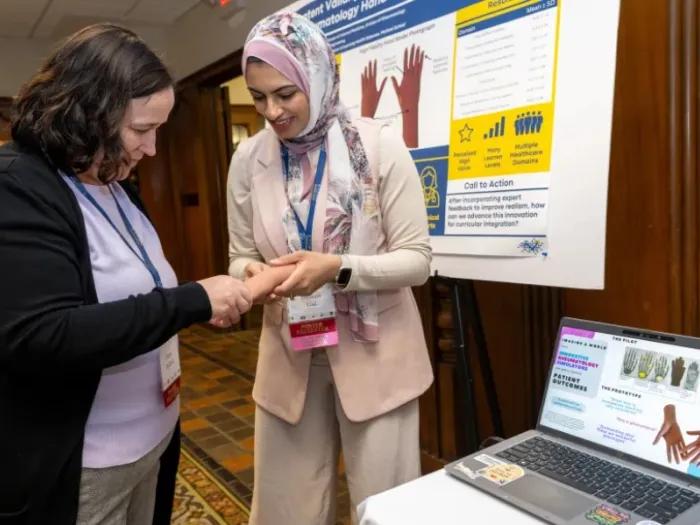
Rethinking how clinicians learn to feel disease
College of Pharmacy alum advances U-M Medical School addiction research
Rethinking care: How ‘de-implementation’ can improve quality and reduce burnout
The Questions That Shape the Future of Medicine
Medical students develop novel technological solutions for unmet patient needs