Beyond the White Coat: Navigating Love in Med School
Meet four medical students – two couples – who are learning to thrive in both their studies and their partnerships at the University of Michigan Medical School
2:00 PM
In this episode, host Mohika Nagpal chats with medical student couples Ava Harb & Piroz Bahar and Cyndi Edelman & Austin Cornish about balancing relationships, academics and clinical rotations at the University of Michigan Medical School. They share how teamwork, communication and little routines help them navigate the demands of med school together. The conversation covers challenges like couples matching for residency and finding time for favorite Ann Arbor date spots.
Transcript
Mohika Nagpal:
Hi, everyone, and welcome to UMich Med Mosaic, a medical student-run podcast we've created to shine a light on the diverse backgrounds and experiences of our students here in Ann Arbor.
I'm Mohika Nagpal. As one of the social media interns, I'm on this podcast team to help highlight the stories and experiences of my peers to life. I hope this podcast helps bring our voices together as a student body so that wherever our journeys take us, we're still connected. So whether you've got us on your walk home from clinic or while you're catching up on the weekend, we're delighted you're here.
Hi, everyone, and welcome to episode two of UMich Med Mosaic. Love is in the air this Valentine's Day season, and today we're talking about balancing relationships, love and dating in medical school. From finding romance in the lecture halls to finding a heart in the anatomy lab, our guests today can hopefully shine a light on how they have actually made it all work.
Today, I'm joined by Ava Harb and Piroz Bahar, who recently just got engaged, and Cyndi Edelman and Austin Cornish. Welcome, you guys.
Ava Harb:
Thanks so much for having us.
Piroz Bahar:
Thank you, Mohika. We're excited to be here.
Mohika Nagpal:
Excited to talk about each other and hear about you guys. It's so fun. This is like the double date of the year. I'm very excited to be your fifth wheel. So of course, my very first question for you all is how did you meet? I'm curious if you came into medical school together or found each other here.
Piroz Bahar:
So Ava and I met at camp, which is the pre-orientation trip for the M1s. And we were not on the same camping trip, but we did overlap camping sites. And so I remember Ava and I got to hang out in the docks on one of the evenings and just started talking about life and found that we had a lot of things in common in terms of upbringing and family life. And we're both Persian, and so I think that was a nice way for us to connect. And we initially weren't...
Ava Harb:
We weren't super close at first. Actually, we live in the same building, and we have since. M1 year and his roommates at the time, who are still some of our closest friends, I was much closer with them, and I lived alone, and I was just looking for anyone to hang out with the first few months of M1 year. And I remember Piroz was very standoffish, and I thought he thought I was weird for sure because I can definitely be very loud.
And I think just over the next four months, getting to know him more as a person and seeing your silly side, and we're different on the outside, but we have a lot in common on the inside, and I think discovering that was a lot of fun. But ultimately when I met you, I thought you were a really special person.
Piroz Bahar:
You too.
Ava Harb:
I just thought for sure you would be someone I would be really close with.
Mohika Nagpal:
This seems like the type of thing that's going to play at your wedding. I'm not going to lie. What about you guys? How did you guys meet?
Austin Cornish:
Well, honestly, I'm really glad you guys went first because that brought back a lot of memories for myself. Cyndi's typically the one with a better memory, but she told me I was the one to take this question.
So stereotypically, it all started at SecondLook at Michigan, otherwise known as SL@M. And when I walked in, she was actually the first person I met that wasn't my roommate, but it didn't really start there. There was a lot of coincidences that played out over the next four or five months that just put us in proximity. So for example, at SL@M, we were in a lot of the same sessions together. And then over the course of the summer, we found out that we were actually neighbors, two doors down from each other in the same apartment complex.
Cyndi Edelman:
We couldn't escape running into each other. So we were like, "Well, might as well at least be friends, so."
Austin Cornish:
We also found out that we had a lot of same interests. One of those was not cooking, but I found out pretty fast that she was a great teacher and cook herself, so we did a little bit of that over the summer to prepare me for meal prepping for weeks on end in medical school. And then similarly to you guys over camp, we, and a couple other friends, actually tried to be in the same group together, but-
Cyndi Edelman:
That failed, I think.
Austin Cornish:
That failed. We actually got split up intentionally for that reason, but we were still able to bond over that summer. And then we grew closer over the course of M1 year, having a lot of flexibility, being able to do a lot of things together, and here we are.
Mohika Nagpal:
That is so sweet. I'm curious if either of you couples had any thoughts about dating within the same academic field before you met each other.
Piroz Bahar:
Yeah. I think when Ava says I was a little standoffish, I think maybe that's where that initial hesitance came from because our medical school is such a close-knit community. And while I wasn't hesitant in any way to date somebody in medicine, certainly amongst our own community I realized that if I were to date somebody, I'd want to make sure that was handled professionally and appropriately so that everybody could maintain friendships. And so I always was enamored by Ava. I thought she was an incredible person, and so I felt like I needed to be a little careful. But as I got to know Ava more, that made me want to ultimately start dating and ask her out and make that jump.
Ava Harb:
That's so sweet.
Piroz Bahar:
And so that's why I was initially hesitant, but I'm really glad that we ultimately ended up together.
Mohika Nagpal:
What about you guys? Any thoughts on dating within medicine versus not wanting to initially?
Cyndi Edelman:
Yeah. So I think coming into medical school, I was like, absolutely not. I am not going to date one of my classmates. I'm definitely not going to date a doctor. I 100% convinced myself that that wasn't going to happen. And then before I even made it to med school, I met Austin at orientation, so that was awkward.
But I think after meeting Austin and I had made up all these reasons why I thought dating somebody in medicine wouldn't be a good idea, but I think I was just, I guess, scared of a narrow dating pool and the similar thing of like, oh, well, I'm only going to be interacting with my classmates, so what if something happens and then it totally blows up? I didn't want to take that chance or ruin any friendships.
But I think after meeting Austin, I was like, oh, he actually relates to me on a lot of different levels and understands this whole crazy process that medical school is and being in the field of medicine, and that was more comforting than I expected it to be. I thought I would need a fresh perspective or somebody to come home to that I wouldn't have to talk about school with. But honestly, I think it makes me feel a lot better knowing that he understands, has that similar experience and we can talk about things at home and I don't have to overexplain. He just automatically is on the same level and gets what I'm talking about, so.
Mohika Nagpal:
That's so wonderful to hear you guys. And that's actually a perfect segue into the next part about how you all have kept your relationships cooking throughout medical school.
So Ava and Piroz, go back in time to M1 year for me. Can we talk a little bit about how you guys decided to spend time with each other? Were there discussions about clear boundaries between schoolwork and relationship time or did you just take it as it came? Tell me what M1 year looked like for you guys.
Ava Harb:
I think one of the strengths that Piroz and I have had throughout our relationship probably is the fact that we're both interpersonally competitive and neither of us are competitive with other people. And for me, I didn't necessarily have any doubts against dating someone in medicine, but I just wanted to be with someone that saw us as little seedlings, and I just wanted to grow with someone, bud and blossom into my full potential and meet someone that wanted to do the same and have that mutual inspiration to just be the best version of ourselves every day. So I think that has been the fuel for our fire the last three years, and I think that's probably what did it.
Piroz also took every quiz on Friday, and I am the world's slowest studier, and I'm proud of that. But I would literally be at the library till 11:00 PM Saturday. Sometimes if we had plans, I'd be taking it Sunday night, and he would literally come to the library with me and do work and do research. And now you have a ton of pubs, so it was totally worth your while, but I'm sure just the give and take of being in a relationship because we're all different, we have different strengths and weaknesses, but I don't know, I think we just tried to meet each other all the time however we can, which I always appreciate.
Mohika Nagpal:
We love a built-in study buddy. Austin and Cyndi, you guys are second-year medical students right now, which is our primary clinical rotation year. Tell me how you guys are navigating being on rotations while being in a relationship with each other. Are there any rules, rituals, or habits that you have to stay connected to each other with a really busy schedule?
Austin Cornish:
Yeah. It's a tough question because I really haven't had a ton of time to reflect on these things. As we're about three or four months in at this point, we've been through surgery so far together and now we're on pediatrics. We chose the same schedule intentionally so that we would understand what each other are going through, like you guys were saying.
And honestly, that's been really helpful so that we're able to inform each other of what's coming up next because within a rotation, there's different segments. So for example, in surgery, there's a section where you're just, it's more of a study period and you have more time, and then there's the actual you're in the OR every day type period. And so when we were on those different things, we're able to inform each other of what was coming up next.
And in those busy periods when we're both not in those flexible study periods, it's a type of decompression when you come home and can discuss the challenges together. And then when we're not on those challenging parts together, when one person's on the flexible part and one person's on the challenging part, we're able to drive each other into work, which is really nice in the winter. It's one of those small pluses.
Ava Harb:
We can relate to that, for sure. We definitely did that, mostly him.
Cyndi Edelman:
I would wake up in the morning and he would already have coffee made for me when I'm going to round-
Ava Harb:
That's awesome.
Cyndi Edelman:
...at 5:00 AM and I can't stomach a breakfast, but I can stomach coffee. So he'd have a coffee made, and I was like, wow, this is the best thing ever. And then when it was his turn to go in early and round, I would crawl out of bed, drive him to the hospital, and then crawl back into bed and sleep a few more hours. But it was a nice way to just give and take responsibility, and I felt like it kept us balanced. At least mentally, we had somebody to have our back and do the small things for us, which really helped get our day started.
Austin Cornish:
I totally agree. When you're really busy, it's about the small things. I take inspiration from a medical school triathlete at, of all places, Ohio State University.
Cyndi Edelman:
Boo.
Mohika Nagpal:
Why?
Cyndi Edelman:
We like him though.
Austin Cornish:
His name's Matthew Marquardt, a world champion triathlete and also a medical student. And so, and he also has a partner in medicine, and he's still able to pull through with the small things like packing a lunch, making coffee, so I take inspiration.
Mohika Nagpal:
That's really sweet. So this is wonderful. And it sounds like some of the best parts about having your partner around include the driving, the coffee, the study buddies, which is great. But you guys are also classmates with your respective partners. What does it look like to be classmates with your partner and does it ever get exhausting to be talking about the hospital or your classes when you get home from work? What does that look like for you guys?
Piroz Bahar:
Yeah, I think that's something we think about and reflect on. We sometimes say we don't want to be one-dimensional individuals. Of course, we're so grateful to be in medical school and thankful for the opportunities that it provides, but there are some times when I'll have had a busy day at work or a hard day and I go home and I don't even talk about it at all just because I'm excited to be with Ava and I'm grateful to hang out with her. And now she's in the MBA, I'm excited to hear about what she's doing. And so it's interesting. Sometimes I think, because I ask a lot of questions in class, I'm on student council, I wonder what Ava's perspective of me is in a lecture hall when I'm asking questions, but I think we have that natural separation and try to be multifaceted people.
Ava Harb:
Just quickly to add on to that, I think it's been nice having him in my class because I like how the medical school creates this fluid male-female friendship dynamic, and so having a lot of the same friends has been really fun. It's like a big party all the time, if you think studying is partying.
But I don't know. I think we make a rule. If it's been a really hard week for both of us and we both have been complaining a little bit, of course, I actually love medical school and I think Michigan has some of the best people I've ever met in my life, and I'm so grateful to be here, but there are days that are hard, but sometimes it makes it harder when you talk about it at home. And so we'll talk about it for five minutes, and sometimes we'll be like, okay, we need to just... We can't. There's no benefit to talking about this. And I think it makes it better to segue into some random conversation about, I don't know, some Instagram Reel one of us saw that was funny or, I don't know, we watch Sex in the City. That's a good distractor.
Mohika Nagpal:
What about you guys? What does it feel like to be peers and partners?
Cyndi Edelman:
It doesn't feel difficult because I think it feels natural. I think that the reason why Austin and I get along is because we have similar interests. We're both in medicine, but also we have a lot of different interests.
So I think that for Austin, he started this Endurance Club, which is a endurance sport club at the medical school, and we've made a lot of friends through that. Even though I tried running, I really didn't like it. I did a half-marathon. I was like, okay, check the box. I don't want to touch running ever again. But then here I am supporting him at his Iron Mans and his Boston qualifying marathons and all of these other crazy med students that are doing the same things.
And I love going to his club events and going to races and hanging out with all these people because they're different than me in the way that they love doing those sports. But I think it's so fun to be able to meet people that are doing different things, and being in a relationship with him and supporting the things that he cares about makes me talk to more people and puts me in all these different situations, and I think that's really, really fun.
So outside of just being classmates, I think that the medical school offers so many different opportunities like clubs and extracurricular things where you get to be a person outside of being a student. And I think that's been one of my favorite things is learning more about the things he loves and then meeting other people who also love those things and getting their perspectives on those. It's really, really, really fun, so.
Austin Cornish:
That was super sweet. I have nothing to add.
Mohika Nagpal:
Aww. Are there any challenges that you guys would like to shed some light on?
Piroz Bahar:
I think one challenge is because we're so close to the experience and we know what the other person's going through so much, I think that any challenges Ava has, I also feel that. And I'm sure that people that aren't in medicine or who are both not in medical school together feel that too, but I think the closeness with which we understand the other person's experiences creates a higher sense of empathy or maybe responsibility for the other person's experience too.
And I think a challenge that we've come to learn is that if the other person is having an experience, it's okay for it to be their experience and not necessarily to have to internalize that on yourself. When I'm on a sub-I and I'm really tired and exhausted and Ava knows what that's like to go through, she can also understand that it's a temporary experience for me and doesn't have to necessarily feel that all herself.
Ava Harb:
I think another thing that's been tough is when our schedules are different and they're both really busy, it's like who's going to cook, really basic stuff. And I don't love cooking, to be honest, and I don't think Piroz does either, but we're both mediocre chefs, at best. But a challenge I recently discovered was that my cholesterol is much higher than it was last year, and I can't blame someone else. It's ultimately up to me to take care of my health and stuff, but I think it's a team effort when you're with someone for so long where you start having basically every dinner with them, I think good communication and being on the same page about a lot of things is helpful.
I love working out. I'm a runner, but I'm not a marathon runner, so I'm super impressed by both of you guys for even... Doing a half-marathon's huge. I'm too scared to do it. I think my hips would fall off, but-
Cyndi Edelman:
Mine almost did.
Ava Harb:
It feels like it sometimes. But Piroz and I go to the gym together every day, even if it's really late, and then we're okay with a mediocre dinner if it's a little bit healthier than I was doing takeout tacos three times a week for a good solid month before I got my cholesterol. So, yeah. Ultimately, if you're willing to talk through it, I think challenges can be a good thing. It's like a little hurdle you can just get over and move on to the next one.
Mohika Nagpal:
Fair enough. So on the note of tacos, I'm curious, what are y'all's favorite Ann Arbor date spots?
Piroz Bahar:
We really like Peridot, which is a Vietnamese restaurant near Main Street.
Ava Harb:
Yes, so good.
Piroz Bahar:
We just went for our three-year anniversary earlier this month, and that was really fun.
Mohika Nagpal:
Nice. What about you guys?
Austin Cornish:
We actually just went to attend a jazz concert that one of our friends was performing at at the Blue LLama. I have been here since undergrad, so this is my seventh year in Ann Arbor, and I've seen Blue LLama. I've walked past it so many times, and we just recently went. And I've got to say, that's probably one of my new favorite date spots. It was a great vibe, great food and great entertainment.
Cyndi Edelman:
We also are suckers for Blank Slate ice cream. We will make any excuse. If we're even in the vicinity of that area of downtown, we're like, well, I mean, we have to go. It's ice cream, and it doesn't matter if it's zero degrees outside, we'll literally run to go get ice cream there, so.
Austin Cornish:
And don't forget the dates that Blank Slate does $10 fill any vessel with ice cream.
Ava Harb:
Oh, yeah.
Austin Cornish:
And so-
Ava Harb:
I saw that.
Mohika Nagpal:
It's coming up.
Austin Cornish:
Yeah.
Ava Harb:
The 18th. I know.
Mohika Nagpal:
I will be there.
Ava Harb:
I marked it in my calendar.
Austin Cornish:
It's in my calendar as well.
Ava Harb:
I'm actually excited.
Mohika Nagpal:
It'll be a double date, it sounds like.
Ava Harb:
I'm going to fill my Stanley with the Lavender Lemon Honey. It's my favorite.
Mohika Nagpal:
That's awesome. Well, I'll have to keep some notes there. Let's talk a little bit about what's coming up next on the horizon. So Piroz, you're applying to residency right now. Ava, you're getting your MBA this year. What do the conversations look like for couples who are applying into residency right now, and what do the conversations look like for you guys as you're on the tail end of this process?
Piroz Bahar:
I think that we all know what's at the end of medical school. And so I think when you start dating somebody in medicine that's always in the back of your mind. You're wondering to yourself, are we going to couples match, are we going to be at that place in our relationship? I think fortunately Ava and I started dating early on in medical school, and I think after about a year and a half, two years, realized that we were serious and wanting to stay together long term. And so at that point we started to think about how we were going to make that possible.
And so for me, I'm applying into urology. And so one thing that we have to do is do a lot of away rotations. And when planning where I was going to do my away rotations, we had to have conversations about which cities we would like to live in, how that would work and what would ultimately work best as a couple, not just for me as an individual or Ava as an individual.
And I think in that process, we came to some shared conclusions about what we both wanted. And now that my rank list is already in, fingers crossed, we'll be staying close to each other in the next year before Ava applies, and hopefully Ava will end up matching where I'm hoping, fingers crossed, by match where I'll end up too.
Ava Harb:
Right. And just for FYI, for you guys and for people listening, Dean McKean is very well versed in the couples matching process. No matter urology doesn't actually engage in formal couples matching, but she gives great advice. And I think she really has been a major asset as we've navigated this process, especially when I decided to do the MBA because I was veering off the couple's matching possibility. But I'm so glad I did the MBA, and I think no matter what, you can make it work however.
Piroz Bahar:
If your priority is to stay together, I think there are a number of ways you can achieve that. One of which is to couples match and graduate in the same year and lock your outcome to the other person. I think there are other ways to maybe target a city and then not couples match whether you're a year apart. Or even if you're applying in the same year, we have friends who are couples who are in the same year but choosing not to couples match. And so if you can target a city that has a lot of programs, maybe you'll have a good chance of matching together.
But I think Michigan has been so supportive, and we've been very supportive of each other. And so I think if you're committed to that, you can make it work.
Mohika Nagpal:
So Ava, if I may ask, was taking the MBA year part of your consideration in planning your future together with Piroz? What did those conversations look like, to shed a little bit more light on that?
Ava Harb:
I thought about it a lot in one year. I was so excited when I got into Michigan because the MD/MBA program was a true pathway that seemed somewhat common. And then I started talking to people who had done it. They loved it. They said it gave them a whole new perspective on healthcare. And I remember more seriously considering it towards maybe the end of M2 year when I had a chance to lift my head up and breathe.
And I was worried Piroz would be upset with me, but he was actually so supportive, which has been awesome because it does change the trajectory of our plans a little bit, but ultimately medicine is a long game. So what's one extra year in a 10-year plan? And I think no matter what, I always appreciate how flexible you've been with that. And hopefully you feel that I've done the same for you. But I think it's just a fun adventure we're on. You can't plan too much about life, but I'm glad we're here. I'm glad I'm doing the MBA, and we'll see what happens next.
Piroz Bahar:
It's been fun seeing Ava do the MBA. She's had new friends. We went to Norway with some of them. Now I get invited to Skeeps on every Thursday with an open bar, so a lot of perks as a partner too.
Mohika Nagpal:
There you go. Oh, wow. Fingers crossed for you guys. That sounds very exciting. So Cyndi and Austin, you guys are in second year again. What have you guys heard about the couple's matching process and are there any conversations you guys are having about what the next phase of medical school and your relationship might look like?
Austin Cornish:
What's really funny is that we find ourselves in a very similar situation to you guys where-
Cyndi Edelman:
It's like looking in a mirror.
Mohika Nagpal:
Yeah?
Austin Cornish:
I'm considering the MBA.
Ava Harb:
You should totally do it. We'll talk about it after.
Austin Cornish:
Sounds great. And I've been interested in business since undergrad. I didn't end up having space for a business minor in my undergrad degree, and so I've always had this on the back of my mind coming into M1. Well, it was part of the reason UMich was one of my top choices of medical school is they had this MD/MBA pathway. And now that I'm here, I'm again hearing how good it is. And so now we're considering how that's affecting our future going forwards. And what we've heard so far is what you guys have mainly said. It's possible if your priority is to stay together, and I don't know, you have some interest in a specific location.
Cyndi Edelman:
Yeah, I want to go to the West Coast. But whether or not that happens, who knows, and whether or not that ends up working out for the both of us, who knows? I think that mainly our conversations surrounding it have been just making sure that we're communicating if things change or where our head's at and checking in because it is early still in our decision making process, I think, with all of that. And at the end of the day, I think we both are looking down the line thinking like, okay, I like having you around. I'd be cool with keeping you around for a while, so as long as that doesn't change, I know that we can make whatever work as long as we're communicating and staying on the same page about things.
So in terms of couples matching, I've heard pros and cons. I was talking to a couple doctors that I shadowed about it, and I was like, "Oh, how did that process go for you guys?" And they were like, "It worked out, but you do have to make compromise and some sacrifices. And so if you do want to make it work with that person, whether that's couples matching or just going down this path with them, then you'll find a way." So truly I think the key to success is communication and knowing where your values lie and what you can compromise on and what you can't compromise on, so.
Mohika Nagpal:
Beautifully put. Thank you. So to wrap up our episode for today, I want to hear your tips for those of our listeners who are looking for their person, possibly in med school, any pieces of advice you'd have for them.
Piroz Bahar:
I think medical school is actually a great opportunity to meet somebody. Sometimes I wonder if me and Ava were specifically accepted so that we would find each other.
Ava Harb:
Spooky.
Piroz Bahar:
So just put yourself out there and realize that it's a great opportunity.
Ava Harb:
I think my best piece of advice is just be open to any sort of change that feels like it should happen because change is scary. Piroz and I were in totally different situations when we started medical school, and I was nervous to have massive change in my life. But medical school is massive change, and so if you just enjoy the journey, let your heart guide the way, even with specialty choice, I think you'll be pleasantly surprised at the end.
And medical school is not scary. It's actually really fun. And the studying is sometimes bad, but everyone's doing it so it feels honestly less bad than undergrad.
Mohika Nagpal:
What about you guys?
Austin Cornish:
I would say if you're thinking that you won't definitely ever date somebody in your class, realize that you may not have a choice in that matter.
Otherwise, I think Cyndi said it really well. I think communication is extremely important in medical school because medical students tend to be ambitious, tend to have goals, and those things can be aligned just coincidentally, which would be ideal. But oftentimes, sometimes they're not. And you have to talk about what it means to get to those goals and what that will look like for you. And so in managing your time, you have to create priorities and make sure that your relationship is one of those priorities.
Cyndi Edelman:
I think my biggest piece of advice is not even really relationship related. I think it's more so just staying true to who you are and what your values are because you came to medical school for those reasons. That's why Michigan picked you. We love people that love their own little things and that are unique in their own ways. And that's what's going to make you shine and that's what's going to make you super happy in your career and feel really fulfilled. And if you can find somebody who matches your vibe, even if it's in a different way, I think that's the key to success.
So I feel like I came into med school also fearing change and being like, oh my God, I totally, I don't even know who I am anymore. I had a lot of big shifts before coming here, and I was struggling to redefine who I was. And I think that meeting Austin and him helping me through that process and reminding me of all the things that I really enjoy and new things that I wanted to try and explore. Like skiing, that was something that he taught me how to do in one year, and I was terrified, but it was something I always wanted to do, and he grew up skiing and snowboarding. So it's things like that where stay true to what you believe in and what your values are and find somebody who will compliment that I think is probably my best piece of advice.
Mohika Nagpal:
Thank you all so much. Happy Valentine's Day. I love both of you.
Piroz Bahar:
You too.
Ava Harb:
Thanks.
Piroz Bahar:
Thank you so much.
Ava Harb:
I love that.
Piroz Bahar:
Congratulations, you guys.
Mohika Nagpal:
Take care, you guys. Good luck with everything and thank you, everyone, for listening.
If you loved today's conversation, share it with a friend. If you are a Michigan medical student and are interested in being a future guest, check out the class pages on Slack for open calls for episodes.
UMich Med Mosaic is produced by the Michigan Medicine Department of Communication in partnership with the University of Michigan Medical School. Find us and subscribe wherever you listen to podcasts. Thanks for listening, and we will see you soon.

UMich Med Mosaic
Listen to more UMich Med Mosaic podcasts - a part of the Michigan Medicine Podcast Network.
Featured News & Stories
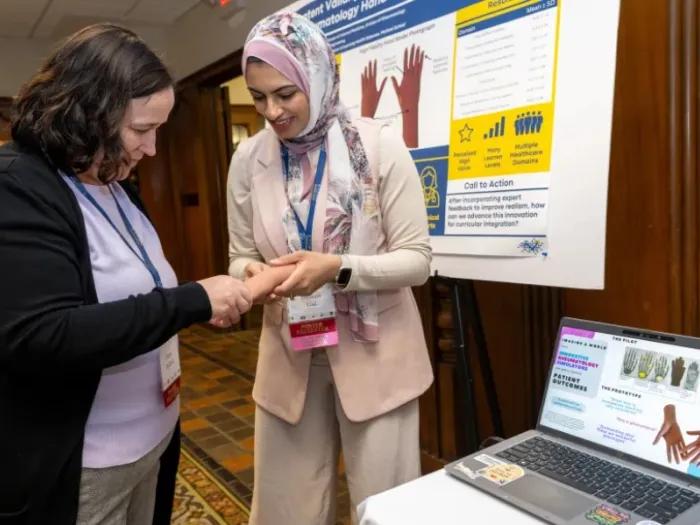
Rethinking how clinicians learn to feel disease
College of Pharmacy alum advances U-M Medical School addiction research
Rethinking care: How ‘de-implementation’ can improve quality and reduce burnout

The Questions That Shape the Future of Medicine
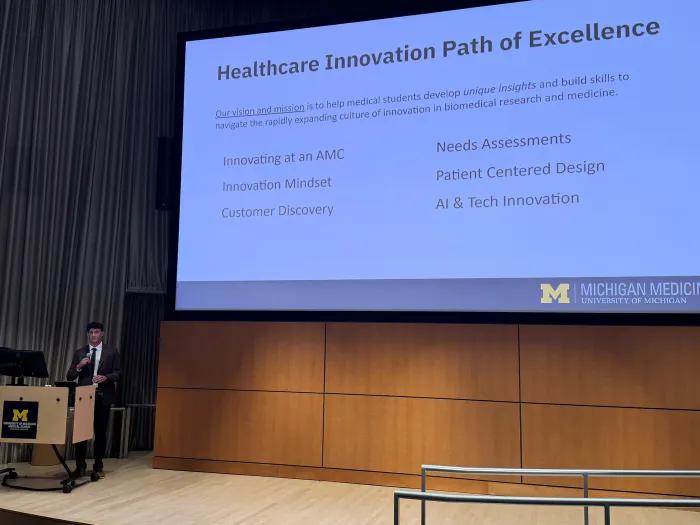
Medical students develop novel technological solutions for unmet patient needs