Beyond the White Coat: Hidden Curriculum, Belonging, Self-Advocacy
Host Mackenzie Kay engages MD students Hanikka Muna and Blake Hardin in a conversation around the unspoken rules of med school and how our first-gen community helps students thrive.
9:00 AM
In Episode 4 of UMich Med Mosaic, host Mackenzie Kay speaks with Hanikka Muna and Blake Hardin, members of the medical student organization First in Family, about the unspoken expectations that shape medical training. They reflect on arriving at Michigan, navigating imposter syndrome and building study systems. They also discuss finding belonging, learning networking and self-advocacy, and how their backgrounds inform patient care through cultural humility, dignity and systems-level advocacy.
More Resources
M-Home Learning Community | University of Michigan Medical School
Support for All Students | University of Michigan Medical School
First in Family | University of Michigan Medical School
UMich Med Mosaic is a part of the Michigan Medicine Podcast Network, and is produced by the Michigan Medicine Department of Communication. You can subscribe to UMich Med Mosaic wherever you listen to podcasts.
Transcript
Mackenzie:
Hi, everyone, and welcome to UMich Med Mosaic, a medical student-run podcast we've created to shine a light on the diverse backgrounds and experiences of our students here in Ann Arbor. I'm Mackenzie Kay. I'm so happy and grateful to be here at Michigan. I wanted to start this podcast to build community through hearing the stories and experiences of my peers. And as an avid podcast listener, I feel passionately about podcasts as a medium. Through these conversations, we hope to show that there is a no one-size-fits-all definition of a medical student. Whether you're a current or prospective medical student, we hope that you feel inspired by these narratives.
Hi, everyone, and welcome to episode two of UMich Med Mosaic. In this episode, we're exploring the hidden curriculum in medicine through the experiences of two medical students who are members of First in Family, a student organization that provides community and support to students who are first to college and medical school.
For those of you listening who are unfamiliar with the term, the hidden curriculum is a set of values, attitudes, and expectations that get taught informally in medicine. In other words, it's everything you learn about how things really work in medicine and medical education that nobody really says out loud. It can be positive, since it's one of the ways that we learn to model professionalism, kindness, and empathy to our patients, but it also can be challenging when it transmits behaviors associated with burnout and perfectionism.
My hope is that some of what we talk about today feels familiar and validating, and that we can create a safe space to share stories, reflect on our experiences, and maybe even offer some strategies for navigating the hidden curriculum, which brings me to our guests. I want to extend a very warm welcome to our two guests today, Hanikka Muna and Blake Hardin. Thank you for being here today. So to start, could each of you introduce yourselves and share a little bit about your background and path to medical school?
Blake H.:
So my name is Blake Hardin. I use he/him pronouns. And as mentioned, I am here as the first person in my family to graduate from college. I grew up in Taylor, Michigan, so the Downriver area. I went to high school there, graduated, and then I went to University of Michigan-Dearborn for undergrad. And then I took a year off for a gap year before starting here for medical school in 2022.
Hanikka M:
Hi, I'm Hanikka. I actually grew up in California. So I was born in Guam, and then I moved out to California when I was four. I grew up in the San Francisco Bay Area. I actually didn't know that I wanted to go to medical school. I wasn't quite sure when I graduated college. So I actually took four gap years, and during that time I did a lot of social systems navigation and then also public health-related work. And I think by the end of all of that, I was like, "Okay, I think that medicine is going to be the route for me, and this is what I want to do."
Mackenzie:
Great. Thank you so much for giving me a little bit of an insight into your experience. I'm also from the Bay Area, Hanikka.
Hanikka M:
What part?
Mackenzie:
I'm from Palo Alto.
Hanikka M:
I thought I saw a 650.
Mackenzie:
So another Bay Area kid is here on the pod. I just wanted to ask, when you first arrived at the University of Michigan, what were you initially first excited about, and what were you most nervous about?
Blake H.:
Yeah. I think for me, I went to University of Michigan-Dearborn for undergrad, which is primarily a commuter school. I lived at home with my family. I was very fortunate to be able to do that and have that support. And I only lived 15 minutes from my undergrad. And so actually moving to Ann Arbor for medical school was the first time moving out, and I had a chance to meet a whole new community and just really broaden my horizons, which ... It was intimidating too. Just a bigger community and a lot of new opportunities to get involved with things and meet new people, but I was just really excited to dive right in and immerse myself in the medical school culture and in Ann Arbor as much as I could.
Hanikka M:
I had no idea, really, honestly, what to expect. All I knew before this was California. I think I was really nervous about picking up my entire life and then putting them in two suitcases and then coming here. I didn't know what the weather was going to be like. I didn't know if I would make friends. I mean, the interview process, I felt like everyone was really kind, which is part of the reason why I chose Michigan, but I was just scared. And I came from a smaller, public university in California. So I went to San Francisco State University. Honestly, throughout my time, I had academic difficulties. It just never really came naturally to me. So I think I was worried about some aspects of imposter syndrome and feeling like I could keep up and be successful in becoming a doctor. So I think a lot of jitters from a social aspect and also a professional, academic aspect.
Blake H.:
I can very much resonate, coming from a bit of a smaller school and, of course, not coming with anybody I knew or anybody in my family as somebody who had went to or graduated from college, let alone medical school. I only briefly heard about it from people that I had interacted with through mentorship programs at my undergrad institution, and I figured it probably was going to be a culture shock, and I didn't really know what to expect either. And so it was nervous to think about how I was going to be able to find friends and how I was able to be a part of the community. Would I actually fit in? Am I actually going to belong here? How am I going to shape my identity through here? So those were a lot of the things that came to mind when I started here too.
Mackenzie:
I'm picking up a lot of threads here. Finding belonging, finding community, and then also figuring out academics were three big ones. I wanted to start on academics because I think imposter syndrome is a huge thing that many people experience when they walk on campus at UMMS and also beyond. How did you figure out the right way to study? What resources did you turn to? And is this an evolving process?
Hanikka M:
I always tell M1s, if I could go back all over again, I would go through the entire Bootcamp series and teach myself everything. Not to say that we don't have wonderful faculty and professors, but I think that sometimes you just need that third-party resource to teach it to you in the way that you best know, and Bootcamp for me was the way to get that knowledge in and stay there. And then unfortunately, I didn't want to be an Anki person, but I had to be. It's just hard not to. The breadth of things you have to memorize ... Blake is our Anki king, literally our class' Anki king.
Blake H.:
Yeah. I don't know. I somehow fell into doing Anki. I think the way I got into it was because before medical school started, I'm like, "I have no idea how I'm going to have to adapt my learning style," because everybody kept telling me, "Oh, it's like drinking from a fire hose." I'm like, "I don't know what that means." Knowing me, my anxious self, I did a deep dive into different resources that have been shown to be helpful to medical students, and I came across Anki. And for anybody who doesn't know, it's basically just a fancy flashcard app with a spaced repetition algorithm built into it. And there's also a lot of great functionality to download pre-made flashcard decks. So you don't have to spend a lot of time making decks that may or may not be as super high quality like some other pre-made decks that are just incredible.
I really got into that, and it seemed like the pattern I picked up on from other people and looking at resources online is just to try to be consistent. And so I just really tried to be consistent with doing that throughout my M1 year and even into my M2 year, in addition to using third-party resources like Sketchy, Boards and Beyond, Pathoma, things like that that really helped solidify the in-house content that we got.
But you also need to be able to adapt your learning style too, because each block is so different from any other block before. Block one is different from block two, from block three, from block four. And I had to adjust the way I studied for pretty much all of them and just learn how to be very flexible and to not get trapped into one particular routine.
And then it changes when you start your clinical, year two. The way you learn and study is a lot different. So basically, just trying to incorporate ways to actively learn content and have the spaced repetition so I don't forget things, earlier on things, I think was really important for me, and just overall being adaptable.
Hanikka M:
I think in your M1 year here, people are very hesitant to stray from what is given because I think people feel that, like, "Oh, that's what they're going to test off of, so therefore I'm going to study that and dissect that." I think they're building towards things that you're going to need for Step 1 and Step 2. So bringing in those third-party resources are actually only going to help you rather than hinder you, because I think M1 year can be a point where you can try things out before you get to M3 and you're like, "Oh, I have to study for Step." Rather than doing the experimentation as much there, maybe you can experiment earlier.
Mackenzie:
This is advice I wish I had. I think when I was in M1, I was freaking out the whole time and never felt like I had time to experiment around, but I totally did. I totally did. I'm in clinical year now, and I actually have no time.
Hanikka M:
That's such a vibe. Yeah.
Mackenzie:
And I have to pick one thing and stick to it because I have no time to play around.
Hanikka M:
Right. Exactly.
Blake H.:
Yeah. You learn the same material over and over and over and over again, but just in different passes. And there's a lot of pressure to feel like you have to understand everything 100% the first time you learn it. I think from being further along, I realized that, okay, maybe you go through your M1 content and say, "I want to learn cardiology." And maybe you learn 75, 80% of what you need to know enough to pass the block, which it's great because our M1 year is in a pass/fail curriculum, but then learning that and then you will then build on that knowledge when you actually see patients. So then maybe you get to 80 to 90% understand it. And then you have to study it again for Step 1 and Step 2. Then you get to, say, 90, 95% understanding it.
So it's always an incremental process and just seeing the same thing over and over and over again in different contexts. And I found that that was the way that things stick. And that was something that I guess I wish I would have known a bit earlier. And it would have, I think, helped ease a little bit of pressure off myself to realize it's okay to not understand everything perfectly the first time around.
Hanikka M:
Yeah. And then also, just side note, it's okay if you're feeling, like, "Will I ever understand this stuff? Will I ever get to a point where I'm confident enough to answer something out loud or do things?" And I think there is some part of you that has to tell yourself, "Eventually, I will know this. Eventually, I will get there. And just because I'm not there today does not mean that I'm any less than or I don't deserve to be here."
I think everyone's different in the way that they learn. For me, it's probably going to take another 10 more times to see these things before I can even feel confident.
Also, too, I think it's helpful when you find attendings and residents who validate that and are very humble in their own abilities, their own knowledge. There will be attendings that will be like, "Yeah, I learned that one time. I don't remember it," but that doesn't mean that I can't go look it up. Learning is not a one and done. It's going to be, for real, lifelong, in medicine particularly.
Mackenzie:
Yeah. I actually wrote that down in my notes, about how attendings and residents model uncertainty is so important for us and our learning. On one hand, it can be so helpful to see somebody who is willing to work through their own problems and maybe is able to stick through it if they feel unsure about something, but it is equally helpful to see somebody who is, like, "You know what? I don't know. Let me find that out for you," or, "Let me go back to my med school notes and go and look this up," or, "Let me figure it out and let me help you," or, "Let's figure this out together." I think that model's a really good behavior for us and helps with that perfectionism, ego, whatever thing that we're all implicitly learning a little bit.
I wanted to change gears just a little bit and talk about the feelings of belonging in med school. We're always saying, "You belong here." And I think a lot of the time we feel that way, but maybe there's sometimes we don't feel that way. And so Blake, I think you mentioned this first, about feeling a little nervous about it or how you would find belonging here. So I was wondering if you could expand on your initial feelings, and then maybe how you found belonging.
Blake H.:
So yeah, I think that was a little bit of a sticking point for me. I think that was one of the most, I think, anxiety-provoking things because I just came from a very different background compared to a lot of my peers, where this was really, for me, the first time being away from home and being in an environment where you're totally immersed. And in addition, I see all my incredible classmates that are so accomplished and just overall amazing human beings, and I'm like, "Man, how am I going to be able to really fit in here?" I felt very, very different, and it was difficult to find my place in the community and also find a close group of friends to really confide in and to form community with.
But I was really fortunate because I was able to find a lot of great communities here. And I knew that was just something that I wanted to really be intentional about, is to form connections with others and form strong relationships with others.
And that, here, started even as early as three or four weeks before medical school even started, with the LEAD program. Hanikka and I were both part of that. And it was a program where we got introduced to what medical school is like here, and we got a chance to meet 20 or 30 friends right away before even starting medical school, which was such a great starting point.
And then I moved into a great apartment complex, Phi Chi, with a lot of other medical students, and that Hanikka also kind of lives in. And then also, I had a chance to form a lot of great communities informally, just through friend groups, but also formally, through organizations like Galens, Tag Days, Smoker, Biorhythms. I formed a community through MSDHA, the disability health group here on campus, through First in Family, through other mentorship programs and things like that.
And all of these things, I think, really contributed to helping me find my footing and just ensuring that I belong here. All of these communities I've been a part of have really helped me to not just survive medical school, but just to do my best to thrive, which is very much easier said than done, but it's allowed me just to be my best self while I'm here. So I'm very grateful for the communities and friendships that I've had through joining the medical school here.
Mackenzie:
Yeah. I'm always seeing your name everywhere and seeing you in every event. It's amazing. Blake is extremely involved.
Blake H.:
Yeah. Yeah.
Mackenzie:
Go you. That's awesome, Blake.
Hanikka M:
I think belonging, to me, can mean different things. I'll speak on friendship belonging, but I also think that different aspects of different parts of my identity, like the multifaceted parts of our lives, feel supported and feel like you're in community at different times. And so I would be lying if I said, "Oh, I feel belonging all the time." I think it's very natural to feel left out in certain things, depending on what aspect of your personality or who you are that you're talking about.
With friendships, I was so worried about who I would make friends with and what, I guess, it would look like. Actually, it's so funny because I think maybe the first month or two of medical school, everyone's going to everything. Every possible social event that there is, people are showing up. Why? Because I think we all just want to make friends. And I felt like I was maybe doing things and extending myself in ways that wasn't authentic to myself because I felt the need to make friends at these events, but I think over time I realized that it's okay to be yourself. The people that you're going to attract are the people that are going to be for you. And I just am not that social. I'm not going to a party all the time. I think I was getting exhausted by the amount of social events there were. And so by the time I was like, "Okay, let me settle in," I think that's when I maybe started to find people that were more my speed.
But also, I will say LEAD really helped. People branched out, of course, but I still am friends with a lot of the people in LEAD too, and I can't say that it had no impact because honestly, some of my closest friends were from LEAD. So yeah, I think it comes eventually, but don't put pressure on yourself to ... I need to make friends right now, lock in, and these are going to be my friends from medical school. No, I think it will shift and change over time, and that's okay and that's just part of life.
Mackenzie:
Yeah, totally. Another aspect of belonging that I wrote down in my notes, and you guys can let me know if this doesn't really call out to you, but this was something that I've personally reflected on because I don't have anyone in my family in medicine, was feeling like for some people who have family in medicine or who have grown up around University of Michigan Medicine, who came into medical school already having a plan or knowing how to navigate medical school or having insider knowledge that I didn't feel like I was privy to. Does that feel familiar to you? Yeah? How did you handle that uncertainty?
Hanikka M:
It's weird because in some ways, it's never a spoken thing, right? It's just like ... You notice it in different ways. One thing for me in particular is my school, they never taught us networking. That wasn't a thing. But as I get more and more into medicine, I'm like, "Whoa." People are so connected, and it truly sometimes is about knowing how to talk to people when you're uncomfortable and you don't want to talk to them or being able to ask for things. I think that's been a huge learning curve in medical school, is having the ability to be brave enough to ask some faculty or somebody for something and explain your needs, and see how you can get those needs met because I think that it truly is a skill to advocate for yourself in these spaces where it's scary to advocate for yourself.
And in some ways, I feel like those skills are handed down in ways that wasn't in my household. I don't know if any of that made sense.
Mackenzie:
No, totally. Yeah. How to ask for research opportunities, or even how to communicate when you're on rounds with an attending or how to professionally behave. Some of these things are unspoken, which is why it's part of a, quote, unquote, "hidden curriculum" that some people maybe have earlier exposure to than others.
Blake H.:
Yeah. You literally took the words right out of my mouth. I was thinking advocate for yourself because that was a big, I think, struggle for me and something I'm still continuing to work on, is being able to put myself in positions where if I know that I need something in order to help me succeed, I need to, especially being first generation, to really do my due diligence and the effort to find the people who can help me get what I need or get these opportunities to get involved.
I want to echo that it's not something that's just taught, and it's something that's definitely learned. And unfortunately, I think for a lot of folks being first generation, you learn that out of necessity. And being able to cold email people, to find people who are further along on the path, for you to ask them what to do, to ask for resources, ask for opportunities, ask for ways to get involved because I think unfortunately, it's pretty easy with how fast medical school moves to just drift along and just be carried along with it, but being able to stand your ground and to get the opportunities to help you succeed, I think, is really critical, especially for first-generation students. So finding those networks, finding those resources, finding those opportunities to make yourself the best possible self, to set you up for success, is critical.
Hanikka M:
How would you say you've navigated that within your own class?
Mackenzie:
I'm not sure. I think I'm still figuring it out. I think a lot of it is just observing, since I'm now transitioning into the clerkship space, and so I get to work on these teams with other medical students. I'm able to observe other medical students and their behaviors with regards to how they work on teams. And that has been really helpful, in watching what are the bounds of how to interact with attendings. Definitely the anxiety about self-advocacy is very much shared. That definitely resonates.
And I think the other thing is not knowing the plan, walking on campus and having it all figured out in terms of what opportunities are ahead or ... I need to have research done by the end of this year. I need to have this number of publications by the end of this year. That embedded knowledge does sometimes give me imposter syndrome, but it's one of those things that I try to just know that I'm on my own journey. I know that I'm also not alone, and I think a lot of people feel the same way.
Blake H.:
Yeah. I think it's something that is not talked about a lot. It's been getting better, but it's still a process in making medical education and medicine a more open and transparent space to talk about successes, talk about failures, talk about unknowns, things that you need help with. And I think medicine is moving in the right direction. I think that this generation of future physicians and future leaders in medicine are really trying to make that push to be able to make that culture change, to make medical education more open and welcoming, but it takes everybody to be able to do that.
And another point, I am very comfortable with reaching out to ... Cold emailing people in different specialties to set up meetings with them and basically be like, "I have no idea what I am doing. Please tell me what to do. Please help. Please help me." I think fortunately, here, there've been a lot of people that have been really, really tremendously helpful in doing those things, but I've just gotten comfortable to be like, "I don't know what I'm doing. Please help me. Somebody, just tell me what to do. Point me in the right direction, and I will do it."
Mackenzie:
That is super true. I have definitely had a couple of specialty interests of mine. I've talked to them, being like, "Okay, what do I have to do to be able to, at the end of four years, be where you are or match where you are?" And they've had very good and real conversations with me about, "Okay, this is what you need to do." That's amazing advice. Don't be afraid to send the cold email because people are super nice here.
Hanikka M:
I agree. I think people do want to help.
Mackenzie:
They do, yeah.
Hanikka M:
As long as you are trying to reach out. I mean, not everyone's going to reply, which you got to know, but a lot of people do.
Mackenzie:
So now you guys are both year three and a halfs. You got a couple years down the pipe. How do you feel now compared to when you stepped on campus?
Hanikka M:
When I'm able to reflect back, I'm like, "Whoa." I actually learned a lot. I actually know so much more than I thought I knew by the end. And even now, I don't know everything, nor even maybe 70% of it, but I think that at the very least, I can say that I tried or I have some level of baseline knowledge of something. And then also, as far as friendships or belonging, I feel like things did fall into place the way that they were meant to fall into place for me, and I wouldn't take it back because then I wouldn't be where I'm at now. So I feel absolutely more confident and actually probably nostalgic for the years that I've had now, especially as the M4s are leaving.
Blake H.:
Yeah. It's so weird to see a lot of our classmates are finishing up interviews and going to find out where they match soon. And so it's a weird feeling, but yeah, I'd want to echo that. I would say I do feel more confident and more sure of myself, but I think when you go along in medical education and just in medicine in general, you get more comfortable with not knowing everything. You start to know a little bit more about what you don't know, versus when you first start off, you think you know. And a lot of times, there are some things that you do, but a lot of times you don't know what you don't know. I've gotten more comfortable to be able to be comfortable in the uncertainty and the unknowns of things, especially when it comes to having clinical knowledge or navigating clinical spaces or bigger-picture things like career path and things like that.
So I think like over time, you just start to get a little bit more comfortable with not knowing everything, and you start to recognize, wow, there's so much more that I can learn about medicine and about life and just about humanity, how to meet people where they are, and to connect with people and connect with patients. So it's a process. You definitely ... You never stop learning. You get more comfortable and more aware of what you don't know over time.
Mackenzie:
So my final question is, how has your background influenced the way that you show up for patients?
Blake H.:
I would say that being the first person in my family to go to college has allowed me to better connect with patients in terms of the social determinants of health and the structural drivers of health that patients and communities face. And it has allowed me to be more humble and have more cultural humility by recognizing that there's just so much that I don't know, and there's a lot of things that patients go through that I have never experienced or never will experience. But even though there are things I will never know ... What patients are going through, I can say, "Well, I'm still going to meet you where you're at and care for you as a holistic person to the best of my possible ability." And it has, in my mind, reinforced the critical role that I can remove from the clinical aspect, but for advocacy, both for individual patients and at the systems level and at higher levels of improving care for all patients and for patients that I will never meet, and giving them a voice to make sure that they're being heard.
Mackenzie:
That's amazing, Blake. And it's amazing that you're going on and getting your MPH too, because it's amplifying your ability to help people and patients. So good on you, Blake.
Hanikka M:
So everyone knows this about me, because I'm very proud of it, is I'm a native Pacific Islander woman. In my culture, it's all community-centered. When one member of the community falls, we all fall. When one member of the community rises, we all rise. And I think that's the strongest part of my identity that brings me to medicine, is when a patient is in your room, you're waiting to go get seen by you, your attending, whoever, that's a community member in there. And it can be very, very easy in medicine to get bogged down with, like, "Okay, what's the diagnosis? Okay, what step do we do? What's the algorithm from here? Okay, this is how we treat it." Blah, blah, blah. 15 minutes, boom, we're done. And I absolutely hate that. It's hard not to sit across somebody and be like, "Okay, you're a human. I'm a human. Maybe I went to school and I learned some things, but actually I don't know your experience. I don't know your experience the way that you know your experience, and so I'm going to learn from you."
And I think I try to bring that to everything I do, and I think that's also why I'm really drawn to Wolverine Street Medicine, is because the whole premise of the organization is human dignity and putting that client, that patient, first.
And I think that's the strongest way that my identity has played into the way that I treat my patients, is just remembering that there's a human sitting across from you who might be in need of something. And you can bring whatever knowledge you might have, but you are not an authority figure. And I think that the power dynamic that is reinforced time and time again in medicine tends to hinder the way that we treat patients, rather than help. I would hope that the future of medicine is we're centering communities and we're centering the human experience over profits and other things.
Mackenzie:
Well, and thank goodness that we have you. Oh my goodness. Oh, and just to wrap it up, I would love to hear what you two are planning on applying because you guys are eventually going to be doing that.
Blake H.:
I will be applying into general surgery in 2027.
Mackenzie:
Yay.
Hanikka M:
Exciting. I am very much torn between family medicine and OB-GYN. So I think I have a little more time to figure it out, but not a lot more time. So I have to get on that.
Mackenzie:
Sorry to be bringing up the stress.
Hanikka M:
Yeah, it's okay.
Blake H.:
Well, I know both specialties will be fighting to get you to join them. So either one will be absolutely privileged to have you part of it.
Hanikka M:
Dude, same. Actually, during Blake's clerkships, his car broke down and this fool walked in the morning to the hospital, 4:30 in the morning, for his surgery sub-I, his sub-I. So that's true dedication right there. I don't know what that is. That's crazy.
Mackenzie:
He'll be talking about this when he's an attending and 60 years old.
Blake H.:
Yeah. I'll be saying, "Oh, I walked uphill to work both ways, negative 20 degrees. My fingers fell off, but I still managed to tie all my knots perfectly because that's what we need to do, and everybody should be able to do the exact same."
Hanikka M:
Yeah. And I have to emphasize, it wasn't a baby walk. Okay? This is a walk, a 30-minute walk.
Blake H.:
Yeah. I walked. My car broke down, and I think, thank goodness, it was not winter. It was in the fall, but I walked a good 30 minutes, 4:30 in the morning, to the hospital for both ways, for a week. And it was a little bit ... The finances with getting my car fixed was a little bit dicey, but it ended up working out eventually.
Hanikka M:
Seriously. Dedication.
Blake H.:
Very fortunate. Yeah. Very thankful.
Mackenzie:
Thank you both for spending time with me on this podcast, and thank you to our listeners for listening to this conversation about the hidden curriculum. These stories remind us so much about just how so much of medical training happens in the quiet moments that go unnamed, and that none of us are navigating them alone. We hope that you listeners leave this episode feeling seen, supported, and maybe a little bit more confident in finding your own path through medicine. Thank you for listening to UMich Med Mosaic. Until next time.
If you loved today's conversation, share it with a friend. If you are a Michigan medical student and are interested in being a future guest, check out the class pages on Slack for open calls for episodes. UMich Med Mosaic is produced by the Michigan Medicine Department of Communication in partnership with the University of Michigan Medical School. Find us and subscribe wherever you listen to podcasts. Thanks for listening, and we hope to see you soon.
UMich Med Mosaic
Listen to more UMich Med Mosaic podcasts - a part of the Michigan Medicine Podcast Network.
Featured News & Stories
College of Pharmacy alum advances U-M Medical School addiction research
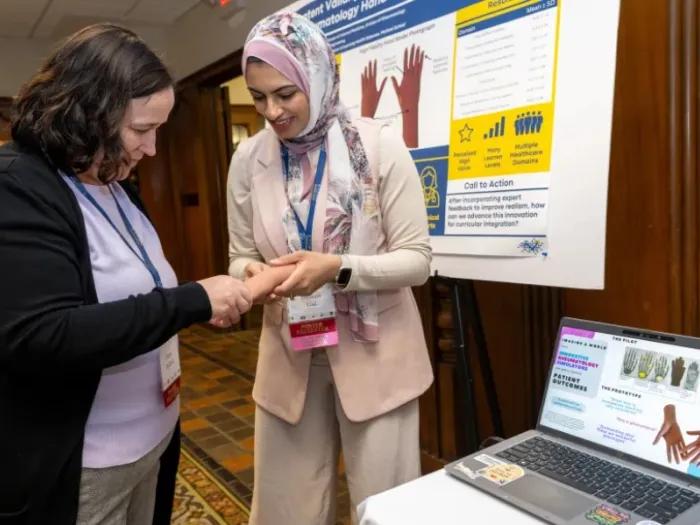
Rethinking how clinicians learn to feel disease
Rethinking care: How ‘de-implementation’ can improve quality and reduce burnout
The Questions That Shape the Future of Medicine
Medical students develop novel technological solutions for unmet patient needs