Beyond the White Coat: Finding Your Voice at the Patient’s Bedside
Host Mackenzie Kay engages MD students Josh Chen and Gabriel Culian in a conversation about the transition from classroom learning to clinical care, reflecting on first patient encounters, meaningful connections, difficult moments and the early experiences that shape future physicians.
In this episode of UMich Med Mosaic, host Mackenzie Kay speaks with MD students Josh Chen and Gabriel Culian about what it feels like to step onto the hospital wards for the first time. They reflect on their earliest patient encounters, the transition from standardized patients to real clinical settings, and the role medical students play in building trust, explaining care plans and supporting patients and families. They also discuss witnessing serious illness, grief and life-changing conversations, while exploring how early clinical experiences shape confidence, empathy and the kind of physicians they hope to become.
Transcript
Mackenzie Kay:
Just a quick trigger warning for our listeners. There's going to be some topics about death, suicide, and mental health discussion. So if that's difficult for you or hard to listen to, I recommend tuning in for our next episode. Thank you.
Hi everyone, and welcome to UMich Med Mosaic, a medical student run podcast we've created to shine a light on the diverse backgrounds and experiences of our students here in Ann Arbor. I'm Mackenzie Kay. I wanted to start this podcast to build community through hearing the stories and experiences of my peers. And as an avid podcast listener, I feel passionately about podcast as a medium. I'm so happy and grateful to be here at Michigan. Through these conversations, we hope to show that there is a no one size fits all definition of a medical student. Whether you're a current or prospective medical student, we hope that you feel inspired by these narratives.
Welcome to UMich Med Mosaic, a podcast that explores the lived experiences of med students as they grow into physicians. Med school is often imagined as years spent studying textbooks, memorizing pathways, and preparing for exams. But at some point every student crosses an invisible threshold. The classroom gives way to the hospital, the sim lab gives way to the bedside, and the standardized patient becomes a real person with a real story.
In this episode, from white coat to first patients, we talk about what that transition actually feels like. What happens the first time when you walk into a patient's room? What surprises you when medicine becomes less theoretical and more human? And how do medical students begin to find their voice, their role, and their sense of responsibility in patient care? Our wonderful guests, Josh Chen and Gabriel Culian, reflect on the early moments that shape a clinician. The first patient encounter, the first meaningful connection, and the first time you feel like a part of the team. And sometimes the first time you confront illness, grief, or loss. These are the experiences that move medicine from something you study to something that you live.
Just a quick disclaimer before we get started. The patient care experiences discussed in this episode have been fully de-identified in accordance with privacy standards. These narratives do not represent any identifiable patient and any resemblance to real individuals is unintentional. So let's start at the beginning.
For most med students, there's a moment when everything feels super real. You go from practicing with standardized patients in a classroom to walking into an actual hospital room and introducing yourself to somebody who is really sick, really vulnerable, and trusting yourself to help care for them. In this segment, we're going to first talk about first patient encounters, and what it actually feels like to step onto the wards for the first time. Both of you, Josh and Gabe, can you tell us what it's like the very first patient that you encountered or interacted with on the wards, and what was going through your head at the time?
Gabriel Culian:
I would say the first one that I encountered, it was on my plastics rotation. And me and Josh had talked about this last week, but what happened was it was a patient for his six week post-op. And it was a top surgery, and really was thankful for the change and the emotion that he was feeling. Because prior to that, he wasn't happy in his own body, and he didn't realize how much of a difference the top surgery would have done for them. And what happened is he wrote a letter to the doctor thanking her for the happiness that she was able to bring to his life and the acceptance he was able to have in his body. So I was just really, really excited for that kind of change that we would actually get to start seeing. And that was just my first patient and it just strong way to start.
Mackenzie Kay:
That is a strong start.
Gabriel Culian:
Yeah.
Mackenzie Kay:
I remember with my very first patient when I walked in, I was super nervous. I was stumbling over my words. Everything that we were doing in our simulated standardized patients, everything kind of fell out the window in terms of the organization that we were talking. I don't know if that was familiar to either of you.
Josh Chen:
Yeah, I think so. So I started on psychiatry. And a lot of what we were doing, I was on the consult liaison service. And so a lot of what we were doing is going around the hospital and seeing patients who their primary teams or the teams that were taking care of them were curious if we could help with a certain issue or address a certain concern that the patients had.
I think one of my more memorable first patient encounters was a patient who we were seeing for, it was a suicide risk assessment. They had said just in their earlier statements while they were hospitalized that they were having thoughts of harming themselves. And so I think oftentimes it's the first time that they're opening up about things like this to people. It was such a privilege to be a part of that conversation and to be in that space. And I think one of the things that I really took away from that experience is that there is so much that a person in the healthcare role can do in that situation to really destigmatize the situation and talk about it.
Mackenzie Kay:
I agree. I just finished my psych rotation as well. And something that I reflected on as well was in my interactions outside of medicine, I think I put so much of a positivity bias on my interactions. I want things to be happy. I want things to be good just because life can be hard if you focus too much on it. And I think it was such a mindset shift to lean into those hard conversations and be willing to go there with patients and take their hand and really ask them the hard questions about their mental health. I think it's really hard to do, and it took a lot of practice for me personally.
Now would be a really good moment to just talk about rotations that we have completed so far. Because we're all halfway through our second year, which at University of Michigan means that we've entered into the clinical space. Other med schools may do it their third year or halfway through their second year, but here at Michigan, we do it our second year. I myself have completed internal medicine, family medicine, psychiatry, and right now I'm on neurology. Josh, what have you done?
Josh Chen:
Similar to you, I've done psychiatry, neurology, family medicine, and then I've completed two of the three months of inpatient internal medicine.
Gabriel Culian:
I've done my three months of surgery, six weeks of pediatrics, and I'm halfway through my OB/GYN rotation.
Mackenzie Kay:
Yeah. So as you can tell, there's a bunch of different ways to slice the core rotations, depending on what you're assigned and also what your interests are. Just to continue on, I wanted to go back to that transition point. So when we were moving from standardized patients to the wards, how prepared did you feel from working with SPs for stepping onto the wards? Did you feel that that was good preparation? Did you feel that that organization worked well for you with the patients that you were working with on that first rotation or did you have to adapt a little bit?
Josh Chen:
The SPs were really useful for me for getting an idea of what the flow of a visit should look like and the types of questions to ask. So from the medicine perspective, it was good preparation, and about as good as you can simulate with those. Our standardized patients at Michigan, first of all, they're excellent, I think. I've had only good experiences with them and they're great. And really it's a lot of, I think, really good preparation, sort of rubber meets the road preparation for applying some of the clinical knowledge that you have.
The thing that I wasn't exactly expecting going into the clinical space, which in the end was a good thing I thought, is the standardized patients, there's always like a lot of anxiety in my experience going into those because you're being evaluated. There's someone watching you on the camera overhead. So I think that it made a very artificial environment for a lot of the cases.
The thing that I really like about the clinical space is that it's just you and the patient. And you can talk about things, you can ask them questions that are not directly targeted to the concern that you're trying to figure out from a medical perspective. And so it just feels like a regular conversation with someone who you're trying to help and trying to get some, I guess, pieces and clues to try and move towards a diagnosis and then a treatment. And so in a lot of ways it felt easier than a standardized patient in the end, and I've enjoyed it quite a bit. But I do think the standardized patients are very useful from the medical perspective, getting ready for that.
Gabriel Culian:
I feel like I had a very different experience in that. Everyone that I've worked with on surgery and on peds, the experience that we have on SPs is we have to get a very generalized history. And even if it's not concurrent with the issue that you get, or the chief concern as they say, you still have to collect every piece of information, which is not something you can do on surgery. So it was a bit of an adjustment.
I think we have this opportunity to do a clinical reasoning elective in our first year, which is like, without grade, you get to actually experience time on the wards. I would say that was more helpful to what we were able to experience a little bit. Because you actually work with patients and you see what they like. Because even when we do a practice standardized patient this year, it's very different to how you would approach a patient now. I think I agree with Josh. It's very helpful for some of the questions to know how things connect, but I don't think the process in which you ask patients questions or get a history in clinic, or even on surgery or sometimes even on peds, is kind of one-to-one or close to it.
Mackenzie Kay:
I also had the experience of, when I was transitioning to the wards, feeling just like a lot more relaxed and able to maybe be a little bit less structured in how I organized the questions that I needed to ask, and maybe a little bit more focused as well. Because some of the history was already taken, like the social history was done by our social work colleagues, or some of the HPI was already collected by the emergency department colleagues. I feel like the SP is really good for learners learning how to have a structured interview so then we can move on to the wards and feel a little bit more relaxed.
This is similar, but I want to move on and just talk a little bit more about strengthening connections with patients, and talk about those really close connections that we've built with patients over the course of our year so far. As we've built confidence in our interviews and our skill sets, I'm sure that both of you have had moments while on the wards where you've developed a really close relationship with a patient or taken really strong ownership over the care of a patient. I just want to talk about some moments where you maybe felt that connection with a patient and started to feel confidence in those interactions. So if you don't mind sharing, can you share a moment where you felt really connected to a patient for the first time, and what helped you build that confidence or feel really confident with the patient?
Josh Chen:
There's one patient that comes to mind and jumps to mind first. For the listeners, the flow of inpatient medicine, at least as I experienced it, typically, early in the morning you will get to the hospital, and you will go and see your patient before the entire team sees the patient. And so you'll get interval updates overnight and you'll see if anything happened, check in with them, and see how their night was. Maybe do a physical exam, and just chat with them how they're feeling that morning. Typically then the entire team will come back in, this is what we call rounds, and we'll go around to see all the patients together as an entire group and that's where you have your attending physician and your residents. Everyone will come in and chat about the plan for the day. And then after that typically is when the residents and the attending, the rest of the work gets done, essentially. Orders get put in, consults get put in, people get seen.
I think one of the nice things in that, especially in that afternoon space for medical students, is that oftentimes, as much as I tried to help, and once the notes were written and everything that I could do from a medical student perspective from the administrative side was done, I had a lot of unstructured time. And so one of the things I really loved doing on the inpatient side is just going back into the patient rooms and checking in, seeing how things were.
Sometimes things have changed since the morning, and so that's an area where you can be of utility to the team, and tell them like, "Hey, they're feeling this way," or, "Something changed and their oxygen saturation dropped," for example. And those are nice things and just having more touch points with patients from a purely medicine perspective is nice. I really think the biggest value for me though as a person was to be able to go back in and really have true conversations with people where you aren't just asking like, "How's your shortness of breath today? Is the chest pain any worse? How's that arm pain doing? Are you still having X, Y, or Z symptom?" I think it's nice to go back in and get to know people. Ask them where they're from, ask them what they like to do, what they are excited to do once they get out of the hospital, things like that.
And you can ask them really... People love to talk to you about the things that are not their diagnosis because I don't really feel like people are defined by their diagnoses. That's what we're treating in the hospital a lot of the times, but the rest of the person is still them. And so I really like to get a feel for like what that's like. What do you like to do? There's this one patient, the one that I was thinking of, she had shortness of breath and was having these pleural effusions that just kept coming back.
I was asking her what she was looking forward to doing outside of the hospital. And I think there's so many things, there's an infinite number of things that you can say. And one of the things that she shared with me is that she drives a Mustang. She loves to drive a Mustang. She can't wait to get back out and drive a Mustang with the roof down. That's not something that you'll find digging through the chart or anything like that. It's something special and something that means something to someone. And so I really feel like that's a special moment and a special thing that got shared there.
She probably doesn't remember that she told me that, but I think it made an impact on me because it's always a reminder, this is a transient time for a lot of people in the hospital especially. And everyone's goal is to so that you don't have to stay in the hospital and so you can get out. And so what we can do to not only fix the pleural effusions, but also get you back to driving your Mustang, I think that's really important and something that the team should know and should appreciate. And so I feel like that's where you can make a connection with the patient is especially in that moment.
I think additionally, those times in the afternoon especially are really good times to ask about emotional health and how people are doing. And so the hospital is not necessarily a place where people oftentimes receive good news. There's a lot of scary things and diagnoses and treatments with risks that get shared in the hospital. And so one of my favorite questions to ask, especially when I have more time and I can sit down and just chat with the patient, is asking them how they're coping with things. I think that's one of the most powerful questions that I've learned to ask is like, how is this affecting you? And also, of course, if there's anything that we can do to help.
But oftentimes just having someone who asks and cares about how people are feeling, that means a lot to people. And it also means a lot to me, knowing how the things that we're trying to do and the treatments that we're trying, the tests that we're trying, how they're affecting people. Because like I said, there's a human behind all of this too. And the human is the main one that I think we should be caring for.
Gabriel Culian:
I'm taking mental notes on everything you're saying. Because as we mentioned already, I'm on a different track and that's not an experience that I was able to really have on surgery specifically because you kind of do rounds really quickly. Then you go and do your busy clinic or surgery, and then you're not done until like 7:00 PM, and then you kind of like done for the day. I wouldn't say I've had an experience like that until peds, which is very similar to internal medicine in which you go in and you do your pre-round, and you go see them in the morning, see how they're doing. You chat with the parents who sometimes tell you more, especially if it's a really young child who can't talk, like six months or one year.
So then you go in and you check on the family. And sometimes they don't like to be woken up, but then they appreciate that someone's taking care of them and that you actually care, especially when you come in the afternoon. And they just are somewhat just like, "Is anyone going to come back to us after this morning?" And on rounds I'm always, the last thing I say before I leave the room is, "I'm going to come see you in the afternoon and just see how everything is going." And the amount of joy that I see brings me a lot of joy to want to ask them and be there for them.
Because even as a medical student, we're starting to learn to ask them medical questions, but we are still people who can ask the personal questions, which I think sometimes they appreciate a little bit more so that they don't just seem like a number or a patient or a room. So I think it's important to kind of help them through what's scary, especially for parents who are like, "This is really scary to have a kid who is on oxygen," Or who might be intubated, and you want to be there and kind of soften that blow.
I also think like inpatient, the opposite side of that coin is being there and supporting them on their happiest moments. Like I did labor and delivery a week ago. And moms are super excited, either if it's their first child, their sixth child, their 10th child, it's a moment of joy for them, and they bring their family. And it's more about asking them about their symptoms and seeing like if everything is medically okay. But also like how can I make this experience the best it can be? How do you like to be supported during your pregnancy? Are there any special things I can get for you? Where would you like your partner? Would you like him sitting next to you, standing next to you, away from you? What would you like him to do? You'll hear a lot of things. But I think you want to be able to talk about their personal request for the happiest and some of the sadder moments or harder moments.
Mackenzie Kay:
I have loved as a med student having kind of the gift of the amount of time that we have. Because the administrative tasks, as you said Josh. Sort of finish up in a couple hours after rounds, especially if there's no teaching afterwards. One thing that I think has been an important role that I feel like I've taken on for patients has been ensuring that patients understand the course of their care. Especially since on rounds it's often very quick in and out, "We've changed this medication dose," or, "You're going in for this procedure today. Let us know if you have any questions." And patients will just say, "Okay, I'm on 50 other medications. What's this one dose changed to me?" And I think in terms of why it matters and how this overall matters in their hospitalization, sometimes that's just lost in the sauce. They don't feel well.
Sometimes that isn't always communicated. And so I've really enjoyed in those afternoons sitting down with the patient. And if they want to, talking through, "This is why we're adjusting your medications. This is the goal that we're trying to get to in terms of your symptoms. This is why we're pursuing this surgical procedure, these lab tests. This is why we're doing these imaging studies." Just so they understand what goal we're trying to get to so that we can get them towards a discharge, towards home, towards rehab, towards whatever.
And I find that patients often feel grateful for that and more empowered so that they can have better questions on rounds too. "Oh, okay, that makes sense. The goal is to reduce my seizure threshold. Do I need an additional anti-seizure medication? Or what side effects should I be looking out for with this additional medication?" I think having the gift of time to be able to give patients that information that just isn't always possible with the number of patients that you have to see on rounds is a really good role that medical students can have, just because we have that information and we have the time to be able to talk to patients.
So yeah, I've loved medicine for that. And any rotation where we've had just a couple of patients where we have the ability to go see them in the afternoon. So any inpatient service where we have the ability to do that, it's been so nice.
Josh Chen:
No, I totally, I mean, grateful and empowered were the two words that I was thinking of actually too. People have question, and I think rightly so, about what we're thinking as a team. And we spend so much time thinking about it. Not a ton of time gets spent in showing our work and seeing why are we thinking the things that we're thinking. Totally agree. I think in the afternoons, afternoons are my favorite time. So you can go back in, and like this one patient who wants to drive a Mustang, she had pleural effusions and so I was showing her the series of x-rays that she had, showing the size of the pleural effusions and why they were causing her to be short of breath. And I think that visual, obviously the symptoms are real to the patient, but then it becomes very logical, like what we're trying to do and why we're trying to do it.
And then you can sometimes get into fun conversations where you explain the med school things that you learn. So Light's criteria for a pleural effusion. I'm sure you guys remember very well Light's criteria and all the things that you're trying to look for in that. But it becomes sort of fun. You can explain it to someone who has no idea what Light's criteria is, and then it becomes real to you too.
I think patients are great teachers because they'll sometimes ask questions that where it's like, I didn't think of that before like. Why are we looking at a transudative versus an exudative? Why do we divide it like that? And so there's so much learning that comes from those moments too. And I think one of the things I've struggled with, and I think now more or less come to, I've reasoned it out to myself a little bit, is the fact that a lot of our learning comes at the intersection of, like our learning intersects with people suffering a lot of the times.
And so they're here with a diagnosis that we're trying to work through and trying to treat. And I really feel like the best way to honor that and to honor their sacrifice of being a case for us to learn off of is to really show them what we're learning, show them what we're doing, and help them cope through it, whatever we can do to help support them through that. I feel like knowledge is power. And so, yeah, I love doing that.
Mackenzie Kay:
We're going to move on to the next segment. So this is going to be a little bit harder for listeners, so I just want to give a quick content note. In this section we're going to talk about experiences with serious illness, death, and some of the harder moments that come up in clinical training. So if that feels heavy for you, feel free to pause or skip ahead.
For many medical students, one of the most profound parts of training is witnessing how physicians support patients and families during very difficult moments. In the next segment, we'll talk about those experiences and what students learn from being present in those moments. So if you feel comfortable sharing, were there any times where you were part of a conversation in which difficult or life changing news was delivered to a patient or family? And if so, what did you learn from watching how an attending or resident handled those moments?
Gabriel Culian:
I can start with this one. So it was actually my first surgery on my surgical oncology service. And this patient had an appendiceal carcinoma. And she had a treatment in which they basically try and get rid of as much of that cancer out of her abdomen. When I was there, it was her second surgery. And the hope was to get rid of kind of other smaller metastases and then do the same thing. But her cancer spread.
And so in order to do less harm, we kind of canceled the operation, closed her up, and spoke with her husband while she was waking up inpatient. Told him the reality of what we saw. That was the first conversation that was really hard for me to be like, wow, this is a reality in which patients go in, and they're expecting a similar course of action, and it's something very different. And inpatient, she was with us for a handful of days, and we kind of talked about kind of what she would want for her life going forward.
Mackenzie Kay:
How did you as a medical student come to terms with being a part of this news, and did you feel like you had to take care of yourself? How did your empathetic self feel about the situation?
Gabriel Culian:
I didn't realize how hard I would take it and how hard that service would be. And then I got hit with that as my first patient. And I was just trying to cope with that, and talk with friends and talk with upperclassmen who have gone through the same things. Talk with my partner, talk with my parents.
Mackenzie Kay:
Yeah. It's so important to have your people.
Josh Chen:
I can jump into, I would say on medicine and on the medicine services, there are a lot of situations where we aren't able to have the outcome that we want and have the person go home essentially. And I think those are really difficult situations to sit with, especially as a medical student. I think in medicine, because we are, a lot of times, very intellectual types of people, we like to talk about things and figure out, from a medical perspective, did we do everything that we could? Did we activate the right algorithm when the right signs came up? Did we do all the right diagnostic testing because could this have been found earlier? Could we have treated earlier? What would have been the risks and benefits of doing all of that?
And I think those are good stimulating conversations to have, and they should be had. You're trying to learn always from a care provider perspective about what you could have done better, and if there were things that could have been changed at an earlier time or explored at an earlier time or tried an earlier time. I think that those are definitely worth talking about, discussing, and then for the next patients who come, taking that learning and applying it to them.
I think that the processing of these of these really difficult situations, it happens a little bit differently for everyone, and the different teams that I've been on have approached that in different ways. And so I think that variation is natural in that some teams are going to spend more time with it and sit with it, and really think about how that affected them. And other teams are going to process it by moving forward and trying to move quickly to the next thing that they can try to fix.
And so I feel like as a hospital system, and at least on the teams that I've worked on, there's definitely been space for me and for the rest of the team to talk about just how we felt about the things that had happened. And I'm grateful for that space because these things are not easy. And especially for people who oftentimes go into this profession wanting to fix things and wanting to help people through these tough times, I think it makes it difficult when the outcome that you desire is not the outcome that's achieved.
I really do think though one of the realizations that I've come to through this is it's in a way not really about the outcomes. It's about a person. And again, their family, and oftentimes their wishes. And so I really think that goals of care conversations are some of the most maybe special is the word that I'll use, like places in the hospital and conversations that are had in the hospital because you're not talking about medicine anymore necessarily. You're talking about what matters. And there's nothing like that. And to be a part of that as a student, it's a privilege of course, but it's also special. And I think you learn a lot from, not just the teams that do it and the teams that have really good conversations. I think I learn a lot from, again, the patients and what they're saying, and the life that they want to live and the things that are important to them. I think that's what matters the most.
Mackenzie Kay:
I agree. I also have gained so much support from my fellow med students too when we've had really hard situations, like losing patients, or just really hard diagnoses. I've found that the services where I've been going through these things with other med students on the team, I've felt infinitely, I don't know, I felt that the difficulty has been spread a little bit more, and that I have more people who kind of can share in that experience and then understand in that experience and that I can talk to.
Because yeah, there is a different way that different teams do approach and move on from these situations. Some push through, some do take the time to do a really good debrief. I've been on both types of teams. But what I've loved about the med students that I've been with is that, when I was on the VA, we lost a patient that we had been with the entire month. And it was our last week and we lost him in that last week. And we all got together and took time to just remember him and think about him. And I think it's really helpful to have those kinds of debriefs and those connections because I think it's healing for us as med students for many of us who were going through these kinds of experiences for the first time.
So just to wrap up this episode, we're going to take a step back and just reflect for a minute. We'll talk about what these early clinical experiences have taught our guests, Josh and Gabriel, and what advice you guys would give to prospective medical students, our peers who are M1s who are about to step into the clerkship space in just a few months, and are just about to meet their very first patients. I am wondering what have some of your early experiences taught you about the type of clinician you hope to become in the future?
Gabriel Culian:
I think something that has really stuck with me is you kind of were choosing to do this as a career, and so every day would be another day for us. But to our patients, and this is like some of the mentors that I have, it's either their hardest, their sickest, or their happiest sometimes. And the happiest is great, but if it's one of their hardest times, I think going in and kind of keeping that perspective if you've had a hard day or you didn't get sleep or you stayed up either like doing a manuscript or studying up on different patients.
Remember that the population that you're seeing, they're being very vulnerable with you and they're trusting you with everything. And I think I want to remember that. And I've been trying to kind of hone that in every day that I go in. Because right now as students, we may not have the responsibility of having our own patients, but we have the responsibility of studying for an exam. And so do we choose to spend more time with our patients or do we choose time to study?
And I think it's important to kind of find that balance, but also remember that you can make a really big mark on your patients and be really meaningful. And I hope to kind of in whatever I choose to do, remember that and give each patient 100% so that they're getting the best possible care, and so that they can come out of there and be like, "This doctor, this intern, this resident, or even right now this med student, he is actually listening to me and he cares about my health and me going forward and not just getting me discharged as soon as possible."
Josh Chen:
Yeah, I think similar to that. The goal, you asked what type of physician that this experience makes us want to be, and I think the pursuit for me, and for I think a lot of our colleagues, is in the end you want to do something that matters. And people find different aspects of the career that matter more to them. This year I found a lot of meaning in being with people in those times of suffering and in those times of pain, and also in the times of joy and having something work. And so that to me gives a lot of meaning to the work that we're doing, and also the training that we're going through right now. And so I guess I see myself in the future continuing to be with patients and continuing to learn about them, continuing to be curious and then continuing to care. And that's the goal. That's the goal in the end.
Mackenzie Kay:
That is the goal. I agree. So like I said, we got some M1s who are coming up about to be M2, stepping into our shoes in just a few months. What advice would you give them if they're feeling a little bit nervous about hopping onto the wards for the very first time and talking to patients?
Josh Chen:
I think it's natural to feel nervous, first of all, and I want to acknowledge that. I think that people feel that way because they care. And if you weren't nervous going into it, you could just have nerves of steel and that's cool, but I think it's important to really value the conversations that you're going to have. And when you do big things, oftentimes you feel nervous before, and that's because it matters to you. And so I think that sitting with that first of all, it's just like a very natural thing and I think it means that it's important. So that's one.
So address it. I think you just got to do it and take the plunge off the deep end. And the more you do it, the more comfortable you get there. I remember, gosh, the first couple times that I was in a patient room by myself just chatting with them, I was nervous. They were going to see like, I don't know, I was starting to sweat or just tripping over my words, things like that. I think after a while you just realize like, I don't know when it happened for me, but at some point it was like I didn't sweat at all that entire time. I wasn't nervous at all. I asked them some questions, and I was genuinely curious about the answers. It felt very natural.
And so it comes with time, just like everything in medicine. So far the journey for me at least, people have told me and mentors have told me, it's just like it takes time. And even though that can be frustrating at times, it's also part of the journey. Part of the journey is to be nervous the first couple of times. And when you do something for the first time, it's to maybe not have the exact best script that you wanted to have when you first talked with the patient. And that's part of the learning too. So if it may sound corny, but embrace it, I guess is the advice that I would give.
Gabriel Culian:
I fully agree with you there. I think you got to embrace it. And you're going to be nervous. And I think you're not getting thrown into this without any knowledge. Like how we started this episode and how we started this talk, it's you practice this with the standardized patients. And of course it's going to be a lot different. But you're not going in not knowing anything. And I think you embrace the nerves. You will sweat. You will sweat and you will mess up, but you learn from it. And I think you take these as like chronic lifelong learning experiences.
I think the biggest thing that I was really happy is that I always brought a book with me, like a little notebook that fits in my pocket in my white coat or in my Patagonia. And I would go around and like write notes on each patient and then write under it, I'll write down things that I think I could have done better or notes that my attending have given to me to be better.
And it gets to a point where you start to take that in naturally and you start to apply them and you see that change. And I don't know when that change happened either, Josh, but you feel comfortable. And you do it one time, two times. A clinic visit is, you get sometimes 10 visits, you're doing it 10 times in that one day. It's good practice. And I think having a note kind of journaling throughout your rotation from the start and then continuing that through and see how that note taking and journaling has changed and progressed will show how you've progressed as a student into a clinician.
Mackenzie Kay:
Yeah. Having that growth mindset I think is absolutely essential. And not being afraid to say, "I don't know." And it's okay to not know. We are new to this hospital system, we're new to this field. It's okay to not know. And I think, Gabe, what you're doing is amazing. I should be doing that. I think that's an amazing way to grow. So you're giving me something that I can do.
So with that, I think I'll wrap up this episode. Josh and Gabe, thank you so much for joining us on UMich Med Mosaic. The transition from the classroom to the bedside is one of the most meaningful turning points in medical training. It is where knowledge meets humanity, where uncertainty meets responsibility, and where students begin to grow into the clinicians they hope to become. If you enjoyed this conversation, we hope you'll continue following along as we explore the many paths, challenges, and reflections that shape the journey through medical school. Until next time, thank you for listening. Take care.
If you loved today's conversation, share it with a friend. If you are a Michigan medical student and are interested in being a future guest, check out the class pages on Slack for open calls for episodes. UMich Med Mosaic is produced by Michigan Medicine Department of Communication in partnership with the University of Michigan Medical School. Find us and subscribe wherever you listen to podcasts. Thanks for listening and we hope to see you soon.

UMich Med Mosaic
Listen to more UMich Med Mosaic podcasts - a part of the Michigan Medicine Podcast Network.
Featured News & Stories
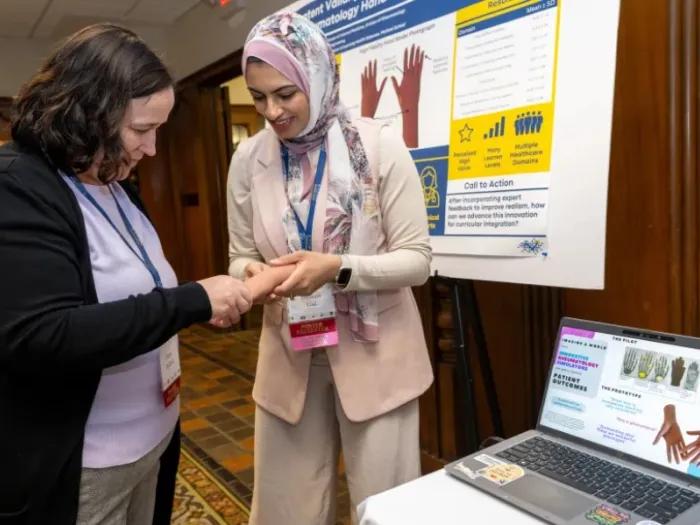
Rethinking how clinicians learn to feel disease
College of Pharmacy alum advances U-M Medical School addiction research
Rethinking care: How ‘de-implementation’ can improve quality and reduce burnout
The Questions That Shape the Future of Medicine

Understanding Your Pathology Report