How One Virtual Program Changed the Anatomical Sciences

A team of experts developed an innovative medical education program via a remote learning platform.

5:00 AM

Author | Jina Sawani
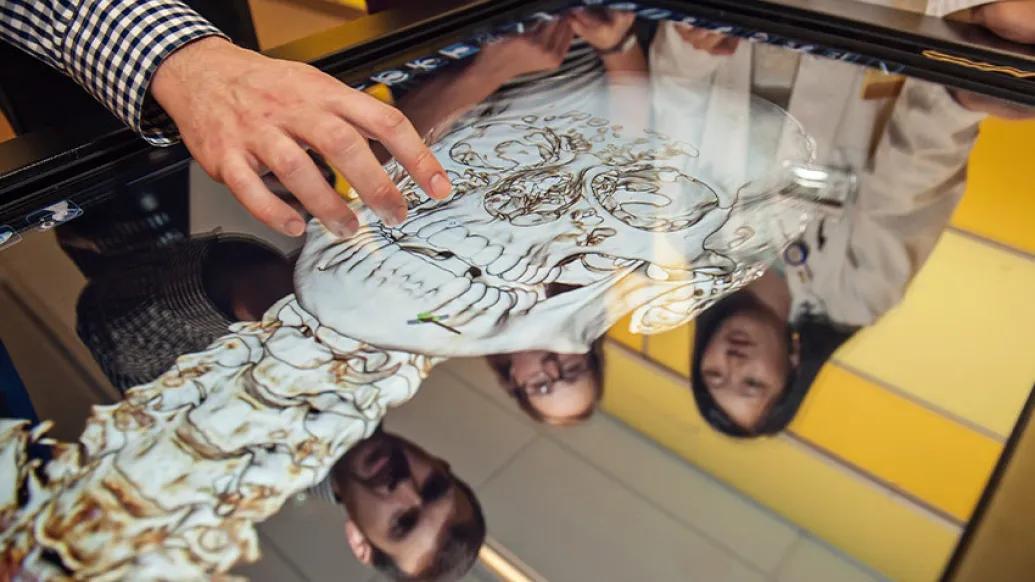
close students standing anatomy table
Pre-COVID, students standing together over an anatomy table. Credit: Michigan Medicine

When the COVID-19 pandemic first started, medical education was met with some serious challenges. As most courses moved to online platforms, gross anatomy, a subject traditionally taught in-person with a corresponding lab component, required some major modifications.

In early March of 2020, the University of Michigan Medical School's division of anatomical sciences had to move all of their courses to virtual learning, which meant that onsite dissections would no longer be an option. However, Michigan Medicine's B. Kathleen Alsup, Ph.D., M.A., director of Anatomical Sciences, and Glenn Fox, Ph.D., M.S., director of the Anatomical Donations Program, leveraged BlueLink, an online education resource, developed in September of 2014. This tool proved to be incredibly useful as faculty and students adjusted to a new way of learning.

"The purpose of BlueLink has always been to share U-M anatomy curricula with the world," says Alsup. "So, the pandemic gave us the opportunity to both use and grow this platform. The tool includes high quality, content-expert reviewed anatomical learning resources. As you can imagine, it has proven to be quite valuable as most courses have been moved to virtual platforms."

Alsup notes that BlueLink includes a library of cadaveric atlas images, or illustrated maps of the human body, as well as relevant lab manuals and dissection guides. Students are also able to access an educational library that includes anatomical learning objective and dissection videos, cadaveric extended reality resources and interactive multiple choice and image-based quizzes.

"All of our BlueLink materials are also free for non-commercial, educational purposes and we really tried to design them around the concept of global access, with a focus on educational equity," Fox adds. "We wanted to free faculty – on a global level – from the burdens of commercial copyright. So, we really view this tool as a timely resource, given the learning constraints put on medical education during COVID-19." 

While BlueLink was already a well-used resource before the pandemic, its use significantly increased: "We noticed an influx of requests for usage, as well as a rapid increase in our website traffic," he says.

MORE FROM THE LAB: Subscribe to our weekly newsletter

The pair notes a multi-university study recently published in Anatomical Sciences Education provides an analysis of anatomy education before and during the COVID-19 pandemic by assessing 67 universities.

"The research team surveyed academic institutions on a global scale," says Alsup. "And what they found was that there was an increase in the use of digital teaching resources during the pandemic, with statistically significant increases in the use of BlueLink resources."

According to Fox, this study's data showed that BlueLink resources are used as much, if not more, than some of the more traditional anatomical resources, such as Gray's Anatomy or the Netter Atlas of Human Anatomy. It also provides evidence that BlueLink resources have been essential in assisting the pandemic-related transition in teaching that occurred at many universities due to COVID-19 restrictions to in-person education.

"As schools rely more and more on XR, or computer-extended reality, BlueLink's cadaveric photographs are often needed to provide context to these images," he adds. "For example, we've seen it used by students within Case Western Reserve University's HoloAnatomy program, among others."

Lastly, the team acknowledges that witnessing the use of content created at Michigan Medicine to support both U-M students and those who seek to understand human anatomy inspires them to work harder.

"We will continue to develop and share resources that connect with learners worldwide," says Alsup. "BlueLink resources help democratize U-M anatomy curricula and help fulfill our mission of public education." 

Paper cited: "An Analysis of Anatomy Education Before and During Covid‐19: May–August 2020," Anatomical Sciences Education. DOI: 10.1002/ase.2051

Like Podcasts? Add the Michigan Medicine News Break on iTunes, Google Podcast or anywhere you listen to podcasts.


More Articles About:

Rounds Medical School Emerging Technologies Future Think Education
Health Lab word mark overlaying blue cells

Health Lab

Explore thousands of health news & research stories by visiting the Health Lab homepage for more.

Media Contact

University Hospital at U-M Health in the spring with flowering trees in foreground and Survival Flight helicopter visible

Public Relations

Department of Communication at Michigan Medicine

[email protected]

734-764-2220

Stay Informed

Want top health & research news weekly? Sign up for Health Lab’s newsletters today!

Subscribe

Featured News & Stories

doctor outside in white coat with headset on and blue mask on in front of greenery
Health Lab

Applying Extended Reality Technologies to Rounds

A fast-tracked collaboration leads to an innovative modality for bringing learners into patient rooms, and sharing best practices and findings with far-flung colleagues.
Rachel Upjohn Building groundbreaking ceremony
News Release

How U-M helped bring depression out of the darkness
The history of the founding of the Eisenberg Family Depression Center at the University of Michigan, the nation's first center focused on research, community outreach and stigma reduction in depression and bipolar disorder.
A smartphone displaying a red heart with a white EKG line on its screen, set against a teal background.
Health Lab

Mobile health app improves heart failure medication use, dosing after hospitalization
A U-M-led trial found a mobile app improved use and dosing of recommended heart failure medications during the 90 days following a hospital discharge.
UMich Med Mosaic on blue background with colorful geometric shapes
UMich Med Mosaic

Beyond the White Coat: Disability, Neurodiversity and Advocacy in Medical School
In this episode of UMich Med Mosaic, host Mackenzie Kay sits down with medical students Jill Maudlin, Sarah Renberg and Bella Johnson to discuss their experiences as disabled and neurodivergent trainees at the University of Michigan Medical School. They reflect on the personal journeys that led them to medicine, the challenges and strengths that accompany living with disabilities and chronic health conditions and the importance of representation within the medical profession. The conversation explores how disability shapes their approaches to patient care, advocacy and teamwork, as well as the role of the Medical Students for Disability Health Advocacy (MSDHA) organization in creating community and advancing accessibility initiatives. They also discuss Michigan’s accommodations in medical education, efforts to improve disability-related curriculum content and the importance of building a culture where disabled and neurodivergent students can thrive.
Minding Memory with a microphone and a shadow of a microphone on a blue background
Minding Memory

Antipsychotic Use in Nursing Homes: Balancing Medication Safety, Policy, and Dementia Care
In this episode, Lauren Gerlach and Matt Davis speak with Theresa Shireman, PhD, Director of the Center for Gerontology and Healthcare Research and a Professor of Health Services, Policy and Practice and Epidemiology at the Brown University School of Public Health. Dr. Shireman’s research focuses on pharmaceutical policy, pharmacoepidemiology, health services research, and medication use among vulnerable populations. Dr. Shireman discusses her recent study, "Impact of Federal Antipsychotic Use Policy in Nursing Homes on New Diagnoses for Approved Indications in Dementia Residents," published in the Journal of the American Geriatrics Society. The study examines whether federal policies designed to reduce antipsychotic use in nursing homes were associated with increases in new diagnoses of conditions, such as schizophrenia, that exclude residents from publicly report antipsychotic quality measures. Using an interrupted time-series design, the researchers examined changes following the 2012 National Partnership to Improve Dementia Care and the 2015 addition of antipsychotic use to the Nursing home Five-Star Quality Rating System. They found that neither policy was associated with an increase in new exclusionary diagnossees, challenging concerns that nursing homes were increasingly assigning these diagnoses to circumvent restrictions on antipsychotic use. The conversation also explores the benefits and risks of antipsychotic medications for people living with dementia, including the potential for serious adverse effects such as sedation, falls, stroke, and increased mortality. Dr. Shireman discusses how public reporting and financial incentives can influence prescribing practices,the limitations of using a single quality measure to evaluate nursing home care, and the importance of balancing medication safety and residents’ individual needs. The discussion highlights the need for shared decision-making among clinicians, nursing home staff, residents, and families, as well as greater investment in staffing, resources, and nonpharmacological approaches to improve quality of life for people living with dementia. The transcript for this episode can be found here.
Well-Being at Michigan Medicine with Dr. Elizabeth Harry
Well-Being at Michigan Medicine

Learning Together: Making Space for Growth at Work

What if well-being starts with how we learn together? On this episode of Well-Being at Michigan Medicine, Elizabeth Harry, M.D., is joined by Rajesh Mangrulkar, M.D., FNAP, Executive Director of U-M’s Center for Interprofessional Practice and Education (IPE), Executive Director of Michigan Medicine RISE (Research. Innovation. Scholarship. Education), and primary care physician of internal medicine whose work focuses on organizational leadership and innovation, and Johnny McGraw, M.A., Marketing & Communications Specialist for both RISE and IPE, about building teams through human connection, psychological safety and learning. They discuss a meeting practice, why leaders shape culture and how investments in collaboration can help health care teams work without asking people to carry everything alone.