Groundbreaking Leukemia Treatment ‘a Whole New Approach’ to Fighting Cancer
Michigan Medicine is the only treatment center in Michigan and one of several dozen sites in the country to offer CAR T-cell immune-therapy for treating childhood leukemia.
8:30 AM
Author |
This article was originally published on August 31, 2017 and was updated on December 5, 2019.
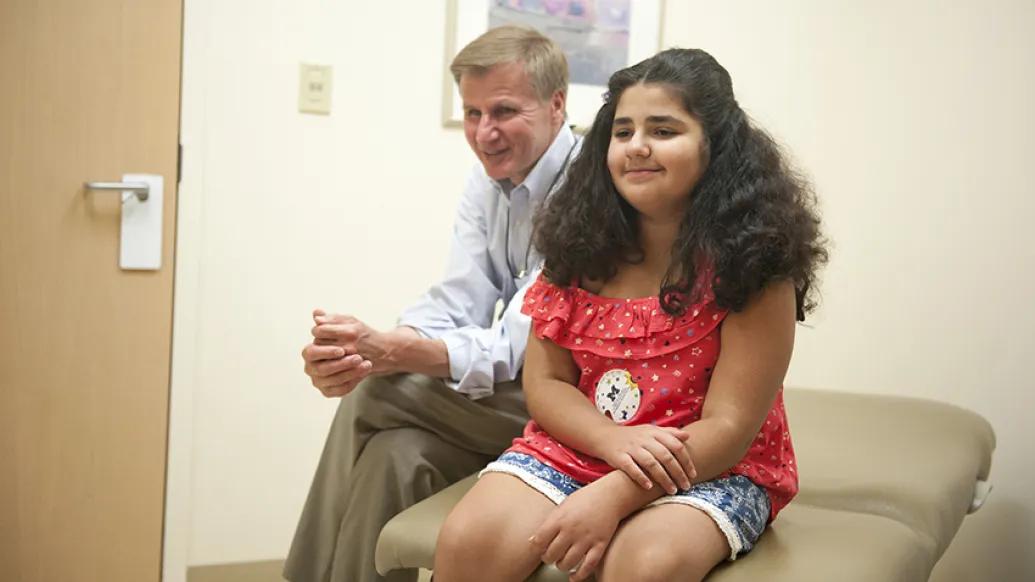
Maryam Rasheed was just seven years old when the cancer she had fought a year earlier returned with a vengeance, and treatment could no longer stop it.
The heartbreaking news came after several rounds of chemotherapy, radiation and a bone marrow transplant from her then 4-year-old brother Rashid to treat acute lymphoblastic leukemia.
So Maryam's doctors in Detroit referred the Macomb Township family to Michigan Medicine's C.S. Mott Children's Hospital for one last chance at finding a cure.
"I told them we will try anything," her mother Asmaa remembers.
At that time, Mott was among a handful of sites in the country participating in a novel clinical trial testing an innovative approach to immunotherapy, in which a patient's immune system is harnessed and re-programmed to attack a patient's own cancer. Maryam enrolled in the study in December, 2014. One hundred days later, a bone marrow test brought stunning news: She was in complete remission.
Today, Michigan Medicine is the only center in the state of Michigan to offer the treatment known as CAR T-cell therapy for pediatric acute lymphoblastic leukemia. Michigan Medicine also offers the therapy for adult patients with acute lymphoblastic leukemia and large B-cell lymphoma, as well as other types of cancer through clinical trials. The institution has now treated over 50 patients through its CAR T-cell program, including roughly 20 children and 30 adults.
Mott was among 15 sites in North America that participated in the original licensing trial in 2017 that led to the Food and Drug Administration's official approval of CAR T-cell therapy in acute lymphoblastic leukemia. Remission rates of 81% were reported, with 50% of recipients remaining leukemia free six months after therapy. The outcomes were striking, as all patients had leukemia that had relapsed or was found to be resistant to other forms of therapy, prior to their CAR T infusion.
"This is a dawn of a new and exciting era in cancer therapy," says Gregory Yanik, M.D., clinical director of the Pediatric Blood and Marrow Transplantation Program at Mott.
"This treatment has the potential to change the face of cancer therapy for years to come, not just for childhood acute lymphoblastic leukemia but in other cancers in which a patient's own T-cells can be collected, genetically modified and redirected to kill a patient's tumor.
"This allows us to turn patients' own cells into a powerful weapon to fight the disease — a weapon that does not rely on chemotherapy but takes a whole new approach to attacking childhood leukemia."
The treatment
T-cells are a special type of white blood cell that normally function as immune surveillance cells, distinguishing cells that are "self" versus "foreign." CAR T-cell treatment involves extracting millions of a patient's own T-cells, and then turbocharging them through bioengineering techniques that reprogram them to target specific proteins on a cancer cell. The technique essentially transforms the patient's cells into what scientists call "a living drug."
Acute lymphoblastic leukemia makes up about a fourth of cancer diagnoses among children under 15 years old and is the most common childhood cancer in the U.S. Children with leukemia often respond to standard treatment, but in 15 percent of cases, cancer cells stubbornly resist treatment or patients relapse.
Doctors are quick to note that while some patients had good responses from CAR T-cell therapy, they have sometimes been short-lived, and the treatment itself can be life-threatening. Side effects can include high fevers, increased blood pressure, rapid pulse and decreased blood flow to internal organs that require ICU stays.
Patients receiving the treatment will be tracked for 15 years in a national registry. Rajen Mody, M.B.B.S., Mott director of pediatric oncology, says just a fraction of patients qualify for the treatment.
"We are pleased that our center was able to play a major role in enrolling patients for the CAR T-cell clinical trial and that we have the expertise and system in place to offer this potentially lifesaving treatment to our patients," Mody says.
"This therapy provides new hope for patients with terminal leukemia in which no other treatment has worked."
This is a dawn of a new and exciting era in cancer therapy.Gregory Yanik, M.D.
Being a kid again
Maryam, now in sixth grade, continues to do well. Every few weeks, she receives IVIG infusions (intravenous immunoglobulin), which involve purified plasma pooled from thousands of blood donors and give her antibodies to fight off germs. Patients on the therapy rely on these infusions to stay healthy because the T-cell treatment not only kills leukemic B-cells but also healthy ones that protect against infections.
After losing her hair three different times, spending long periods wearing face masks, falling behind in school for treatment and spending months at a time hospitalized, Maryam is finally experiencing regular kid life, her family says. She has enjoyed family vacations and time with friends.
Her mother said it was an emotional whirlwind to go from considering hospice to hearing doctors say all signs of cancer were gone.
"It was like a dream," Asmaa said at the time. "We know there are no guarantees the cancer won't come back, but this treatment is the only reason she's here now."

Health Lab
Explore thousands of health news & research stories by visiting the Health Lab homepage for more.
Media Contact

Public Relations
Department of Communication at Michigan Medicine
Stay Informed
Want top health & research news weekly? Sign up for Health Lab’s newsletters today!
Featured News & Stories
Online resources and coaching helped people seek genetic testing for cancer
U-M-led consortium to receive up to $52 million in NIH funding to study why viral respiratory infections affect children differently
4 in 5 parents say having a baby is too expensive
Many hospitals still don’t do enough to prevent UTIs from catheters
Histotripsy research center launches to advance sound-wave-based cancer treatment