A lifeline for primary care amid a crisis in youth mental health
Michigan-wide effort connecting primary care providers with psychiatrists and behavioral specialists for consultation and training supports their ability to provide care in local clinics.
1:12 PM
Author |
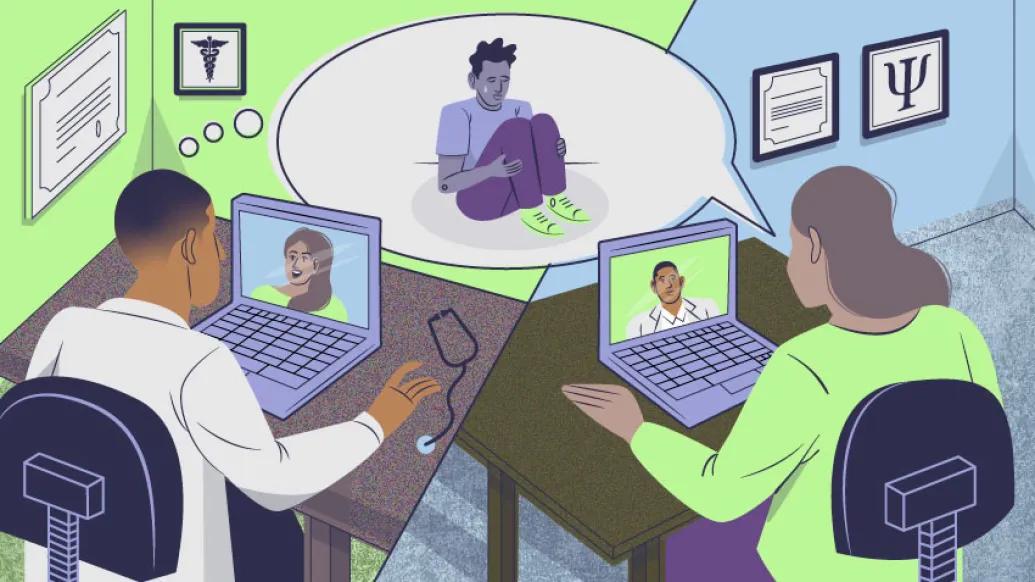
Most mental health care in America doesn't happen in psychiatrists' offices – especially when it comes to children, teens and young adults.
Instead, young people with depression, anxiety and more turn to the same people they already go to for all kinds of other health issues: their pediatricians, family doctors, school-based clinics and other primary care providers.
But where do those providers turn when they need more help in handling the mental health concerns of their patients – especially more serious issues that they're not trained to handle?
If they're anywhere in Michigan, they can turn to the team at MC3.
For nearly a decade, the MC3 program has helped thousands of primary care providers throughout the state care for the mental health needs of young people up to age 26. It also aids providers caring for pregnant women and new mothers of any age who have mental health needs.
More than 16,000 times since 2012, MC3's psychiatrists and pediatric behavior specialists from the University of Michigan have connected directly with more than 1,800 primary care providers by phone, for consultations about their patients.
Together, they've mapped out plans for handling ADHD in young children, suicide-prevention safety planning for teens and symptoms that might signal schizophrenia in young adults.
There's no charge to providers or their patients, thanks to the program's funding from state and federal grants.
For providers whose patients recently had a mental health emergency or are waiting for an appointment with a child psychiatrist or a psychiatric inpatient bed, the service can literally be a lifeline: one in five of the consults involve a patient who has expressed suicidal thoughts or harmed themselves.
How it works
MC3 also offers video-based telehealth appointments to connect patients of participating providers with psychiatrists. U-M and Michigan State University experts have also created a wide range of training options for professionals available on the MC3 website.
Though the demand has grown in recent years thanks to the pandemic, the program has room for more Michigan providers to join the network and get access to its services.
Each connection starts by contacting one of the trained professionals in MC3's network of Behavioral Health Consultants, located throughout the state. MC3 also works closely with the state-funded Community Mental Health agencies across the state.
Like Podcasts? Add the Michigan Medicine News Break on iTunes, Google Podcasts or anywhere you listen to podcasts.
"Only about 3% of the children, teens, young adults and moms that our participating providers have consulted with us about are in treatment with a psychiatrist. We're providing access to specialist-informed care to young people who wouldn't otherwise have it," said Sheila Marcus, M.D., who heads the pediatric component of MC3 and is a professor of psychiatry at Michigan Medicine, the University of Michigan's academic medical center.
"The reality is that no matter where they live and no matter what their family's income level, most of these patients would not have easy access to a specialist because of the critical shortage of such providers," she added. "In some counties, there are no local providers trained to provide this level of care."
SEE ALSO: Primary Care in a Pandemic: Spotting Mental Health Needs During COVID and More
Primary care providers inside and outside Michigan can also access MC3's free online resources, even if they're not enrolled in the program.
These include prescribing guides for mental health medications and online provider education, to equip them to provide diagnosis and care that might not have been part of their formal professional training. Much of that training offers continuing education credits that can help physicians, nurse practitioners, physician assistants and certified nurse midwives keep up their license.
"For me, MC3 has been a game changer," said Lia Gaggino, M.D., who first interacted with the MC3 team through her pediatrics practice in Portage, Michigan and now is the team's consulting pediatrician. "Since its inception I have used their services for children and teens who presented with very complicated mental health concerns. I wished I had had a psychiatrist to help me and then MC3 appeared and offered me a lifeline. Their services changed my prescribing practices and improved my skills and I am so grateful for their advice and support. I encourage my colleagues to sign up and call –MC3 is there to help us!"
Local care amid a national emergency
As the nation grapples with a national emergency of rising mental health concerns among young people, MC3 and similar programs in other states are expanding access to critical psychiatric services at a time when demand is soaring.
The national organizations that declared that emergency in October called for more support of mental health care in primary care settings, as well as efforts to overcome the national shortage of mental health specialists for young people, especially in rural and low-income areas.
We're providing access to specialist-informed care to young people who wouldn't otherwise have it.Sheila Marcus, M.D.
That shortage is what drove the creation of MC3 in the first place.
Michigan is third from the bottom among all states in supply of mental health professionals for young people. Only Washtenaw County, where the University of Michigan is located, meets national population-based criteria for having enough mental health providers specializing in children and teens.
The pandemic has made matters worse across Michigan and the United States. A national report from November 2020 showed that anxiety and depression in pregnant women have more than doubled, and emergency department visits for mental health concerns in children had risen by double digits since the pandemic began.
Joanna Quigley, M.D., another MC3 consulting psychiatrist from Michigan Medicine, recently presented data at a national meeting showing that 30% of MC3 consults during 2020 focused on pandemic-related concerns.
"The COVID-19 pandemic has cast a glaring light on the fragility of our mental health care delivery system," she said. "However, the MC3 program has really been able to shine as a model in which to support the increased demand on primary care to meet the mental health care needs of children and adolescents in our state."
The pandemic has prompted MC3's team to plan to offer extra training to help providers identify the needs and handle the concerns of children traumatized by experiences they or their families have had during COVID-19.
MORE FROM THE LAB: Subscribe to our weekly newsletter
Trauma-informed care is also important for children who even before the pandemic experienced very disruptive life events.
Terri Rosel, NP-C, a nurse practitioner at Cherry Health in northern Michigan, wrote to the MC3 team: "I work in a small student health center in Cedar Springs and am the sole provider in the office. Since starting this job four years ago I have had the pleasure of seeing so many students with mental health concerns. I felt ill-equipped at times to help them with my degree as a family practice nurse practitioner. I would utilize MC3 often to help with treatment plans for these wonderful kids who needed help but could not get into psychiatric services soon enough."
As the program continues to grow, it will partner more with schools through a direct connection with the TRAILS program that offers mental health awareness and support services.
Positive feedback from providers
The MC3 team has surveyed participating providers and found that 99% agreed with the statement that "following phone consultation(s) I felt more confident that I could effectively treat patients' behavioral health problems."
The team published other findings from its survey of providers, and responded to feedback by making changes.
The quotes they received from providers are equally compelling.
"This service has been absolutely 'practice- changing'," said one. "As we have more and more patients with mental health issues and limited local resources- we are essentially the only option for these kids. Having MC3 support helps us make good treatment decisions and is also 'on the job training' which we can apply to future patients."
SEE ALSO: Why Pediatricians Should Screen for Depression in Young Patients
In fact, MC3 data show that 25% of the interactions help the patient avoid a higher-level of care that may be difficult to access, such as a psychiatric hospital bed or emergency psychiatric visit.
One of the maternal health providers who joined MC3 recently said, "I can't even express how this service has enhanced the care I can provide. In the past, we'd screen and diagnose and then send moms out. We'd place referrals and hope that folks could navigate the complex system. Now, with MC3, I can collaborate with psychiatry, start meds or treatment, and access community resources that I am confident they will be able to access. It's really been invaluable."
Paper cited: "Michigan Child Collaborative Care program (MC3): Ten years of growth, adaptation, and learning," American Academy of Child and Adolescent Psychiatry annual meeting. DOI: 10.1016/j.jaac.2021.07.142

Health Lab
Explore thousands of health news & research stories by visiting the Health Lab homepage for more.
Media Contact

Public Relations
Department of Communication at Michigan Medicine
Stay Informed
Want top health & research news weekly? Sign up for Health Lab’s newsletters today!
Featured News & Stories

Galens Tag Days celebrates 100 years of helping kids

From 20 seizures a day to more time for play: How personalized epilepsy care helped young patient
More babies with hypoplastic left heart syndrome surviving critical period between surgeries

Type 1 diabetes does not mean sitting out for 10 year old

Giving Voice to Lived Experience in Dementia Research