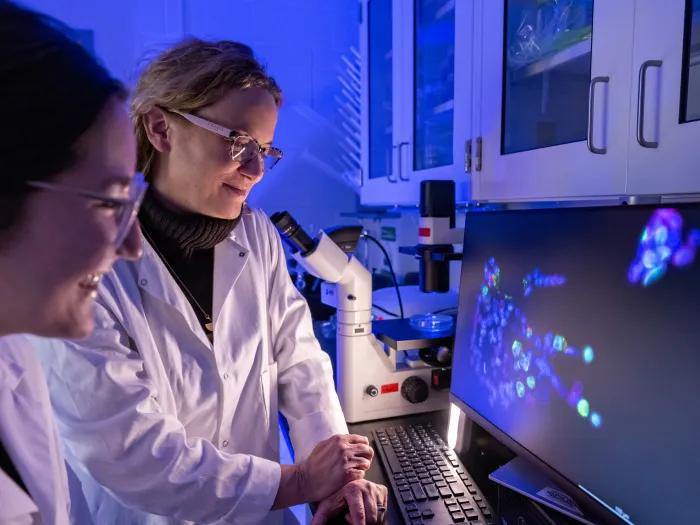
U-M, MEDC award $1.8M to support eight innovative biomedical research projects
10:00 AM
Eight biomedical research projects designed to address challenges ranging from tinnitus to opioid use disorder to preterm birth have received more than $1.8 million from the Michigan Translational Research and Commercialization Life Sciences Innovation Hub.
Led by researchers at the University of Michigan, Corewell Health and Wayne State University, the projects aim to address significant unmet health care needs and enhance quality of life.
The MTRAC Life Sciences Innovation Hub is supported by the Michigan Economic Development Corporation and is co-managed by Innovation Partnerships, based in the U-M Office of the Vice President for Research, and Fast Forward Medical Innovation at the U-M Medical School Office of Research.
Since 2014, the hub has provided more than $20 million to support projects led by Michigan-based researchers that range in scope from medical devices and therapeutics to diagnostics and health information technology. Projects supported by the hub have yielded more than $180 million in follow-on funding, launched more than 40 startups and created 140 high-tech jobs in Michigan.
"The MTRAC Life Sciences Hub has a proven track record of generating strong positive impact across our state and region," said Kelly Sexton, associate vice president for research-innovation partnerships and economic impact. "We are incredibly grateful for the continued investment in high-tech biomedical research from the MEDC and the U-M Office of the Vice President for Research."
MTRAC Life Sciences received 20 competitive proposals this year from institutions statewide, including Corewell Health, Michigan State University, Oakland University, U-M and WSU. Projects were then selected by an oversight committee composed of experienced technologists, entrepreneurs, industry partners and venture capitalists developing and investing in life sciences technologies. Applicants and awardees benefit from access to experienced mentors-in-residence, commercialization education programming and feedback from an extended network of professionals.
"The MTRAC Life Sciences Innovation Hub continues to source and fund high-impact biomedical technologies from across the state of Michigan," said MEDC University Technology Program Director Larry Herriman. "The program has yielded returns to the state through follow-on funding, job creation and technology licensing."
Funding from the MEDC will support the following five projects:
- Product development and human feasibility trial of novel non‐invasive device for effective treatment of tinnitus (Maik Hüttemann and Jinsheng Zhang, WSU)
- PressRite: Novel compression device to reduce post-operative hematoma formation and improve wound healing in patients undergoing pacemaker/defibrillator implantation (Nishaki Mehta, Corewell Health)
- Rectal expulsion device (RED): A point-of-care test to transform care for chronic constipation (Eric Shah, U-M)
- Fully quantitative cervical elastography: Addressing a key unmet need in pregnancy care (Molly Stout, U-M)
- Allosteric modulators for the treatment of opioid use disorder (John Traynor, U-M)
"The projects funded by the hub focus on biomedical innovations that have the potential to greatly impact human lives," said Steven Kunkel, executive vice dean for research at the Medical School and chief scientific officer of Michigan Medicine.
In addition to funding from the MEDC, OVPR and Innovation Partnerships elected to support three additional projects that were reviewed favorably by the oversight committee:
- A powered energy-assist ankle orthosis for arthritic ankle deformities (Robert Gregg, U-M)
- Hemorrhage predictor: A multimodal, neuro-symbolic, and federated AI-based tool for subarachnoid hemorrhage prediction (Khalid Malik, UM-Flint)
- Dual functional drug overcomes STING resistance by eliminating Bregs for long-term anticancer efficacy in pancreatic cancer (Duxin Sun, U-M)
"These projects are designed to find solutions to some of the greatest challenges impacting healthcare," said Rebecca Cunningham, U-M vice president for research and innovation. "This support reflects the University of Michigan's ongoing commitment to translating research discoveries and innovations to positively impact society."
Written by Meghan Cuddihy, U-M Innovation Partnerships
Featured News & Stories
Innovative children’s vision research gets a boost from the Knights Templar Eye Foundation

Pain, psychological factors and physical function closely linked in people with systemic sclerosis
Many hospitals still don’t do enough to prevent UTIs from catheters

15 years of data will help uncover how flu spreads—and how to reduce its impact

Rural-urban disparities in head and neck cancer