Two new global health funds honor champion of women’s health
From Ann Arbor to West Africa, Tim Johnson, M.D., devoted his career to advancing women’s health and elevating the field of global health.
Author |

Tim Johnson, M.D., served as Bates Professor of Diseases of Women and Children during his tenure as chair of the Department of Obstetrics and Gynecology from 1993 until 2018. He was also an Arthur F. Thurnau Professor, professor of obstetrics and gynecology in the Medical School, and professor of women’s and gender studies at U-M.
Johnson passed away in May 2025, leaving a legacy of incredible work that improved and saved the lives of countless women and children and helped shape the field of global health.
Now, two new funds created at Michigan Medicine will honor Johnson’s memory and carry his legacy forward for decades to come.
“Tim Johnson did many things, but he had two core principles,” says Dee Fenner, M.D., who succeeded Johnson as chair of the department and Bates Professor. “One was safe motherhood, both locally and across the globe, with a focus on West Africa and Ghana. He was also a huge advocate for equality for women and others. He valued all people. Those were his core motivating beliefs that drove him to do what he did.”
Johnson’s colleagues valued his principled leadership, generosity, and compassion.
Cheryl Moyer, Ph.D., M.P.H., associate chair of the Department of Learning Health Sciences and professor of learning health sciences, obstetrics and gynecology, and health management and policy, worked with Johnson both as a student and later as a collaborator in Ghana.
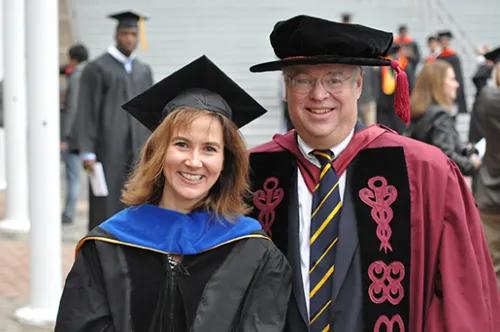
“Tim was always a fierce advocate for women,” Moyer says. “He used to wear a little button that said, ‘Listen to Women.’ He would testify in front of Congress. He would go out on a limb and talk about the value of reproductive health, and he was never afraid of the controversy it might stir up because he had a really strong sense of what was right. And he never shied from that. I think at the end of the day, he had a huge heart.”
Strengthening health systems from within
A pivotal moment in Johnson’s career occurred in the late 1980s when he stepped in for a colleague at the last minute and took their place on a trip to Ghana to give a talk on safe motherhood.
When Johnson heard of women dying during childbirth, the tragedies weighed heavily on him. An expert in women’s health who knew how to train medical students, he decided to do something to improve women’s care options.
At the time, Ghanaian students who wanted to be obstetricians and gynecologists had to train abroad, and most never returned.
“They had a very high brain drain rate because nobody was coming back after those three to five years of medical training elsewhere,” Moyer says.
Johnson and his colleagues developed an in-country training program for obstetricians and gynecologists to train health care workers to save women’s lives and keep this expertise in Ghana.
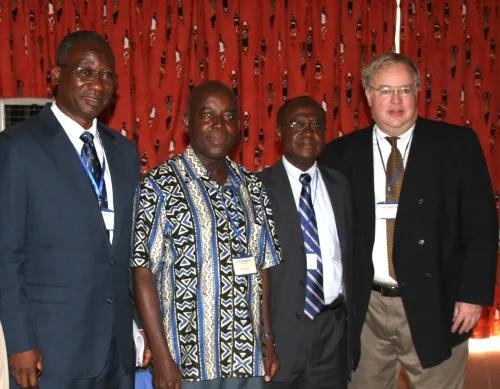
Johnson’s work led to Ghana’s first in-country OB-GYN residency program. A 2022 study published in the British Journal of Obstetrics and Gynaecology found that of the 245 OB-GYN physicians trained in the program, 241 continue to practice in Ghana.
“The program was very different from other models at the time,” Moyer says, “which usually involved exporting a U.S. system, placing it somewhere else, and calling it a local training program. This program was different because it was a system designed in Ghana for Ghanaian trainees, appropriate to the Ghanaian context.”
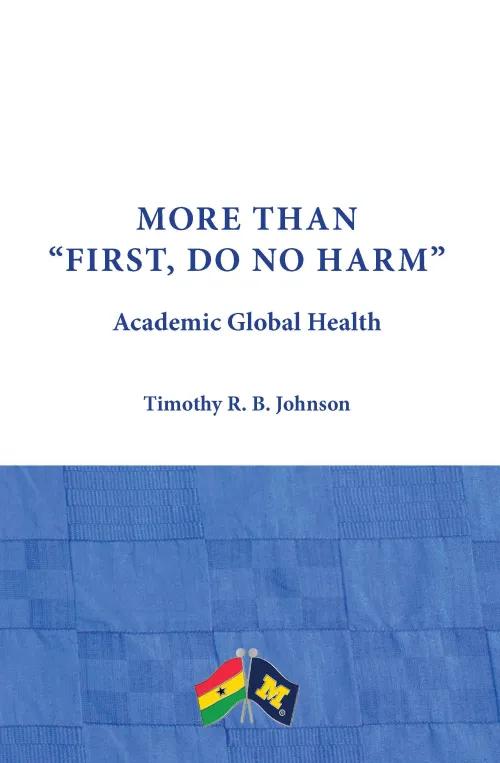
Johnson emphasized the importance of local ownership and leadership of the program to keep it effective and sustainable. His book, “More Than ‘First, Do No Harm,’” shares his experience in Ghana and is an important resource for professionals working to strengthen health systems in low-resource settings.
A focus on partnership
Johnson felt strongly about avoiding a one-way “helping” mentality in global health.
“So much of what Tim stood for was global engagement and partnerships that were mutually beneficial,” Moyer says. “I think some people think about global engagement as, ‘We're going to go help people who are less fortunate.’ But Tim was really adamant about getting over that kind of arrogance.”

“I think that was a very fundamentally different way of approaching global health and something that makes Michigan stand out. There are plenty of ways that we can benefit from learning from our partners elsewhere. They might not have the exact same equipment and supplies that we have, but we can learn a lot from them.”
Moyer recounts a colleague’s experience during a complicated delivery at U-M. A visiting resident from Ghana, where C-sections are less readily available, talked the care team through a maneuver that enabled the patient to continue with a vaginal delivery.
“Examples like that remind us that there are many different ways to accomplish things, and just because we have all this technology doesn't necessarily mean we do it better,” Moyer says.
Opening doors and sharing connections
Moyer remembers how Johnson connected people and helped them build careers in global health.
“He would open doors for people,” she says. “He would use his network and connect people who had never previously met. He would make sure that he could share all the things he had learned and been exposed to. He was never territorial about his contacts and his partnerships.”
Johnson encouraged Moyer to pursue research in Ghana, where she studied maternal and newborn health and helped build local research capacity.
“I used to say that if Tim thought you had a pulse and a skill set, he would put you on a plane to Ghana,” Moyer says. “And I had a pulse and a skill set, so the next thing I knew, I was on a plane to Ghana, thanks to Tim. I had never been there before, but he was working on a grant that ended up turning into my research career. Without him, I wouldn’t be what I am today, and so many people I know would say the same thing.”
Johnson also changed Fenner’s entire career and life trajectory.
“I had trained here and then worked at the University of Washington,” Fenner says. “He brought me back 25 years ago to be the director of the Division of Gynecology. That changed the course of my career and life, and I owe him a huge debt of gratitude.”
Building a global legacy
Both the Department of Obstetrics and Gynecology and the Center for Global Health Equity have created funds to honor Johnson’s memory and carry his vision forward.
The Timothy R.B. Johnson OBGYN Global Health Fund, created by the Department of Obstetrics and Gynecology, will continue the department’s work in Ghana.
“These funds will primarily support the ongoing collaboration in Ghana and global engagement,” says Fenner. “They will also help fund the wonderful exchange program we’ve had for the last 40 years.”
Through the exchange program, Ghanaian students, fellows, and residents come to U-M to learn, and U-M faculty, residents, and fellows go to Ghana and other West African countries to collaborate in global health work and research.
“This fund will continue his vision and mission to ensure that women and all people receive the best care, that we prevent maternal mortality and other conditions that affect women, and that we can try to make the world a smaller place and learn from each other to support education, training, and the advancement of care worldwide,” says Fenner.
The Center for Global Health Equity created the Timothy R.B. Johnson, M.D., Student Award in Global Health Fund.
“This fund will recognize a student who exemplifies a deep and sustained commitment to interdisciplinary collaboration and global engagement,” says Moyer.
The award will be open to undergraduate, graduate, and professional students across all three U-M campuses. Nominees will be evaluated based on their interdisciplinary approach, ability to bridge disciplines, their engagement with international partners or communities, equity-driven purpose, and their commitment to improve health and well-being in an impactful and collaborative way.
“To put it simply, the award recognizes some of the characteristics that we so valued in Tim,” Moyer says.
Thanks to the support of so many colleagues, learners, and other donors to the funds, Johnson’s remarkable legacy in women’s health, global equity, and academic medicine will continue around the world. Each gift helps to carry on his vision and honor his memory.
“There is nothing that will ever replace Tim Johnson,” Moyer says. “He was larger than life. But I do feel like every time we speak his name, we keep him alive.”
If you would like to help honor Johnson's memory and advance his life saving legacy, please consider making a gift to the Timothy R.B. Johnson OBGYN Global Health Fund or the Timothy R.B. Johnson, M.D., Student Award in Global Health Fund.
About the Look to Michigan campaign
These gifts are part of the Look to Michigan fundraising campaign, which aims to create transformative answers to health care’s biggest challenges for the benefit of people in our state and beyond. Building on 175 years of leadership in medicine and as part of the University of Michigan’s Vision 2034 strategic framework for impact, we are breaking new ground in patient care, research, medical and graduate education, health equity, and health care facilities. Together, we can improve and save lives. For more information, visit michiganmedicine.org/giving/look-to-michigan.
Philanthropy News
Discover how donors at Michigan Medicine drive advances in patient care, research, and education. See how philanthropy brings Michigan answers to patients and families.
In This Story
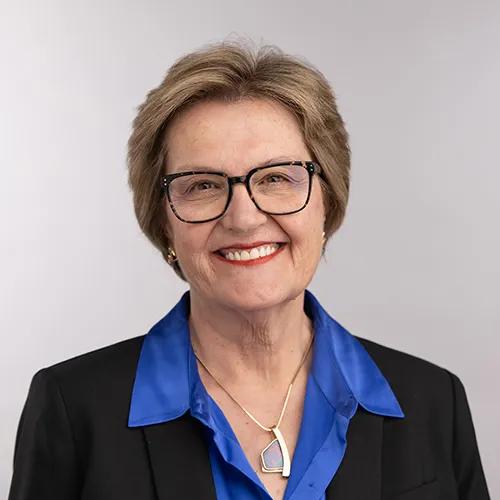
Dee E Fenner, MD
Professor

Cheryl A Moyer, PhD, MPH
Professor
Featured News & Stories
PCOS has a new name

Kellogg care inspires gift to vision research

Rare cancer diagnosis inspires community of support

Foundation gift inspires additional gifts to strengthen youth mental health care

A Gift to Benefit All: Bill and Sally Martin’s Visionary Support for Sports Medicine