Michigan Medicine donors fuel breakthroughs in discovery research
Michigan Medicine launches Discovery Research Week to celebrate essential work that points the way to new treatments and cures.
Author |
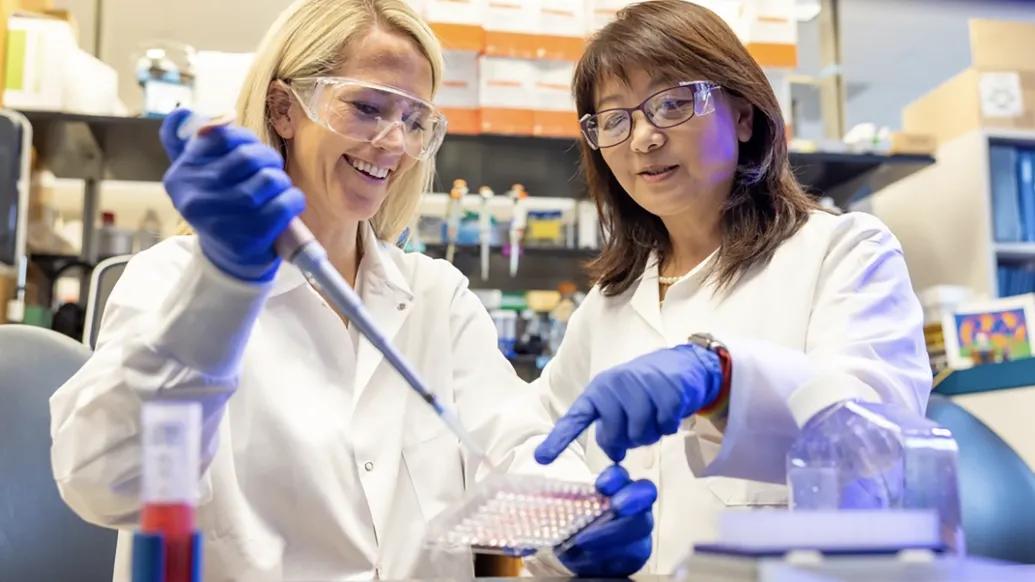
On September 29, 2025, Michigan Medicine will launch Discovery Research Week to celebrate and support researchers and scientists who lay the foundation for everything we do and whose pioneering work points the way to the medical breakthroughs of tomorrow.
We also celebrate the generosity of you, our donors, who make so much of this work possible.
The foundation of medical discovery
Discovery research focuses on the fundamental processes of life and reveals how biology, genes, and environment shape our health. It is the foundation of medical discoveries and has a profound impact on patients and health care.
The knowledge we gain from discovery research can translate from the lab to the clinic, pointing the way to new treatments and cures for people who face debilitating and life-threatening diseases.
Your support fuels breakthroughs
At Michigan Medicine, discovery scientists and researchers ask bold questions — how to destroy tumors once thought to be inoperable, how to ensure transparency and human dignity in medical innovation, how to use the power of RNA to treat diseases like Alzheimer’s and Parkinson’s — and find answers that will improve health and save lives in Michigan and beyond.
Your generosity makes many of these discoveries possible. Gifts of all sizes launch the critical first stages of projects, bridge funding gaps, create outstanding opportunities for learners, and give our researchers and scientists the freedom to test high-risk, high-reward ideas that have incredible potential.
Advancing groundbreaking treatments
Our donors help us advance new therapies that deliver long-awaited options and hope against the most challenging diseases.
U-M scientists and researchers discovered that focused ultrasound could noninvasively liquify tissue without heat and developed histotripsy, a groundbreaking new treatment approach. In 2023, the U.S. Food and Drug Administration approved histotripsy to treat liver tumors, an incredible leap in cancer care. Clinical trials are now underway to evaluate its use for kidney, prostate, and pancreatic tumors. Learn about the surprising discovery that led to histotripsy.
One longstanding challenge in medicine is the development of effective treatments for diseases that are shaped by our genes. Thanks to philanthropic support, our scientists and researchers are unlocking how a wide range of devastating diseases, from widely known conditions like Parkinson’s and Alzheimer’s to rare diseases like Batten disease, originate and progress. Our team’s development of a novel treatment for Batten disease, which uses small, synthetic, RNA-like molecules to change how genes behave, holds incredible potential for the treatment of many other genetic diseases, and donations are helping us continue this work
Accelerating breakthroughs
Donations do more than support individual projects. They also accelerate research across Michigan Medicine and beyond. These gifts empower our researchers and scientists with the cutting-edge tools and technology they need, like high-powered microscopes and computational technology to study cellular processes and pathways that shed light on health, development, and the origins of disease. Gifts also magnify scientific impact by helping our scientists and researchers develop projects with experts in other U-M units as well as other leading institutions.
Nine units from across Michigan Medicine are joining their expertise to make strides in cystic fibrosis research. Building on the work of renowned U-M scientist Francis Collins, M.D., Ph.D., who discovered the gene for cystic fibrosis, the team aims to translate the latest advances from the lab to the patients and families who need them most. Learn more about the cystic fibrosis initiative.
Fostering the future of discovery
We know that just one moment of discovery can change the course of a young person’s future. Immersive scientific learning experiences for high school students, like our six-week Genetics Immersion Program, reflect our long-term commitment to research and education and help students build a path to advanced science education.
Donor-supported fellowships, scholarships, and other opportunities keep our early career faculty, Ph.D. students, and other learners on the leading edge so they can launch research careers and contribute to science and medicine for decades to come. Their discoveries yield new understanding and pave the way for additional high-impact projects. Read about a fellow’s research examining changes in the brain that may drive us to seek food.
Your support is essential
Our work is possible because of the generosity of donors like you who invest in a healthier future for all of us, and our scientists and researchers need your support now more than ever.
We invite you to join us in celebrating the profound impact of discovery research on human health and support the work of those who do so much to deliver the breakthroughs we need. To make a gift, please visit the Discovery Research Week campaign page.
Thank you for believing in the power of science.
Philanthropy News
Discover how donors at Michigan Medicine drive advances in patient care, research, and education. See how philanthropy brings Michigan answers to patients and families.
Featured News & Stories

A Gift to Benefit All: Bill and Sally Martin’s Visionary Support for Sports Medicine
New drug combination may help treat advanced prostate cancer
College of Pharmacy alum advances U-M Medical School addiction research

Block Out Cancer: From a crisis abroad to answers at Mott

How a common virus's hijack of cell repair processes may promote cancer