Dedicated football fans create professorship for life-saving research after wife’s glioblastoma treatment
Author |
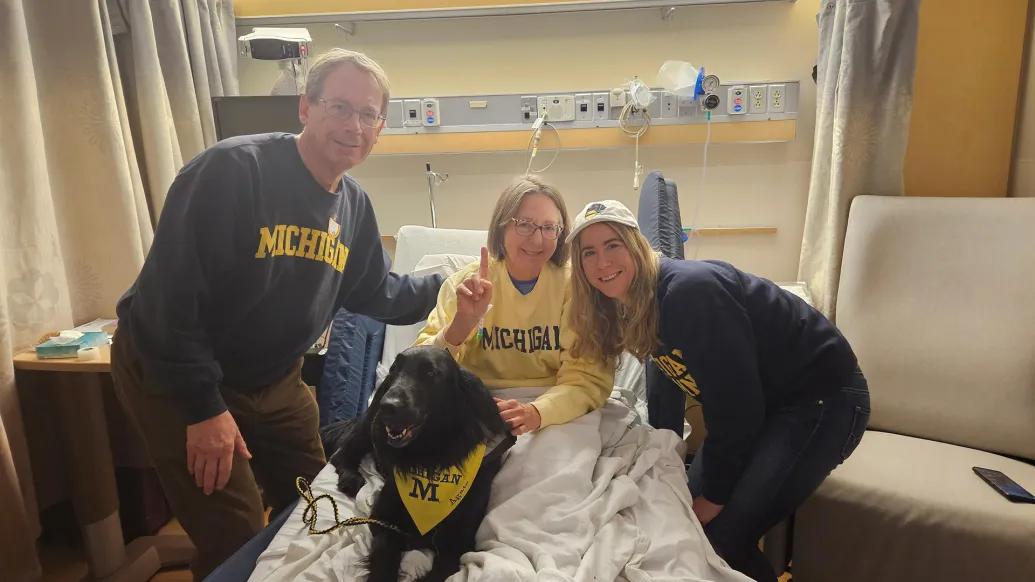
U-M alumni Jim and Connie Achtenberg are loyal Wolverine football fans. “We got married on a Friday in November 1984 so we could go to the Michigan versus Minnesota game on Saturday,” says Jim.
The Achtenbergs lead busy lives traveling to games, attending their daughter Connie’s figure skating competitions, and spending time on Lake Superior with their flat coated retriever, Agate.
Late in 2023, the Achtenbergs began to notice that Connie, a certified U.S. Figure Skating announcer and regular reader at their church, was struggling with reading and that the problem was getting worse. They saw their doctor at University of Michigan Chelsea Family Practice Center, and a CT scan and MRI were scheduled over the next several weeks.
Connie’s symptoms continued to worsen. “On December 30, we were getting ready to go see my mom and travel to Pasadena to see the Rose Bowl,” says Jim. “Connie was having trouble. She couldn’t get her things packed and was just struggling.”
They canceled their flight and headed to Michigan Medicine’s Department of Emergency Medicine.
A life-changing diagnosis
Connie had an MRI that day and was admitted to University Hospital. They watched the Rose Bowl from her hospital room as doctors worked to determine the cause of her symptoms. “There were several possibilities that they kept eliminating until they finally said, ‘it just really looks like a glioblastoma,’” says Jim.
Glioblastoma is an aggressive brain tumor that occurs in adults. It originates in the brain’s glial cells, which support nerve function, and it is often fatal.
Connie’s biopsy happened to be scheduled for January 8th, the day of the 2024 College Football Playoff National Championship. She and Jim watched the game from her recovery room. “The Wolverines won and it was the biggest moment of a U-M football fan’s life,” says Jim, “but that wasn’t the most important thing for us that day.”
Unfortunately, the biopsy confirmed that Connie had glioblastoma.
The Achtenbergs began to work with experts on the Rogel Cancer Center’s neuro-oncology team to develop a plan for Connie to undergo radiation and chemotherapy. The team worked closely together to ensure that Connie could start radiation as soon as possible. “They spent so much time getting things just right,” says Jim.
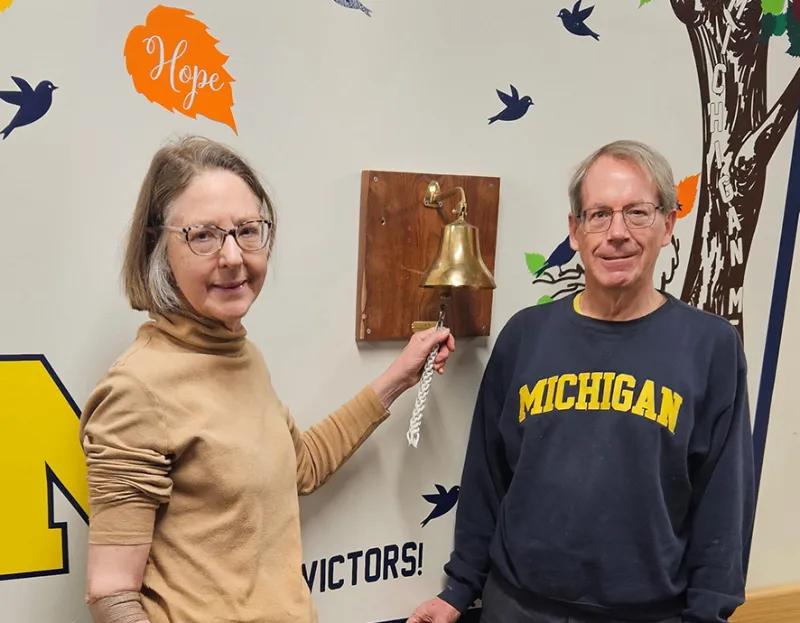
Over the course of Connie’s treatment, which went well, the Achtenbergs worked closely with Nathan Clarke, M.D., assistant professor of neurology.
They also met regularly with Dan Wahl, M.D., Ph.D., associate professor of radiation oncology and associate professor of neurosurgery. As a physician scientist, Wahl cares for patients and conducts research on glioblastoma and other types of brain tumors.
Jim was interested in learning more about Wahl’s research. He read about it on the lab website and would also ask questions at Connie’s appointments. “When I ask him about his research and what’s going on in the lab, you can just see his eyes light up,” says Jim. “He just has this glow about him when he talks about his research.”
Transforming the future of glioblastoma research
Jim and Connie began to consider making a donation to support glioblastoma research and spoke with Amanda Knapp, senior associate director of development in Michigan Medicine’s Office of Development. Knapp arranged for them to tour Wahl’s lab.
Wahl was impressed by the Achtenbergs’ interest in his research and their desire to help future patients have the best treatment options. He showed them some of the lab’s cutting-edge equipment.
“Jim and Connie seemed really excited about our next generation spatial mass spectrometer,” says Wahl. “It was a new addition to the lab within the last few months and is already generating some really great data. I was able to show them some of the early results.”
The spatial mass spectrometer performs detailed metabolic mapping of the molecular structure of brain tumors. It will help Wahl and his team have a clearer understanding of how tumors grow and interact with their environment. This data will lead to better ways to detect tumors, understand their biology, and develop new treatments.
Jim and Connie were inspired by the dedication of Wahl and his team and the work they are doing. “The passion of the people in the lab was just amazing,” says Jim. “Everybody in that lab lights up when they talk about what they are doing. They know they are making a difference.”
The Achtenbergs’ gift will fund a new professorship named the Achtenberg Family Research Professorship in Radiation Oncology. For Jim and Connie, the gift is a testament to their profound gratitude for the care Connie received and their belief in the power of research to transform lives.
They hope the professorship will help pave the way for new groundbreaking discoveries and better outcomes for glioblastoma patients everywhere.
Philanthropy offers hope
Wahl emphasizes the importance of donations of all sizes to medical research. “Philanthropy is an important funding source for our team,” he says. “It lets us invest in high-risk, high-reward ideas and pursue new angles of research. Philanthropy is absolutely critical to the development of exciting new treatments for brain tumors.”
“When I look at making a donation,” says Jim, “there are quite a few areas we could look at. We follow Michigan hockey and Michigan football quite a bit. But I think what we’re doing here is making a difference. When you talk about brain tumor research, that’s going to make a difference.”
One thing Jim hopes for is the expansion of histotripsy, a technique currently used for liver tumors, to brain tumors.
“So many things are happening in glioblastoma research,” says Jim. “Things are so different from how they were five or ten years ago, and so much will happen over the next five years. This is an area where there is a lot to be done, and I think Michigan is moving fast in this area. With the right support, we can move faster. I want to give people hope that there is going to be a way to treat this.”
If you are interested in learning more about donating to radiation oncology research and care, please visit the radiation oncology giving page or give directly to Wahl’s research. Thank you for your support!
About the Look to Michigan campaign
This gift is part of the Look to Michigan fundraising campaign, which aims to create transformative answers to health care’s biggest challenges for the benefit of people in our state and beyond. Building on 175 years of leadership in medicine and as part of the University of Michigan’s Vision 2034 strategic framework for impact, we are breaking new ground in patient care, research, medical and graduate education, health equity, and health care facilities. Together, we can improve and save lives. For more information, visit michiganmedicine.org/look-to-michigan.
Philanthropy News
Discover how donors at Michigan Medicine drive advances in patient care, research, and education. See how philanthropy brings Michigan answers to patients and families.
In This Story
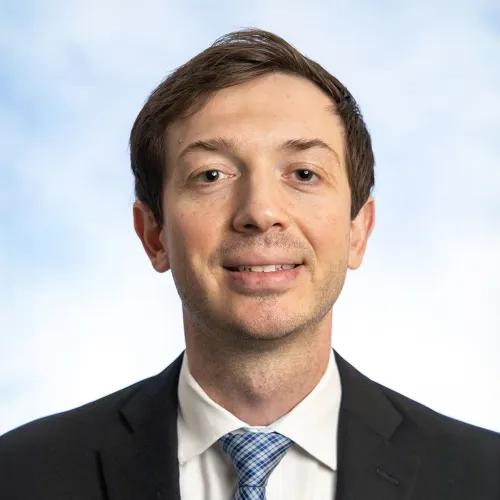
Nathan H Clarke, MD
Clinical Assistant Professor
Amanda Knapp
Senior Associate Director of Development
Daniel R Wahl, MD, PhD
Professor
Featured News & Stories
A second chance at life
Exceptional response to immunotherapy gives patient with liver cancer more milestones to celebrate
A pediatric epilepsy fundraiser that changes lives
Innovative children’s vision research gets a boost from the Knights Templar Eye Foundation
FDA-approved drug offers hope for patients with polycythemia vera, a rare bone marrow disorder