Learning How to Think Like a Physician

Chief concern course gives M1s an early look at clinical reasoning

Author | Katie Vloet
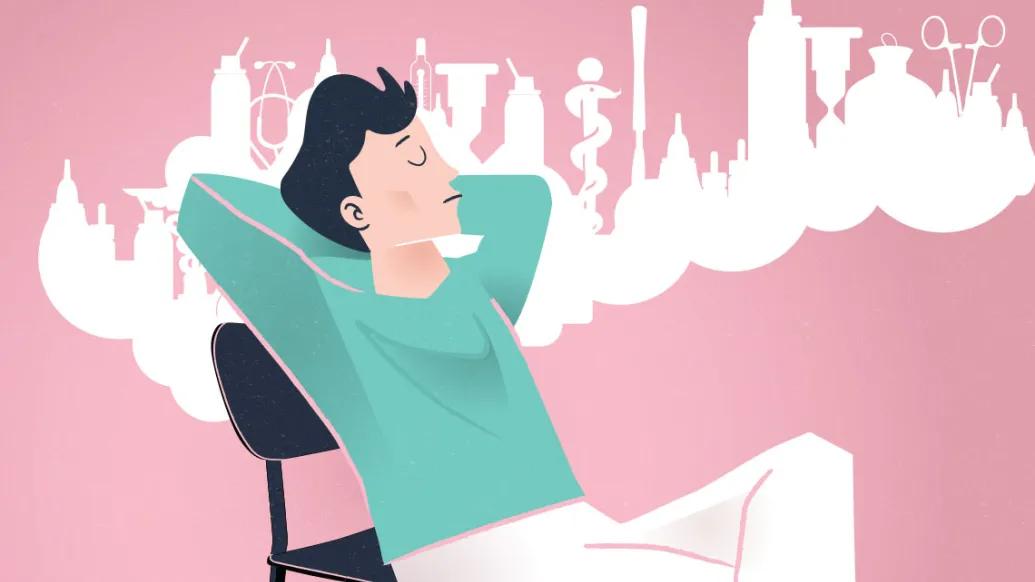
Illustration by B. Creative Group

When Genevieve Allen, now an M3, began her clinical years and was required to interpret lab results, the undertaking felt familiar to her. That's because she had learned the skill in her first year of medical school as a student in the chief concern course (CCC), in which preclinical students review actual patient cases. 

In this class, part of the Medical School's new curriculum, students learn how to think about a patient's chief concern and reason through the clinical presentation to discover what is at the root of each patient's problems. "Chief concern" is the terminology because the course leadership intentionally moved away from the more common "chief complaint" to show greater respect for the patient and his or her medical issues. 

"I think it helps by getting people to start a different way of thinking in the preclinical part of the curriculum, and I think that will make us better physicians," says Allen. "I know that I am much more capable of thinking like a physician because of the CCC." 

Playing physician-detective requires the students to combine pattern recognition and analytical skills, says Sandro Cinti, M.D. (Residency 1995, Fellowship 1998), co-director of the CCC. "The students know they need to keep their minds open to the universe of science and medicine because we are presenting cases from a variety of disciplines," he says. "We discourage overly compartmentalized thinking by crossing organ systems." 

The CCC has been a big hit among students and has gained recognition around the Medical School and the university, winning the 2017 U-M Provost's Teaching Innovation Prize. 

"This is one of the ideal times for introducing clinical reasoning into the students' medical education," says Michael Cole, M.D., co-director of the course. "It gives them a way of bringing together the seemingly disparate facts they are learning in other first-year classes to apply them to the clinical practice of medicine." 

The CCC also incorporates technology and emphasizes the importance of working well with other students. "We were able to work in teams, in a way that is difficult to simulate in a lecture format," Allen says. "This will be very helpful when we are physicians, working in teams with different personalities and expertise." 

Students learn many significant lessons in the class, perhaps most importantly that they aren't always right. "They are okay with getting the wrong answer and learning from that," Cinti says.


More Articles About:

Education Classroom Clinical

Featured News & Stories

Minding memory above a microphone on a blue background
Minding Memory

Is the United States Lagging Behind Europe in Memory Improvement?
In this episode, Lauren & Matt speak with Neil Mehta, PhD who is the associate dean for research and a professor in the Department of Epidemiology at the University of Texas Medical Branch in Galveston. Dr. Mehta’s research focuses on US life expectancy trends, the effects of obesity on disability and mortality, the sources of socioeconomic status disparities in mortality, and patterns of health in the United States and Europe. Dr. Mehta talks about a recent manuscript from the NIA-funded TRENDS study called “Trends in Memory Function and Memory Impairment Among Older Adults in the United States and Europe, 1996 to 2018.”, which looks at data from several sources to compare trends in memory function across 13 different countries.
Minding Memory with a microphone and a shadow of a microphone on a blue background
Minding Memory

The Care Ecosystem: Supporting People Living with Dementia and Their Families
Welcome back to Season 6 of Minding Memory! In this episode, Lauren & Matt speak with Dr. Katherine (Kate) Possin, who holds the John Douglas French Alzheimer’s Foundation Professorship at the University of California, San Francisco Fein Memory & Aging Center. Dr. Possin talks about the Care Ecosystem, a telephone and web-based model that provides ongoing education, support, care planning, and coordination for people living with dementia and their care partners. They’ll dig into how the Care Ecosystem was developed, and what studies have shown about its impact on people living with dementia.
women looking at model hand in front of poster and computer on table next to them
Health Lab

Rethinking how clinicians learn to feel disease
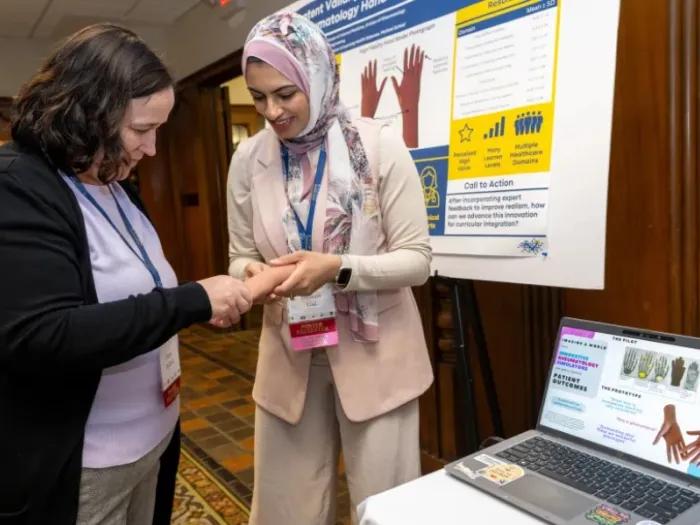
For most doctors, learning to recognize swollen joints begins in the classroom. A clinical assistant professor in Michigan Medicine's Division of Rheumatology saw a gap in how to distinguish subtle swelling in joints, thus creating a hand simulator to help.
Well-Being at Michigan Medicine with Dr. Elizabeth Harry
Well-Being at Michigan Medicine

Rethinking care: How ‘de-implementation’ can improve quality and reduce burnout
In this episode of Well-Being at Michigan Medicine with Dr. Elizabeth Harry, Dr. Eve Kerr explores the concept of de-implementation—scaling back unnecessary tests, treatments, and administrative hurdles. Kerr shares how eliminating low-value practices can reduce clinician overload, lower patient costs, and improve overall health outcomes. Discover how both healthcare organizations and local frontline teams can foster a culture of high-value care by eliminating outdated processes.
presentation on stage with slideshow up
Health Lab

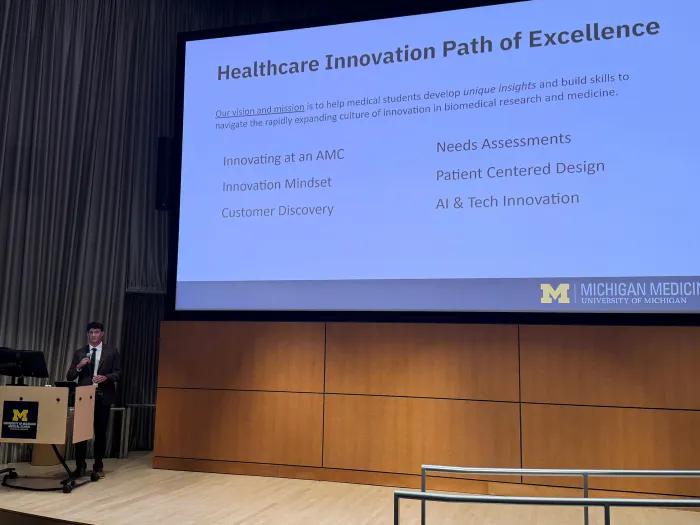
Medical students develop novel technological solutions for unmet patient needs
University of Michigan medical students showcased AI-driven healthcare innovation projects focused on melanoma support, transplant recovery and primary care access.
Michigan Medicine Presents in spotlights on blue background
Michigan Medicine Presents

Michigan Medicine Presents: Tommy Wang, M.D., Dean, University of Michigan Medical School

Join MD student Cassie Evans and PhD student Sam Collie for a wide-ranging conversation with Dean Tommy Wang, M.D. As he reflects on his journey to medicine and academic leadership, Dr. Wang shares his perspectives on student well-being, artificial intelligence, education, research and patient care through the lens of his new role as dean of the University of Michigan Medical School.
