U-M medical students learn their next steps at Match Day 2026

Author | Sam Page

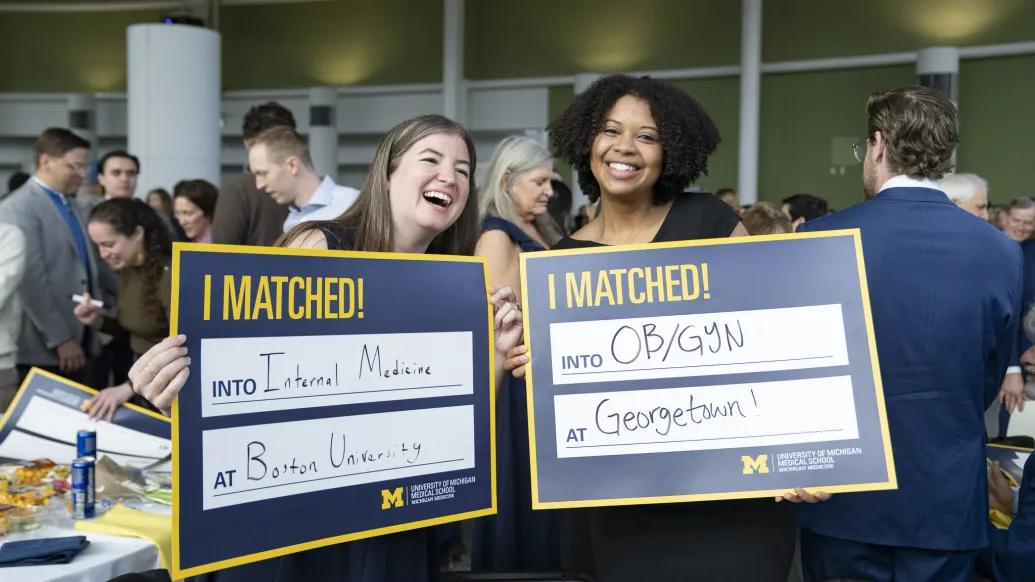
Two U-M medical school students hold up cards announcing their residency matches. The left card reads "Internal Medicine at Boston University." The right card reads "OB/GYN at Georgetown!"
Credit: Carrie Pitzer, Michigan Medicine

This year’s University of Michigan Medical School graduating class will begin residency training in 26 states and Washington, D.C. 

As part of Match Day 2026, 170 U-M medical students found out from the National Residency Match Program where they will continue their medical education.

Family and friends gathered at the University of Michigan’s North Campus Research Complex for a highly anticipated envelope-opening ceremony.

“University of Michigan Medical School students are truly the leaders and best. I’ve been grateful to watch them become exceptional physicians who are committed to their patients, as well as to the health of Michigan, the nation and the world,” said Erin McKean, M.D., MBA, FACS, Assistant Dean for Student Affairs at the U-M Medical School.

“As they have learned and honed their clinical skills, they have had significant impact in research, innovation and service. I'm honored to celebrate alongside them and share our collective congratulations!”
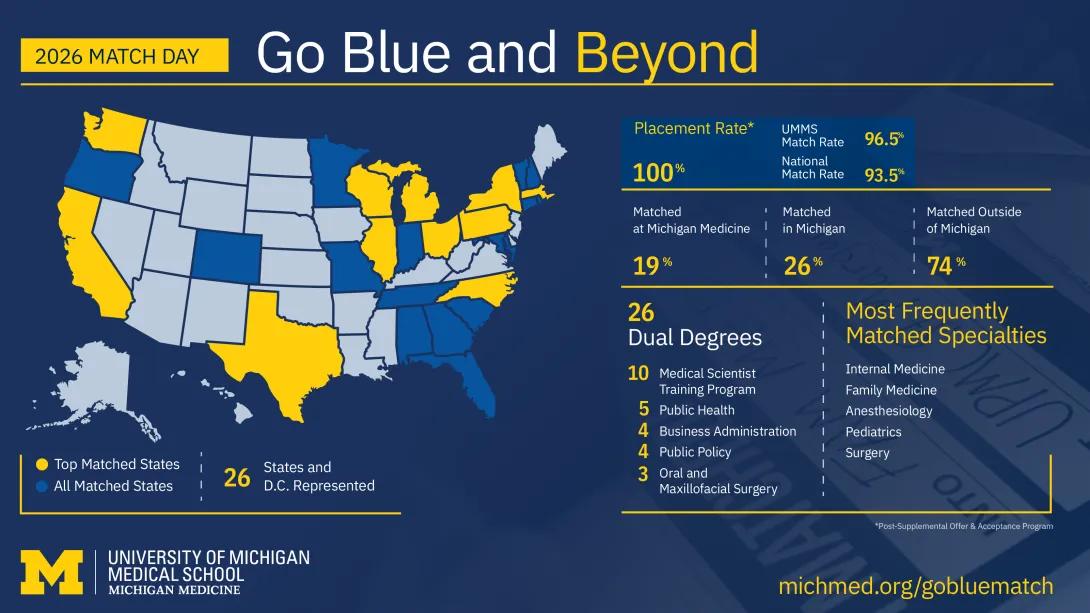
This image displays data about the 2026 Match and includes a visual image of a map of the United States with maize and blue color coding to indicate match placement. A link to the full visual description is in the image caption.
Follow this link for a detailed description of the graphic. 

The placement rate for U-M medical students was 100%. Nineteen percent of this year’s class will continue at U-M after matching at Michigan Medicine — with a total of 26% matching in-state.

The rest of the class will practice at a variety of medical centers elsewhere across the continental United States. 

The most frequently matched specialties were internal medicine, family medicine and anesthesiology.

Outside of Michigan, the top states for matches were California (17 future residents), Illinois (15) and Massachusetts (9).

Twenty-six of the students who matched today are completing dual degrees. 

“Match Day is a major milestone for our senior medical students, and I’m so pleased to celebrate everything they’ve accomplished,” said Thomas Wang, M.D., Dean of the U-M Medical School. 

“They’re an outstanding group of future physicians and I am proud to have them represent the University of Michigan Medical School.”

For more about Match Day, please visit: https://nrmp.org.

And for more about Match Day at the U-M Medical School, please visit: https://michmed.org/gobluematch.


More Articles About:

Medical education Medical Students Medical Student

Featured News & Stories

sanjay gupta and woman on zoom interview
Health Lab

Sanjay Gupta recounts his U-M years and shares life lessons for medical school commencement
Sanjay Gupta speaks with a Michigan Medicine Medical School graduate with words of wisdom for U-M graduates and his favorite past times of Ann Arbor.
U-M medical students on Match Day 2025
News Release

Meet your match: graduating U-M medical students find out what’s next at Match Day

University of Michigan Medical School students found out where they will complete their residency training during Match Day 2025.
A group of costumed med students sing together outside an Ann Arbor storefront.
Philanthropy News

Galens Tag Days celebrates 100 years of helping kids
University of Michigan Medical Students are celebrating the 100th annual Galens Tag Days fundraiser for Washtenaw County children’s organizations.
UMich Med Mosaic on blue background with colorful geometric shapes
UMich Med Mosaic

Beyond the White Coat: Disability, Neurodiversity and Advocacy in Medical School
In this episode of UMich Med Mosaic, host Mackenzie Kay sits down with medical students Jill Maudlin, Sarah Renberg and Bella Johnson to discuss their experiences as disabled and neurodivergent trainees at the University of Michigan Medical School. They reflect on the personal journeys that led them to medicine, the challenges and strengths that accompany living with disabilities and chronic health conditions and the importance of representation within the medical profession. The conversation explores how disability shapes their approaches to patient care, advocacy and teamwork, as well as the role of the Medical Students for Disability Health Advocacy (MSDHA) organization in creating community and advancing accessibility initiatives. They also discuss Michigan’s accommodations in medical education, efforts to improve disability-related curriculum content and the importance of building a culture where disabled and neurodivergent students can thrive.
Well-Being at Michigan Medicine with Dr. Elizabeth Harry
Well-Being at Michigan Medicine

Learning Together: Making Space for Growth at Work
What if well-being starts with how we learn together? On this episode of Well-Being at Michigan Medicine, Elizabeth Harry, M.D., is joined by Rajesh Mangrulkar, M.D., FNAP, Executive Director of U-M’s Center for Interprofessional Practice and Education (IPE), Executive Director of Michigan Medicine RISE (Research. Innovation. Scholarship. Education), and primary care physician of internal medicine whose work focuses on organizational leadership and innovation, and Johnny McGraw, M.A., Marketing & Communications Specialist for both RISE and IPE, about building teams through human connection, psychological safety and learning. They discuss a meeting practice, why leaders shape culture and how investments in collaboration can help health care teams work without asking people to carry everything alone.
female surgeon on ground upset hands to face in scrubs and scrub shoes
Health Lab

Depression in OBGYN residents needs more attention, study suggests

New onset depression in obstetrics and gynecology residents in their intern year is common and often untreated, and linked to depression history, higher work hours and less sleep.