U-M has 14 top 10 medical education programs in latest Doximity Residency Navigator

1:00 PM

Author | Sam Page
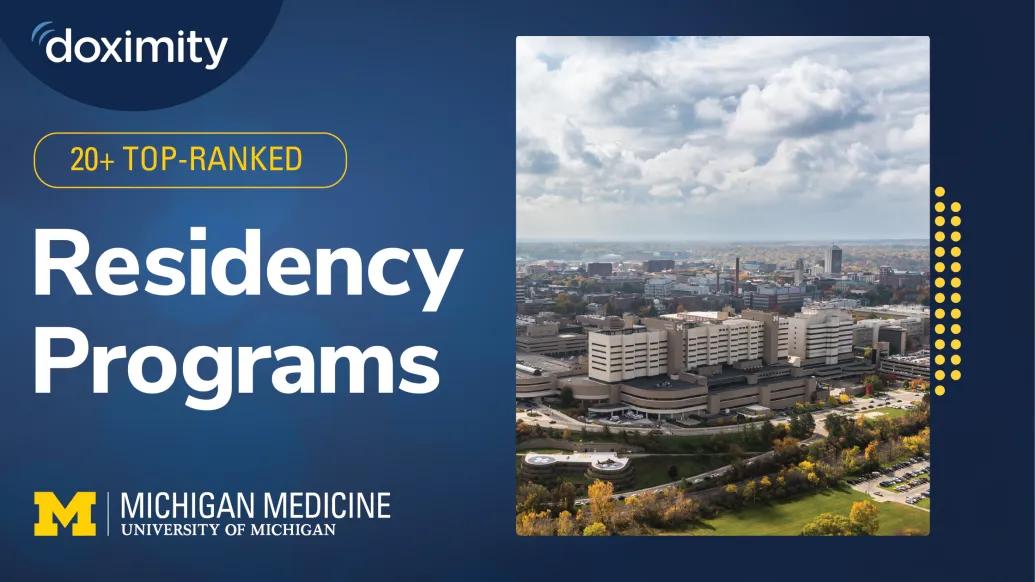
Text reading "20+ Top-Ranked Residency Programs" next to an image of Michigan Medicine buildings

The University of Michigan Medical School has 14 top 10 residency programs, according to the 2024-25 Doximity Residency Navigator. Michigan boasts an additional nine programs that rank within the top 25.

U-M’s surgery residency ranked No. 1 out of 358 programs nationwide. Otolaryngology, pathology, plastic surgery, and urology all ranked No. 3 in their respective specialties. 

Other top 10 programs at Michigan include medicine-pediatrics (ranked No. 5), nuclear medicine (6), anesthesiology (7), internal medicine (7), ophthalmology (7), radiation oncology (7), neurology (8), obstetrics & gynecology (8), and neurological surgery (10).

Also ranking in the top 25 in their specialties were dermatology (11), radiology (11), child neurology (13), physical medicine & rehabilitation (13), emergency medicine (14), family medicine (17), pediatrics (18), psychiatry (19), and orthopaedic surgery (24).

“Our programs’ rankings in the Doximity Residency Navigator reflect our continuing commitment to excellence in graduate medical education,” said J. Sybil Biermann, M.D., associate dean for graduate medical education at the U-M Medical School. “All of our ranked specialties placed in the top 25 with six in the top 5. Prospective residents can see that no matter their focus, Michigan has programs that rate among the nation’s best.”

Doximity’s Residency Navigator is a tool for medical students making residency decisions. It compiles ratings and reviews from current residents and alumni. Prospective residents can search for programs by a variety of criteria and build personalized lists. Doximity also collects data to create a reputation score for each school in each program, which are the basis for these rankings. 

Satisfaction data is derived from satisfaction survey responses from each residency’s current residents and recent graduates, while reputation data is derived from nomination survey responses. This portion is limited to board-certified physicians in that specialty and is alumni weighted. Objective data is compiled from a variety of public sources, including the Doximity database, which covers all U.S. physicians.

For more information about the residency programs at U-M Medical School, visit medschool.umich.edu/programs-admissions/residency-fellowship.

To learn more about Doximity’s Residency Navigator results, visit doximity.com/residency.


More Articles About:

Graduate and postdoctoral education residency resident

Featured News & Stories

Doximity and U-M Medical School logos with text reading "20+ Top-Ranked Residency Programs" next to a photo of U-M buildings.
News Release

Seven U-M residency programs make national top 5 for their specialties
Twenty-four University of Michigan Health residency programs ranked within the top 25 for their specialties in the 2025-26 Doximity Residency Navigator.
The Fundamentals Podcast Hero Card Final 1800 x 1350
The Fundamentals

The Race to Uncover the Hidden Causes of Idiopathic Pulmonary Fibrosis

Season four of The Fundamentals is here, and we're celebrating by doing a special two-episode release to launch the season! On this episode of The Fundamentals, we talk to two clinician scientists determined to unlock the mysteries of idiopathic pulmonary fibrosis. Dr. Marc Peters-Golden and his mentee, Dr. Sean Fortier, discuss their research and the race to uncover the hidden causes of IPF to offer new hope to patients. Be sure to check out our second launch episode and our entire back catalog on The Fundamentals website, or on your favorite podcast player.
doctor presenting in conference room to other doctors in white coats table in middle and screen
Health Lab

Dermatology resident’s China rotation highlights value of global training

Leaders in Dermatology at Michigan Medicine are expanding a program that enables select residents to pursue a clinical experience abroad during the final year of training, with one resident having visited China late last year and three more expected to train abroad in the coming months.
Well-Being at Michigan Medicine with Dr. Elizabeth Harry
Well-Being at Michigan Medicine

Permission to Flourish: Well-Being for High Performers with Shigehiro Oishi

In this special live episode, Dr. Elizabeth Harry hosts Dr. Shigehiro Oishi of the University of Chicago for a compelling, audience-engaged conversation recorded at U-M’s Rackham Building. Drawing on cutting-edge research, Oishi challenges conventional notions of happiness, examining the tension between achievement and meaning. With practical insights for high performers, this energizing discussion invites listeners to rethink success and intentionally cultivate a more expansive, sustainable path to well-being.
UMich Med Mosaic on blue background with colorful geometric shapes
UMich Med Mosaic

Beyond the White Coat: Balance, Burnout and Being Human in Med School

In this episode of UMich Med Mosaic, host Mohika Nagpal engages M3 Krupa Patel in a year-by-year conversation about navigating medical school. They unpack M1 imposter syndrome and study strategies, the unique pressures of M2 clinical year, and the autonomy and stressors of M3 and M4 years, including Step studying and specialty decisions. They share coping tips like “brain, body, heart” check-ins and how to prioritize rituals and rest. The episode also highlights U-M support options such as peer support advocates, mental health counseling, CAPS and student wellness representatives.
Well-Being at Michigan Medicine with Dr. Elizabeth Harry
Well-Being at Michigan Medicine

Credentialing: Supporting Clinicians, Protecting Patients

Credentialing plays a critical role in patient safety — but it can also affect whether clinicians feel safe seeking mental health care. In this episode, leaders from Michigan Medicine and the Dr. Lorna Breen Heroes Foundation discuss evolving credentialing practices, reducing stigma and supporting clinician well-being while protecting patients. The conversation highlights how thoughtful policy changes can help create a healthier, more compassionate health care system. Learn more: Dr. Lorna Breen Heroes’ Foundation