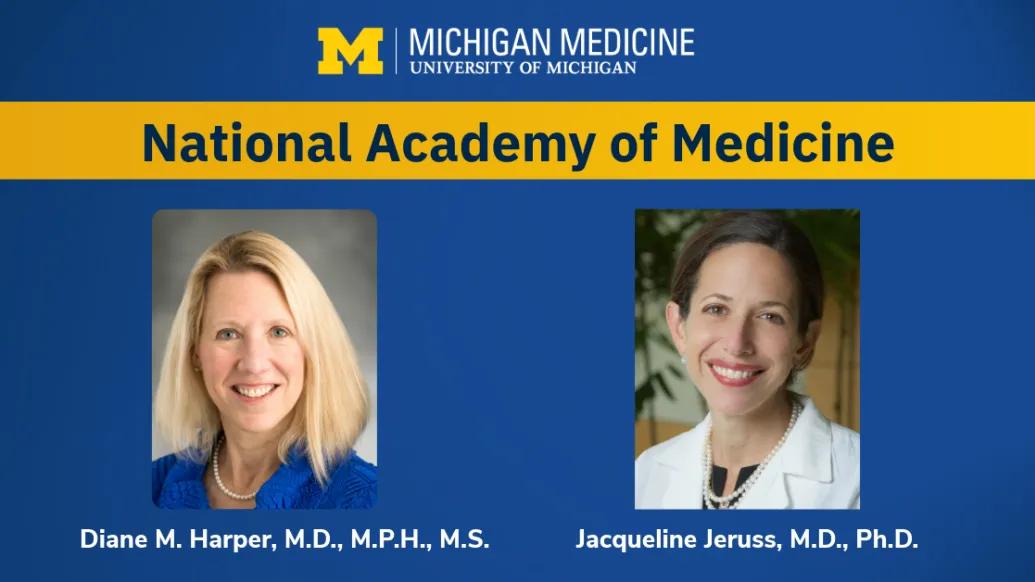
Earlier today, two University of Michigan faculty members, Diane M. Harper, M.D., M.P.H., M.S., and Jacqueline Jeruss, M.D., Ph.D., were elected to the prestigious National Academy of Medicine, joining 98 other honorees in receiving one of the highest distinctions in health and medicine.
Their election recognizes their exceptional contributions to health and medicine and reinforces University of Michigan’s leadership in research and innovation.
They join 86 current, former and late U-M faculty members who have earned this distinction, reflecting the university’s longstanding commitment to advancing scientific discovery and improving health.
Diane M. Harper, M.D., M.P.H., M.S
Diane M. Harper, M.D., M.P.H., M.S., is an MIT-educated physician-scientist and master clinician whose patient care informs her clinical research. She has been honored by the New Hampshire and Michigan chapters of the American Academy of Family Physicians. Harper was the lead author of global clinical trials for HPV vaccination and established a benchmark study demonstrating the equivalency of self-sampling for cervical cancer screening in the United States, contributing to a shift away from routine speculum use for screening. She has served in every major departmental leadership role, including clerkship director, residency director, research director and chair of Family Medicine, while continuing her research to improve women's health.
Harper is an internationally recognized physician-scientist in cervical cancer prevention. She has received two European awards for distinguished scientific accomplishment, the Prix Monaco and EuroGin. She has served as a consultant to the World Health Organization on global cervical cancer prevention and served on review committees for the European Commission and the National Institutes of Health.
Harper has been recognized for her educational leadership by the University of Michigan and the Society of Teachers of Family Medicine, receiving a lifetime award for excellence in education and multiple Teacher of the Year awards. Her research has been recognized by the Society of Teachers of Family Medicine with the Curtis Hames Lifetime Achievement Award and nationally by the American Association of Physicians and the American Association for the Advancement of Science, to which she was the first family medicine physician elected.
Twenty years after the FDA approved HPV vaccines, cervical cancer incidence among U.S. women ages 18 to 34 has decreased by 50%.
Jacqueline Jeruss, M.D., Ph.D.
Jeruss is the Alfred E. Chang, M.D., Research Professor of Surgical Oncology in the Department of Surgery, with additional appointments in the departments of Pathology and Biomedical Engineering. She serves as associate vice president for research, integrity and compliance at the University of Michigan and associate dean for regulatory affairs at the Medical School. She is director of the Polly Cheung Breast Surgical Oncology Fellowship and co-director of the Surgical Oncology T32 Training Program. She previously served as director of the University of Michigan Breast Care Center. Her clinical practice focuses on caring for high-risk patients and patients with benign and malignant breast disease.
Jeruss earned undergraduate degrees in neuroscience and history from Brandeis University and her medical degree from the University of Vermont. She completed her general surgery residency at Northwestern University Medical School and earned a doctorate from Northwestern University, where she studied breast cancer biology. She completed a fellowship in breast surgical oncology at MD Anderson Cancer Center and joined the faculty in the Division of Breast Surgery at Northwestern before joining the University of Michigan in 2014.
For two decades, Jeruss' National Institutes of Health-funded clinical and basic research program has focused on targeted therapies for aggressive breast cancer subtypes, novel approaches to managing cancer metastasis, fertility preservation and surgical ethics. Her research has advanced understanding of the mechanisms underlying breast cancer cell cycle deregulation, the use of bioengineered scaffolds to prevent cancer metastasis, and the basic science and clinical translation of fertility preservation for young patients with cancer.
Jeruss teaches students at all levels of training and is active in several professional societies, including the American College of Surgeons and the Society of Surgical Oncology. She is president-elect of the Breast Surgery International Society.
Media Contact

Public Relations
Department of Communication at Michigan Medicine
In This Story
Diane M Harper
Professor
Jacqueline S Jeruss, MD, PhD
Professor
Related
Five U-M faculty members elected to National Academy of Medicine
Five faculty members with diverse backgrounds elected to National Academy of Medicine
Featured News & Stories

Understanding family history key to early detection of pancreatic cancer

Patient with rare form of diabetes finds answers in genetic testing, clinical trials

5 ways to manage politically induced stress
Treatment with norrin helped maintain healthy blood vessels, preserved vision in diabetic rats

Small comforts make a world of difference