Thomas Wang named new dean of University of Michigan Medical School

10:15 AM

Authors | Beata Mostafavi | Sam Page

Thomas J. Wang, M.D.
Thomas Wang, U-M Medical School dean

ANN ARBOR, Mich. – Thomas J. Wang, M.D., has been appointed as the next dean of the University of Michigan Medical School, effective Sept.15.

He will also hold the title of professor with tenure in the U-M Department of Internal Medicine.

Wang brings a distinguished track record of leadership, research excellence and commitment to medical education as a professor and chair of the Department of Internal Medicine at the University of Texas Southwestern Medical Center. 

“I’m truly honored to join the University of Michigan and Michigan Medicine,” Wang said. “I'm very familiar with the medical school’s legacy of outstanding patient care, discovery, and education and it has been great to learn about all the ways the institution is building on that tradition. I’m excited to have the opportunity to contribute to this incredible community as the next dean.”

A native of Boston, Massachusetts, Wang received his medical degree from Harvard Medical School after graduating summa cum laude from Harvard College. He completed residency training in internal medicine and advanced training through a fellowship in cardiology at Massachusetts General Hospital.

“We are thrilled to welcome Dr. Wang to our leadership team,” said David Miller, M.D., M.P.H., University of Michigan’s executive vice president for medical affairs and chief executive officer of Michigan Medicine.

“His vision for interdisciplinary collaboration, scientific innovation and transformative education aligns seamlessly with our mission to train the next generation of physicians, scientists, and healthcare leaders.”

Wang previously served on the faculty of Massachusetts General Hospital and Harvard Medical School from 2003 to 2013 where he led a nationally recognized program in patient-oriented research and pursued clinical work in heart failure and transplantation. From 2013 to 2020 he served as director of the division of cardiovascular medicine and physician-in-chief of the Vanderbilt Heart and Vascular Institute.

Wang’s research has received continuous support from the National Institutes of Health, contributing to advances in understanding the natriuretic peptide system, cardiovascular biomarkers, and the prevention of cardiovascular disease.

“His scholarship encompasses the continuum from fundamental research to clinical application, but it is his ability to orchestrate complex academic enterprises that makes him uniquely qualified for Michigan Medicine,” said Laurie McCauley, provost and executive vice president for academic affairs at U-M.

“He is the visionary leader our medical school requires as we address the most critical health challenges facing society.”

Wang, the physician-in-chief at UT Southwestern’s William P. Clements Jr. University Hospital, joined the Dallas-based medical center in February 2020, leading its largest department through the challenges posed by the COVID-19 pandemic. During that time, the department served as the primary service for the vast majority of hospitalized COVID-19 patients, nearly 500 a day across three hospitals during the peak surges.

As the seventh chair in the history of UT Southwestern’s Department of Internal Medicine, Wang led transformative growth, recruiting more than 400 new faculty. With the addition of several tracks, the Internal Medicine residency program is now second largest in the country.

Wang is currently president-elect of the Association of Professors of Medicine, a standing member of the FDA Endocrinologic and Metabolic Drugs Advisory Committee and the NIH Human Studies of Diabetes and Obesity study section and an elected member of the Association of American Physicians and the American Society of Clinical Investigation.

His commitment to education has been recognized with the American Heart Association Genomics and Precision Medicine Mentoring Award and the Outstanding Mentor Award from Mass General Brigham.

Wang succeeds Marschall S. Runge, M.D., Ph.D., who served as executive vice president for medical affairs and chief executive officer of Michigan Medicine since March 2015 and dean of the U-M Medical School since January 2016.

“We would like to express our gratitude to the search advisory committee members for their exceptional service. We are also deeply appreciative of the many stakeholders across our community who provided thoughtful feedback and engaged meaningfully throughout the search process,” Miller said. 

“A special thanks goes to Dr. Marschall Runge for his dedication and continued service as Medical School dean during the transition period. We are all thankful for his dedication to both the medical school and the university in this capacity.” 


More Articles About:

Education

Featured News & Stories

UMich Med Mosaic on blue background with colorful geometric shapes
UMich Med Mosaic

Beyond the White Coat: Disability, Neurodiversity and Advocacy in Medical School

In this episode of UMich Med Mosaic, host Mackenzie Kay sits down with medical students Jill Maudlin, Sarah Renberg and Bella Johnson to discuss their experiences as disabled and neurodivergent trainees at the University of Michigan Medical School. They reflect on the personal journeys that led them to medicine, the challenges and strengths that accompany living with disabilities and chronic health conditions and the importance of representation within the medical profession. The conversation explores how disability shapes their approaches to patient care, advocacy and teamwork, as well as the role of the Medical Students for Disability Health Advocacy (MSDHA) organization in creating community and advancing accessibility initiatives. They also discuss Michigan’s accommodations in medical education, efforts to improve disability-related curriculum content and the importance of building a culture where disabled and neurodivergent students can thrive.
Minding Memory with a microphone and a shadow of a microphone on a blue background
Minding Memory

Antipsychotic Use in Nursing Homes: Balancing Medication Safety, Policy, and Dementia Care
In this episode, Lauren Gerlach and Matt Davis speak with Theresa Shireman, PhD, Director of the Center for Gerontology and Healthcare Research and a Professor of Health Services, Policy and Practice and Epidemiology at the Brown University School of Public Health. Dr. Shireman’s research focuses on pharmaceutical policy, pharmacoepidemiology, health services research, and medication use among vulnerable populations. Dr. Shireman discusses her recent study, "Impact of Federal Antipsychotic Use Policy in Nursing Homes on New Diagnoses for Approved Indications in Dementia Residents," published in the Journal of the American Geriatrics Society. The study examines whether federal policies designed to reduce antipsychotic use in nursing homes were associated with increases in new diagnoses of conditions, such as schizophrenia, that exclude residents from publicly report antipsychotic quality measures. Using an interrupted time-series design, the researchers examined changes following the 2012 National Partnership to Improve Dementia Care and the 2015 addition of antipsychotic use to the Nursing home Five-Star Quality Rating System. They found that neither policy was associated with an increase in new exclusionary diagnossees, challenging concerns that nursing homes were increasingly assigning these diagnoses to circumvent restrictions on antipsychotic use. The conversation also explores the benefits and risks of antipsychotic medications for people living with dementia, including the potential for serious adverse effects such as sedation, falls, stroke, and increased mortality. Dr. Shireman discusses how public reporting and financial incentives can influence prescribing practices,the limitations of using a single quality measure to evaluate nursing home care, and the importance of balancing medication safety and residents’ individual needs. The discussion highlights the need for shared decision-making among clinicians, nursing home staff, residents, and families, as well as greater investment in staffing, resources, and nonpharmacological approaches to improve quality of life for people living with dementia. The transcript for this episode can be found here.
Well-Being at Michigan Medicine with Dr. Elizabeth Harry
Well-Being at Michigan Medicine

Learning Together: Making Space for Growth at Work

What if well-being starts with how we learn together? On this episode of Well-Being at Michigan Medicine, Elizabeth Harry, M.D., is joined by Rajesh Mangrulkar, M.D., FNAP, Executive Director of U-M’s Center for Interprofessional Practice and Education (IPE), Executive Director of Michigan Medicine RISE (Research. Innovation. Scholarship. Education), and primary care physician of internal medicine whose work focuses on organizational leadership and innovation, and Johnny McGraw, M.A., Marketing & Communications Specialist for both RISE and IPE, about building teams through human connection, psychological safety and learning. They discuss a meeting practice, why leaders shape culture and how investments in collaboration can help health care teams work without asking people to carry everything alone.
Minding memory above a microphone on a blue background
Minding Memory

Is the United States Lagging Behind Europe in Memory Improvement?

In this episode, Lauren & Matt speak with Neil Mehta, PhD who is the associate dean for research and a professor in the Department of Epidemiology at the University of Texas Medical Branch in Galveston. Dr. Mehta’s research focuses on US life expectancy trends, the effects of obesity on disability and mortality, the sources of socioeconomic status disparities in mortality, and patterns of health in the United States and Europe. Dr. Mehta talks about a recent manuscript from the NIA-funded TRENDS study called “Trends in Memory Function and Memory Impairment Among Older Adults in the United States and Europe, 1996 to 2018.”, which looks at data from several sources to compare trends in memory function across 13 different countries.
Minding Memory with a microphone and a shadow of a microphone on a blue background
Minding Memory

The Care Ecosystem: Supporting People Living with Dementia and Their Families
Welcome back to Season 6 of Minding Memory! In this episode, Lauren & Matt speak with Dr. Katherine (Kate) Possin, who holds the John Douglas French Alzheimer’s Foundation Professorship at the University of California, San Francisco Fein Memory & Aging Center. Dr. Possin talks about the Care Ecosystem, a telephone and web-based model that provides ongoing education, support, care planning, and coordination for people living with dementia and their care partners. They’ll dig into how the Care Ecosystem was developed, and what studies have shown about its impact on people living with dementia.
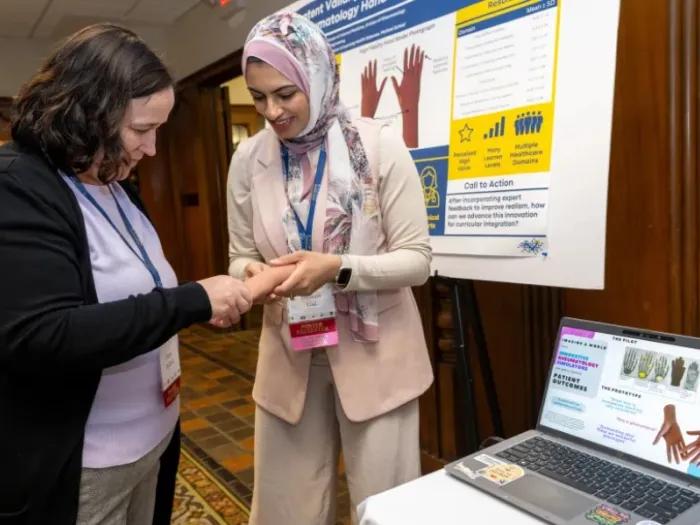
women looking at model hand in front of poster and computer on table next to them
Health Lab

Rethinking how clinicians learn to feel disease

For most doctors, learning to recognize swollen joints begins in the classroom. A clinical assistant professor in Michigan Medicine's Division of Rheumatology saw a gap in how to distinguish subtle swelling in joints, thus creating a hand simulator to help.