Seven U-M residency programs make national top 5 for their specialties

The University of Michigan Medical School boasts 24 top 25 programs in the 2025-26 Doximity Residency Navigator

Author | Sam Page
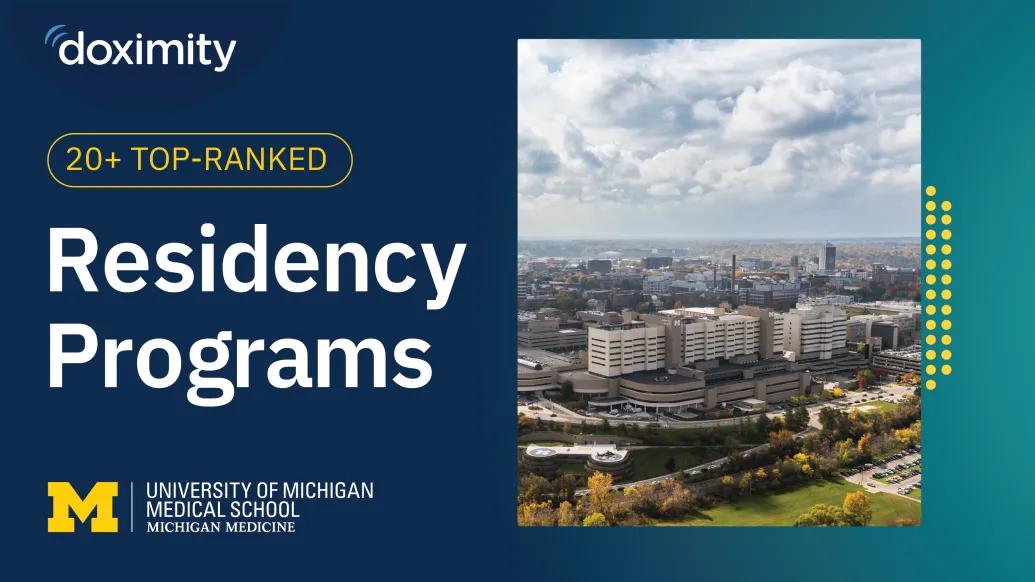
Doximity and U-M Medical School logos with text reading "20+ Top-Ranked Residency Programs" next to a photo of U-M buildings.

In the latest Doximity Residency Navigator, the University of Michigan Medical School has 13 top 10 graduate medical education programs, including seven in the top 5. An additional 11 U-M programs ranked within the top 25.

University of Michigan Health’s surgery residency ranked No. 1 out of 355 programs, while otolaryngology was No. 2 of 131.

Other top 10 U-M programs include pathology (No. 3), plastic surgery (3), urology (3), medicine-pediatrics (4), nuclear medicine (4), anesthesiology (7), obstetrics and gynecology (7), radiation oncology (7), internal medicine (8), neurology (8) and ophthalmology (9).

“Over 20 top-ranked residency programs reflect University of Michigan Health’s continued ability to attract the best teachers and trainees,” said J. Sybil Biermann, M.D., associate dean for graduate medical education at the U-M Medical School.  

“I want to congratulate our faculty and staff. These rankings speak to their tireless work.”  

Among the other U-M residencies ranked in the top 25 of their specialties were neurological surgery (11), radiology (11), dermatology (12), family medicine (13), physical medicine and rehabilitation (13), child neurology (14), emergency medicine (18), pediatrics (18), psychiatry (20), orthopaedic surgery (21) and interventional radiology (24).

The Doximity Residency Navigator is a directory designed to help medical students make decisions during the match process. Students can read reviews from current and former residents for each program. Each specialty can be sorted by criteria such as reputation, research output and program size.

The above rankings reflect how the University of Michigan Medical School residency programs rank when each specialty is sorted by reputation. The reputation score is calculated based on the nominations of physicians whose eligibility was determined by their board certifications and weighted by alumni status.

For more information about the residency programs at U-M Medical School, visit medschool.umich.edu/programs-admissions/residency-fellowship.

To learn more about Doximity’s Residency Navigator results, visit doximity.com/residency.

About University of Michigan Medical School: The U-M Medical School is committed to educating the next generation of physicians, health professionals and scientists. It is one of the nation's biomedical research powerhouses, with total research awards of more than $830 million. In 2025, the U-M Medical School is celebrating its 175th anniversary. The school was the first to have medical professors who were full university faculty (1850), the first to open a university-owned hospital (1869), the first major medical school to admit women alongside men (1870) and the first to require clinical clerkship training for all students (1899). Learn more about its first 175 years at https://medumi.ch/175th.


More Articles About:

Graduate and postdoctoral education residency resident

Featured News & Stories

Text reading "20+ Top-Ranked Residency Programs" next to an image of Michigan Medicine buildings
News Release

U-M has 14 top 10 medical education programs in latest Doximity Residency Navigator
The 2024-25 Doximity Residency Navigator has been released. It shows that U-M has six top 5 medical education programs, with nine more in the top 10 and another nine in the top 25.
UMich Med Mosaic on blue background with colorful geometric shapes
UMich Med Mosaic

Beyond the White Coat: Disability, Neurodiversity and Advocacy in Medical School

In this episode of UMich Med Mosaic, host Mackenzie Kay sits down with medical students Jill Maudlin, Sarah Renberg and Bella Johnson to discuss their experiences as disabled and neurodivergent trainees at the University of Michigan Medical School. They reflect on the personal journeys that led them to medicine, the challenges and strengths that accompany living with disabilities and chronic health conditions and the importance of representation within the medical profession. The conversation explores how disability shapes their approaches to patient care, advocacy and teamwork, as well as the role of the Medical Students for Disability Health Advocacy (MSDHA) organization in creating community and advancing accessibility initiatives. They also discuss Michigan’s accommodations in medical education, efforts to improve disability-related curriculum content and the importance of building a culture where disabled and neurodivergent students can thrive.
Minding Memory with a microphone and a shadow of a microphone on a blue background
Minding Memory

Antipsychotic Use in Nursing Homes: Balancing Medication Safety, Policy, and Dementia Care
In this episode, Lauren Gerlach and Matt Davis speak with Theresa Shireman, PhD, Director of the Center for Gerontology and Healthcare Research and a Professor of Health Services, Policy and Practice and Epidemiology at the Brown University School of Public Health. Dr. Shireman’s research focuses on pharmaceutical policy, pharmacoepidemiology, health services research, and medication use among vulnerable populations. Dr. Shireman discusses her recent study, "Impact of Federal Antipsychotic Use Policy in Nursing Homes on New Diagnoses for Approved Indications in Dementia Residents," published in the Journal of the American Geriatrics Society. The study examines whether federal policies designed to reduce antipsychotic use in nursing homes were associated with increases in new diagnoses of conditions, such as schizophrenia, that exclude residents from publicly report antipsychotic quality measures. Using an interrupted time-series design, the researchers examined changes following the 2012 National Partnership to Improve Dementia Care and the 2015 addition of antipsychotic use to the Nursing home Five-Star Quality Rating System. They found that neither policy was associated with an increase in new exclusionary diagnossees, challenging concerns that nursing homes were increasingly assigning these diagnoses to circumvent restrictions on antipsychotic use. The conversation also explores the benefits and risks of antipsychotic medications for people living with dementia, including the potential for serious adverse effects such as sedation, falls, stroke, and increased mortality. Dr. Shireman discusses how public reporting and financial incentives can influence prescribing practices,the limitations of using a single quality measure to evaluate nursing home care, and the importance of balancing medication safety and residents’ individual needs. The discussion highlights the need for shared decision-making among clinicians, nursing home staff, residents, and families, as well as greater investment in staffing, resources, and nonpharmacological approaches to improve quality of life for people living with dementia. The transcript for this episode can be found here.
Portrait of Thomas Macek. He's wearing a navy blazer and light blue button-down shirt.
Philanthropy News

College of Pharmacy alum advances U-M Medical School addiction research
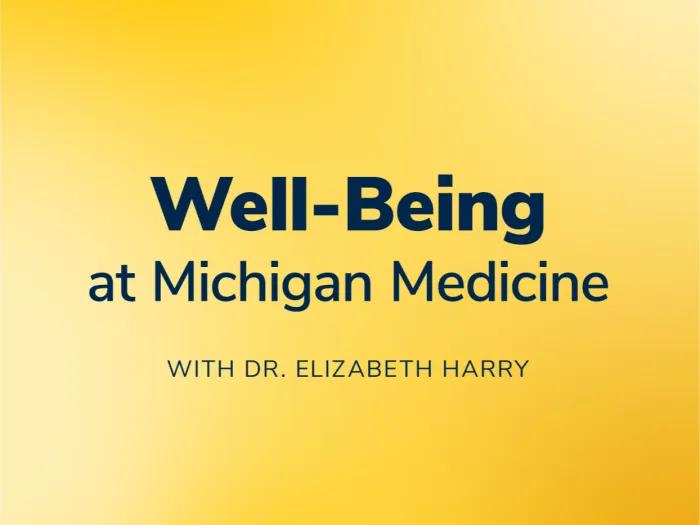
Grateful for support that help launched his career in pharmacology research and drug development, Tom Macek, Ph.D., has made a gift to the University of Michigan Medical School to advance addiction research.
Well-Being at Michigan Medicine with Dr. Elizabeth Harry
Well-Being at Michigan Medicine

Rethinking care: How ‘de-implementation’ can improve quality and reduce burnout

In this episode of Well-Being at Michigan Medicine with Dr. Elizabeth Harry, Dr. Eve Kerr explores the concept of de-implementation—scaling back unnecessary tests, treatments, and administrative hurdles. Kerr shares how eliminating low-value practices can reduce clinician overload, lower patient costs, and improve overall health outcomes. Discover how both healthcare organizations and local frontline teams can foster a culture of high-value care by eliminating outdated processes.
Michigan Medicine Presents in spotlights on blue background
Michigan Medicine Presents

Michigan Medicine Presents: Tommy Wang, M.D., Dean, University of Michigan Medical School

Join MD student Cassie Evans and PhD student Sam Collie for a wide-ranging conversation with Dean Tommy Wang, M.D. As he reflects on his journey to medicine and academic leadership, Dr. Wang shares his perspectives on student well-being, artificial intelligence, education, research and patient care through the lens of his new role as dean of the University of Michigan Medical School.