Parolia Lab Receives Grant to Fund New Pediatric Cancer Research
3:09 PM
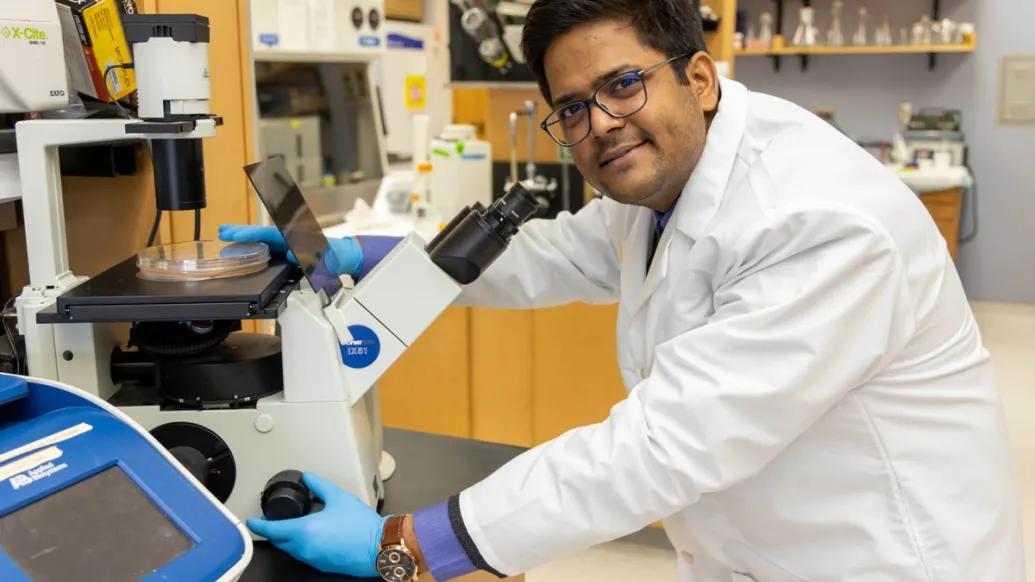
A national research grant is helping a Rogel Cancer Center laboratory take a major step into pediatric cancer research, aiming to develop more precise treatments for an aggressive childhood cancer. The award supports the work of Abhijit Parolia, PhD, and his lab in the Department of Pathology, which currently studies how changes in the genome’s regulatory machinery can drive cancer.
The grant, provided by Alex’s Lemonade Stand Foundation, allows the Parolia Lab to expand its research into Ewing Sarcoma, a rare cancer that primarily affects children and young adults. The proposal “Characterizing and targeting SWI/SNF chromatin remodeling activity in Ewing sarcoma” was selected by the ALSF’s Scientific Advisory Board for an ‘A’ Award totaling $800,000.
Only five investigators nationwide were selected for this year’s award, placing Parolia and his lab in a highly selective group traditionally dominated by long‑established pediatric cancer researchers.
“This is my first major award in the pediatric cancer space, and that makes it especially meaningful,” said Parolia. “Being shortlisted alongside investigators who have devoted their careers to pediatric oncology serves as a strong endorsement of the rigor and the potential impact of our approach. It allows us to bring our expertise in genome regulation to a disease where there are currently no targeted therapies.”
Currently, the Parolia Lab focuses on studying the function of enhancers in human cancers. Enhancers are stretches of DNA that act like control switches, telling genes when to turn on and off. While the human genome contains roughly 25,000 genes, more than 95% of our DNA does not encode genes. Instead, it consists largely of regulatory regions, such as enhancers.
“If you think of the genome as a book, enhancers are the bookmarks,” he said. “They tell the cell which pages to open and which instructions to read in order to function properly.”
The grant will support a four-year project focused on a protein complex called SWI/SNF, which plays a critical role in opening up enhancer regions so they can be activated. Parolia’s earlier work helped lay the foundation for drugs that target this complex, some of which are now being tested in clinical trials for adult cancers.
The research has two main goals: first, to understand why only certain Ewing sarcomas depend on SWI/SNF activity; and second, to test whether existing SWI/SNF inhibitors are effective in preclinical models of the disease.
“There are no precision treatments available for Ewing sarcoma,” said Parolia. “We’re trying to change that.”
The award also brings important momentum to a growing lab. A graduate student and postdoctoral fellow are already dedicated to the Ewing sarcoma project, while other members of the lab continue to study enhancers in prostate cancer. The funding will allow Parolia to recruit additional researchers and, just as importantly, raise the lab’s visibility in the pediatric cancer research community.
“When a foundation like Alex’s Lemonade Stand puts its support behind your work, it sends a powerful message,” Parolia stated. “It helps us attract talented scientists who want to work on childhood cancers.”
Parolia’s lab will combine its research expertise with other clinical expertise at the University of Michigan. The lab will leverage the clinical expertise of Dr. Patrick Grohar, a pediatric oncologist in the Department of Pediatrics, who has led multiple clinical trials for Ewing sarcoma and is a key collaborator on this proposal.
“Cancer research isn’t a one-person effort,” Parolia noted. “It takes a team that includes basic scientists and clinicians working together. Dr. Grohar’s experience is invaluable as we think about how our findings could eventually reach patients.”
Parolia’s interest in pediatric cancer grew out of surprising discoveries from his work on adult tumors. As prostate cancers become more aggressive, his lab found that their chromatin, the structure that organizes DNA, begins to resemble that of early embryonic cells.
“The more advanced and dangerous the tumor becomes, the more it looks like it’s reverting to an early developmental state,” he said. “It starts accessing parts of the genome that should be locked away in adult cells.”
This insight provides a powerful link between pediatric and adult cancers. Pediatric tumors often hijack developmental programs directly, while aggressive adult cancers appear to fall back into those same programs over time and treatment.
“By studying these mechanisms in pediatric cancers like Ewing sarcoma, we may also learn something fundamental about how adult cancers evolve and adapt to therapy more broadly.”
Written by Anastazia Hartman
Featured News & Stories
Talent show brings joy to kids at children’s hospital
U-M alumni return from Central Asia to seek treatment for their child at Mott

Block Out Cancer: From a crisis abroad to answers at Mott
Path forward for glioblastoma treatment
Vascular STING activation facilitates natural killer cell anti-tumor immunity in small cell lung cancer