New sculpture on U-M medical campus creates lasting COVID-19 tribute
Bronze figures on marble bench in hospital courtyard capture the strength and caring of all who responded to the pandemic
1:50 PM
Author |
Six years ago this week, everything changed for patient care teams at University of Michigan Health, when the first of thousands of people with COVID-19 arrived on the Ann Arbor medical campus.
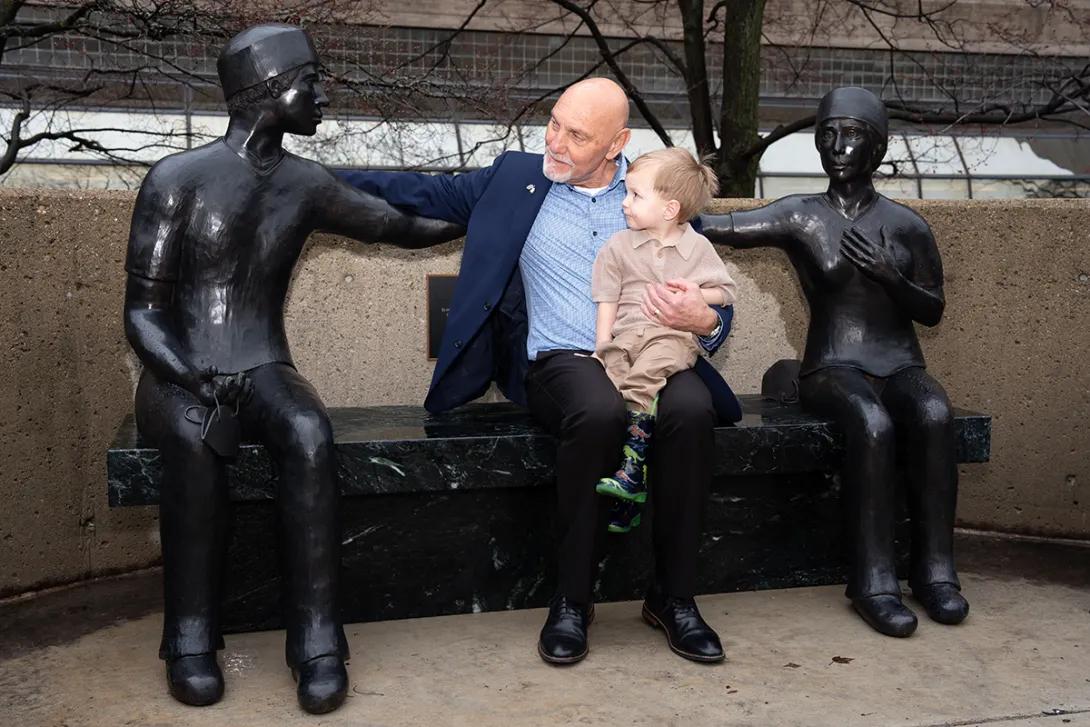
Today, that first patient returned for the unveiling of a sculpture that pays tribute to everyone who took part in the massive effort to care for those patients, and to respond in many other ways to the pandemic over multiple years.
Just two years after receiving a double lung transplant at University Hospital, Paul DeWyse became U-M’s, and the state of Michigan’s, first hospitalized COVID-19 patient.
But he survived, thanks to the specialized intensive care of a U-M team.
Members of that team and hundreds of other faculty, staff, learners and supporters joined him at today’s ceremony in the hospital courtyard to mark the anniversary and see the sculpture.
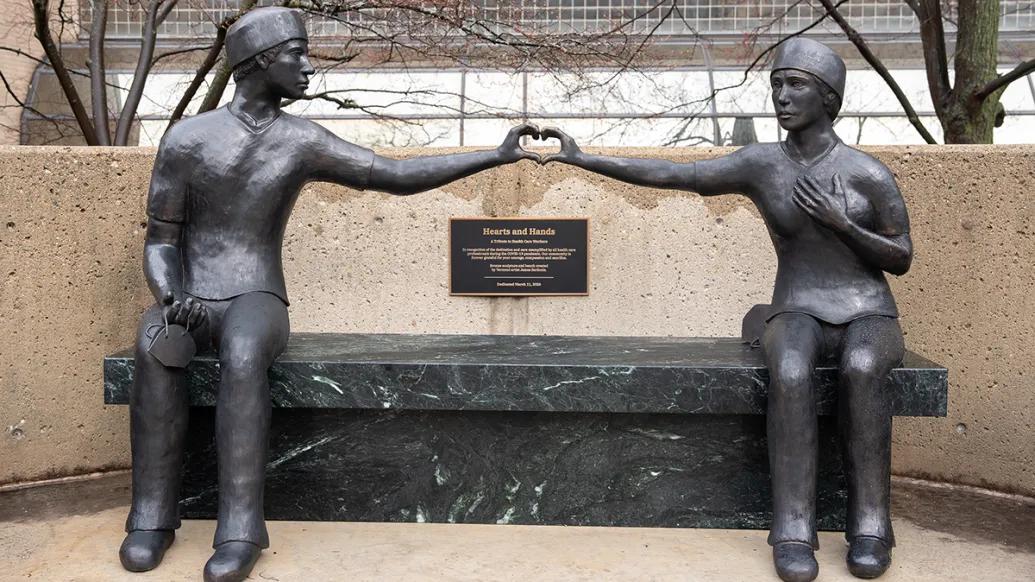
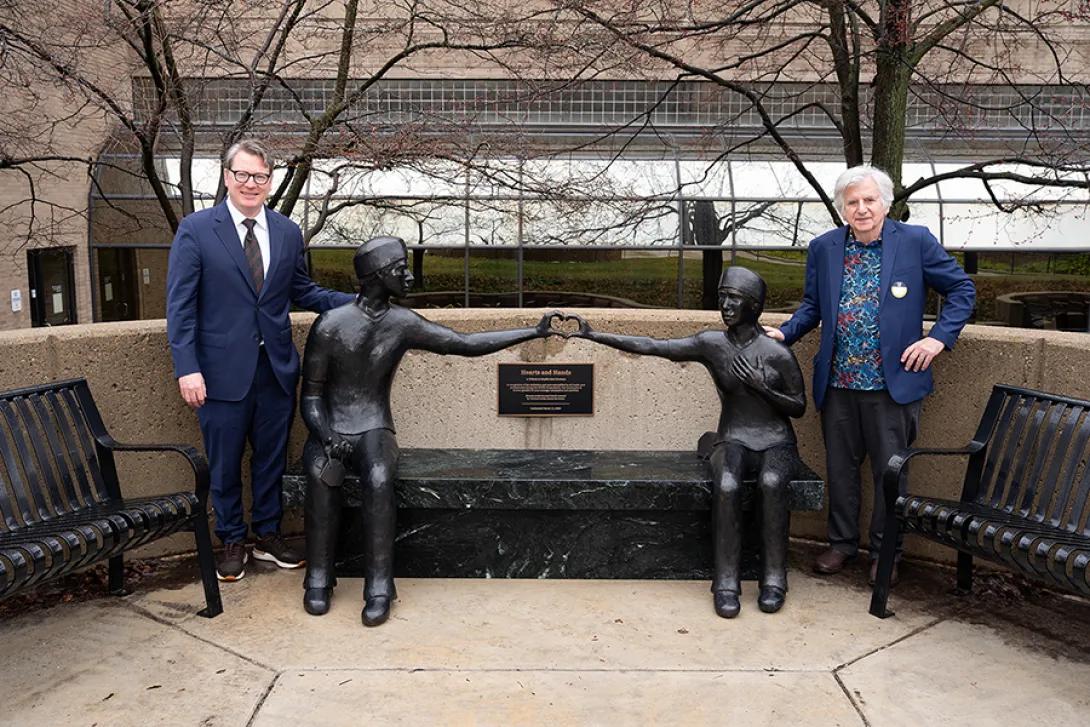
Titled Hearts and Hands – A Tribute to Health Care Workers, the sculpture was created by Vermont artist James Sardonis and funded by donations.
It features two bronze figures in clinical attire, sitting apart on a marble bench, each with an arm outstretched toward the other. Their fingertips, barely touching, form a heart.
Speaking at the unveiling ceremony, U-M Health Chief Nurse and Operations Executive Julie Ishak, M.S.N., R.N., NP-BC, said the sculpture stands as a symbol of the collective strength and compassion of all involved in the COVID-19 response.
“For frontline workers, courage meant showing up day after day despite exhaustion and anxiety. We became the bridge between isolated patients and their loved ones. We held phones to our patients’ ears so that if they could not recover, they could hear their loved one’s voices one more time,” she said. “We leaned on one another, even when we could only see each other’s eyes through all of our protective gear.”
Tribute to the entire COVID-19 response
By the last week of 2020, those frontline workers were the first to receive the new COVID-19 vaccine, through a massive campaign that even harnessed Michigan Stadium as a vaccination site.
In addition to the frontline patient care and support teams, the sculpture also stands in tribute to researchers who pivoted rapidly to study the novel coronavirus and its impact on the body, and the pandemic’s ripple effects throughout society.
It also salutes the generosity of community members who responded immediately in March 2020 to donate protective gear, food and other supplies for frontline workers, as well as donors who supported research funds.
A Michigan Medicine-sponsored food drive that began in spring 2020 to support community members in need during the pandemic disruption brought in more than 313,000 meals’ worth of nonperishable food and monetary donations for Food Gatherers. Michigan Medicine has kept up the effort with a Million Meals Mission to raise funds and is close to hitting the goal.
About the sculpture
U-M Health joins the University of Vermont Medical Center and University of North Carolina Health in installing the Sardonis sculpture as a tribute to all those involved in the COVID-19 response.
"To me, this piece is all about communicating love,” Sardonis said. “That’s what the figures convey in the sculpture and that’s what health care workers do, nationwide, every day.”
He adds, “I would love to see [the sculpture] all over the country.”
The installation at U-M Health happened in part because of a Vermont connection: U-M Medical School Department of Surgery Chair Justin Dimick, M.D., M.P.H., is from the same Vermont town of Randolph where Sardonis has his studio.
“Growing up in Vermont, I was familiar with the beauty, meaning, and power of Sardonis’ work,” said Dimick. “When I saw the tribute first installed at the University of Vermont, I was moved by the way the Hearts and Hands sculpture recognizes the sacrifices of health care workers during pandemic. When I saw the second installation, and the possibility of more, I knew we needed to share this opportunity to memorialize the front-line workers who saved so many lives with their compassion and skill—and continue to do so every day. Thanks to our generous donors, we were able to participate and bring permanent visibility to this powerful symbol of gratitude.”
The entire sculpture is Vermont-made, with bronze casting done by Vermont Custom Casting, enlarging of Sardonis’ original figures by Campbell Plaster and Iron, and the bench made by Vermont Verde Antique from marble quarried in Vermont.
An ongoing COVID-19 response
The COVID-19 response continues at U-M, with hundreds of people with the disease treated in U-M Health’s Ann Arbor hospitals in just the past few months, and others receiving outpatient care.
Although vaccination and treatment protocols have reduced the risk of severe illness and death for most people in recent years, the disease can still cause serious issues or even prove fatal in some patients.
Those at highest risk include infants and toddlers, people over age 65, people of any age with immune systems weakened by health conditions, people taking medications that affect the immune system such as those used to treat cancer or after organ transplants, and those who have not kept up to date with annual vaccination.
U-M Health continues to follow vaccination recommendations from the state of Michigan and major professional societies, which recommend a dose of COVID-19 vaccine every year for everyone over the age of six months.
A second dose is recommended each year for those over age 65 and those at very high risk of severe illness including people who are immunocompromised.
U-M Health’s experts continue to update clinical guides for treatment of people with COVID-19 and other infectious diseases, and make them available to clinicians worldwide.
For those experiencing the long-term effects of what is sometimes called Long COVID, U-M Health offers a Post-COVID-19 Clinic for adults.
Media Contact

Public Relations
Department of Communication at Michigan Medicine
In This Story

Julie Ishak, DNP, RN, NP-BC, CENP
President, University of Michigan Health Academic Medical Center

Justin B Dimick, MD, MPH
Professor
Related
Conquering COVID-19: Michigan Medicine’s First Patient Shares His Story
Featured News & Stories
Continuing the legacy of a doctor’s doctor
Family’s gift honors wife and mother, supports nephrology nurses
A second chance at life
A pediatric epilepsy fundraiser that changes lives
Innovative children’s vision research gets a boost from the Knights Templar Eye Foundation