Michigan Medicine statement on the passing of Prop 3, access to abortion care

Author | Beata Mostafavi

Michigan Medicine remains dedicated to providing our patients, families and communities with specialized lifesaving and lifechanging reproductive health care, including abortion.

In the months since the Supreme Court’s Dobbs decision, our patients faced uncertainty about whether they would be able to continue to turn to University of Michigan Health for all of their reproductive healthcare needs.  With the passage of Proposal 3 we can now assure all people who need our services that we will be there for them.

The past few months have also brought uncertainty to our clinical learners, and we are also pleased that we can continue to provide full-spectrum reproductive health education to students, residents and clinical fellows. Our faculty and staff can also now be assured that they can continue to provide compassionate care without fear of legal prosecution.

Patient safety and wellbeing are and remain our highest priorities, and we are devoted to providing high-quality, safe and compassionate care across all reproductive health needs.

To see the full message from leaders at University of Michigan and Michigan Medicine, visit the U-M Key Issues page.

Featured News & Stories
doctor in white coat explains eye surgery to patient in yellow sweater inside a medical setting
Health Lab

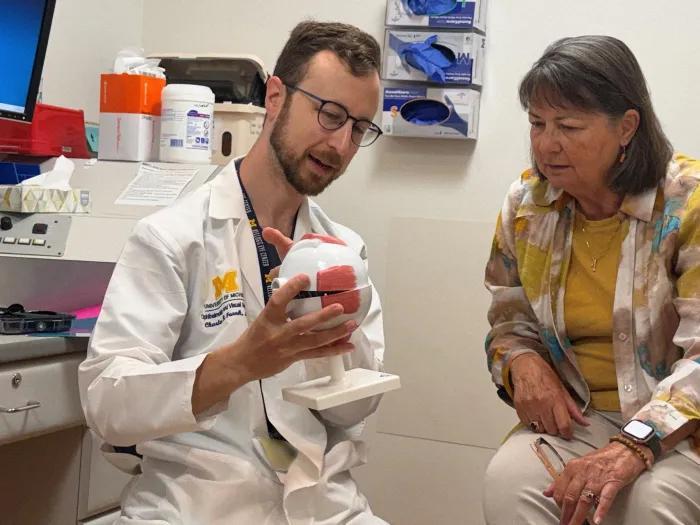
Eye surgeries bring patient’s vision into focus

A personal journey through uveitis, vision loss, glaucoma treatment, and two eye surgeries at the University of Michigan Kellogg Eye Center.
A family discussing end of life wishes during Thanksgiving
Health Lab

How to discuss health care and end-of-life wishes during the holidays

The holidays are a great time to discuss end-of-life decisions. Learn the importance of having a health care power of attorney & discussing it with your family.
A physician’s hands on a laptop with icons representing legal forms and justice symbols (scales and gavel) in the air
Health Lab

Court appointed medical guardian study reveals role in care of highly vulnerable older adults

Court can appoint medical guardians for patients who didn’t designate someone to make decisions for them, when they can no longer make their own decisions. A study shows high levels of vulnerability in this population, but especially those appointed professional guardians.
The Parade Company artist Kennedy Perkins, wearing blue shirt, paints the “Little Victors” sign for the new C.S. Mott Children’s Hospital float in America’s Thanksgiving Parade.
Health Lab

From patient to artist: A project close to her heart

More than two decades after undergoing lifesaving surgery for complex heart conditions -- ventricular septal defect and discontinuous left pulmonary artery -- an artist is bringing hospital’s new Thanksgiving parade float to life
On the left, a woman sits in a hospital gown with her scar showing on her chest. On the right, two women pose each wearing medals from athletic competition.
Health Lab

New heart, three medals and a shot at the world stage

After a heart transplant for heart failure caused by congenital heart disease, woman won three medals at the Transplant Games and will compete on Team USA in 2027
Minding Memory with a microphone and a shadow of a microphone on a blue background
Minding Memory

What Can a Blood Test Really Tell Us About Alzheimer’s Disease?

In this episode, Lauren & Matt talk to Suzanne Schindler MD, PhD. Dr. Schindler is an associate professor of neurology at Washington University in St. Louis. She's a neurologist and a neuroscientist whose laboratory develops and validates blood and cerebral spinal fluid biomarkers for Alzheimer's disease and related dementia. Dr. Schindler talks about the use of biomarkers in Alzheimer's disease and related dementia. Specifically, Dr. Schindler focuses on the rapidly changing research on blood-based biomarkers, including how they detect proteins associated with dementia, how accurate the tests are and their limitations, and how they may ultimately be used to improve diagnosis and treatment.