Michigan Medicine names Anika Gardenhire as first Chief Digital and Information Officer

12:00 PM

Author | Mary Masson

A collage of images representing Michigan Medicine

ANN ARBOR – Anika Gardenhire, R.N., MMCI, will become Michigan Medicine’s first Chief Digital and Information Officer on March 1.

Headshot of Anika Gardenhire with a welcome message

Gardenhire has more than 20 years’ experience leading technology, digital strategy, data and cybersecurity functions. Most recently, she served as Chief Digital and Transformation officer for Ardent Health, a system of 30 hospitals and more than 200 sites of care headquartered in Brentwood, TN.

In her new role at Michigan Medicine, Gardenhire will lead the organization’s IT strategy and operations and guide implementation of Michigan Medicine’s multi-year information technology plan. She will also spearhead comprehensive digital strategies, leveraging current and emerging technologies.  

“We are thrilled to have an experienced information technology leader like Anika join our team. Her background in nursing and bedside care is a real advantage as we continue to find the best ways to use technology to improve our patient care delivery,” said Quinta Vreede, MHSA, Chief Administrative Officer for Michigan Medicine.

“Anika will lead efforts to ensure that our information technology structure enables the highest standard of care and operational excellence, while also advancing biomedical and health sciences research and education.”  

Gardenhire is a clinically trained registered nurse with a Master of Management in Clinical Informatics from Duke University. She says her nursing background helps tremendously in roles leading digital strategy and information technology in health care.

“Technology has the ultimate ripple effect,” said Gardenhire. “Technology kept happening to us at the bedside and no one ever asked us how it could be better. If you actually talk to end users and try to listen and design to their needs, you end up with technology that’s better, faster and more convenient for our health care teams and most importantly for our patients.”

Gardenhire said she’s eager to join Michigan Medicine, which has a statewide network of 12 acute care hospitals, 48,000 employees, the U-M Medical School and research funding over $800 million.

“This is a career-culminating move,” said Gardenhire. “You know the brands and organizations you aspire to, and Michigan Medicine is at the top of that list for me.”

About Michigan Medicine: At Michigan Medicine, we advance health to serve Michigan and the world. We pursue excellence every day in our 12 hospitals and hundreds of clinics statewide, as well as educate the next generation of physicians, health professionals and scientists in our U-M Medical School.

Michigan Medicine includes the U-M Medical School and University of Michigan Health, which includes the C.S. Mott Children’s Hospital, Von Voigtlander Women’s Hospital, D. Dan and Betty Kahn Health Care Pavilion, University Hospital, the Frankel Cardiovascular Center, Kellogg Eye Center, University of Michigan Health-West, University of Michigan-Sparrow and the Rogel Cancer Center. The U-M Medical School is one of the nation’s biomedical research powerhouses, with total research funding of more than $800 million.

More information is available at www.michiganmedicine.org. 


More Articles About:

Emerging Technologies nursing administration

Media Contact

University Hospital at U-M Health in the spring with flowering trees in foreground and Survival Flight helicopter visible

Public Relations

Department of Communication at Michigan Medicine

[email protected]

734-764-2220

Related

News Release

Innovative patient stability technology developed at MCIRCC gets FDA market approval

A medical device that works to detect if a patient will become unstable earlier than traditional vital signs received the green light to be marketed to U.S. hospitals.

Featured News & Stories

Minding Memory with a microphone and a shadow of a microphone on a blue background
Minding Memory

Antipsychotic Use in Nursing Homes: Balancing Medication Safety, Policy, and Dementia Care
In this episode, Lauren Gerlach and Matt Davis speak with Theresa Shireman, PhD, Director of the Center for Gerontology and Healthcare Research and a Professor of Health Services, Policy and Practice and Epidemiology at the Brown University School of Public Health. Dr. Shireman’s research focuses on pharmaceutical policy, pharmacoepidemiology, health services research, and medication use among vulnerable populations. Dr. Shireman discusses her recent study, "Impact of Federal Antipsychotic Use Policy in Nursing Homes on New Diagnoses for Approved Indications in Dementia Residents," published in the Journal of the American Geriatrics Society. The study examines whether federal policies designed to reduce antipsychotic use in nursing homes were associated with increases in new diagnoses of conditions, such as schizophrenia, that exclude residents from publicly report antipsychotic quality measures. Using an interrupted time-series design, the researchers examined changes following the 2012 National Partnership to Improve Dementia Care and the 2015 addition of antipsychotic use to the Nursing home Five-Star Quality Rating System. They found that neither policy was associated with an increase in new exclusionary diagnossees, challenging concerns that nursing homes were increasingly assigning these diagnoses to circumvent restrictions on antipsychotic use. The conversation also explores the benefits and risks of antipsychotic medications for people living with dementia, including the potential for serious adverse effects such as sedation, falls, stroke, and increased mortality. Dr. Shireman discusses how public reporting and financial incentives can influence prescribing practices,the limitations of using a single quality measure to evaluate nursing home care, and the importance of balancing medication safety and residents’ individual needs. The discussion highlights the need for shared decision-making among clinicians, nursing home staff, residents, and families, as well as greater investment in staffing, resources, and nonpharmacological approaches to improve quality of life for people living with dementia. The transcript for this episode can be found here.
Purple shaded illustration of doctor listening to heart of patient on a bed
Health Lab

The AI is listening: Implications of machine generated clinical notes on health care
Michigan Medicine experts argue that use of artificial intelligent scribes during health care visits should be more carefully examined .
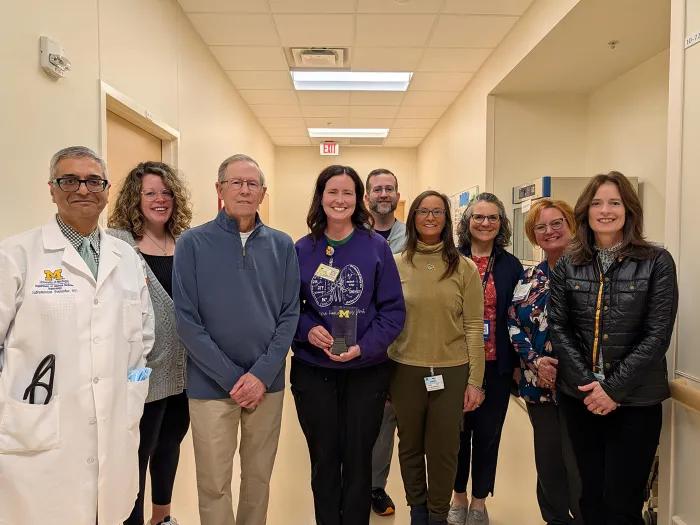
Members of the nephrology care team and Coulson family at the recent awards ceremony.
Philanthropy News

Family’s gift honors wife and mother, supports nephrology nurses

The Coulson family is honoring Barbara Coulson's memory by recognizing exceptional dialysis nurses and investing in professional development that will strengthen patient care.
Two people in medical scrubs are in a blurred hospital setting. In the foreground, hands are holding a digital tablet.
Health Lab

Digital alerts support timely treatment decisions of critically ill cardiac patients

Well-designed alerts for critically ill cardiac patients can change what happens at the bedside, according to new Michigan Medicine research.
Minding Memory with a microphone and a shadow of a microphone on a blue background
Minding Memory

The Care Ecosystem: Supporting People Living with Dementia and Their Families

Welcome back to Season 6 of Minding Memory! In this episode, Lauren & Matt speak with Dr. Katherine (Kate) Possin, who holds the John Douglas French Alzheimer’s Foundation Professorship at the University of California, San Francisco Fein Memory & Aging Center. Dr. Possin talks about the Care Ecosystem, a telephone and web-based model that provides ongoing education, support, care planning, and coordination for people living with dementia and their care partners. They’ll dig into how the Care Ecosystem was developed, and what studies have shown about its impact on people living with dementia.
A collage of multiple buildings that are part of Michigan Medicine's statewide network
News Release

U-M Regents approve Michigan Medicine leadership changes

Two leadership positions for Michigan Medicine approved by U-M Board of Regents