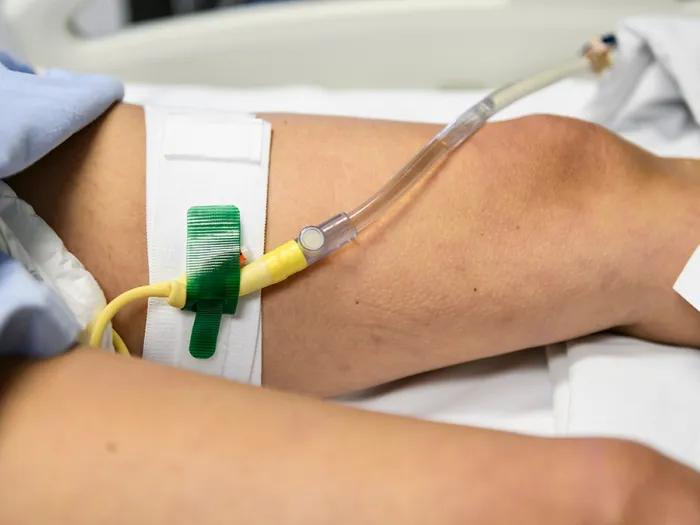
Michigan Medicine and Henry Ford Health to conduct clinical trial on effect of CBD on post-surgical opioid use
The study will be the largest yet to evaluate if CBD administered pre- and post-surgery reduces opioid consumption after surgery.
10:30 AM
For many of the 14 million-plus Americans with knee osteoarthritis — a painful and often debilitating disease — a total knee arthroplasty is necessary to alleviate symptoms and improve the knee’s function.
Despite advances in perioperative pain care, acute and persistent pain remain a major issue following surgery, with opioids currently serving as the primary treatment for acute pain after surgery. But since opioids can become habit forming — and include side effects like nausea, dizziness, and constipation — two Michigan healthcare institutions are partnering to investigate alternatives that could limit post-surgery opioid use.
Michigan Medicine and Henry Ford Health soon will launch a multisite clinical trial to assess if administering cannabidiol (CBD) before and after surgery may reduce the need for opioids following a total knee arthroplasty. The $6 million, 5-year grant was awarded by the National Institute of Arthritis and Musculoskeletal and Skin Diseases (NIAMS) within the National Institutes of Health.
Chad Brummett, M.D., Kevin Boehnke, Ph.D., and Joel Gagnier, Ph.D., (Western University Ontario) will serve as co-primary investigators.
An estimated 14% of the general public currently uses CBD — a non-psychoactive component of cannabis — most frequently for chronic pain and related symptoms. But researchers say more information is needed to determine its post-surgical pain benefits.
“While CBD shows great promise in reducing opioid craving, pain, and anxiety, clinical research is limited,” said Brummett, the Bert N LaDu Professor of Anesthesiology and co-director of the Opioid Research Institute at the University of Michigan. “We are excited to partner with Henry Ford Health on this trial, which will be the largest and most rigorous trial yet to assess whether perioperative CBD reduces opioid consumption after surgery.”
The research team will recruit 380 adult patients from Michigan Medicine and Henry Ford Health undergoing primary total knee arthroplasty for the double-blind randomized controlled trial. Participants will receive one of four combinations of placebo or CBD (300 mg/day) for one week prior to surgery together with CBD or placebo for four weeks following surgery. They will also get a standard pain treatment pathway, including an opioid prescription following hospital discharge and refills as needed.
“This trial design will allow us to investigate when — if at all — CBD may be most usefully administered in the perioperative period,” said Boehnke, research assistant professor within the Michigan Medicine Department of Anesthesiology. “We want to understand whether CBD changes opioid consumption after surgery, and our study will also contribute to a nuanced understanding of CBD’s effects on pain intensity, anxiety, inflammation, and sleep.”
Looking ahead, the research team believes the successful completion of this study could give much needed evidence for the role of CBD as an opioid-sparing medication for pain after a range of surgeries.
“This represents a major step in assessing CBD’s potential to reduce opioid consumption following surgery,” said Lara Zador, MD, a specialist in anesthesiology and pain medicine at Henry Ford Health. “While this study will focus on patients with total knee arthroplasty, the results may have broad implications regarding appropriate perioperative CBD use for a wide variety of elective surgeries where opioids remain the mainstay of therapy.”
Co-investigators:
University of Michigan
Andrew Schrepf, M.D., Anesthesiology
Dan Clauw, M.D., Anesthesiology
Rachel Bergmans, Ph.D., Anesthesiology
Mark Bicket, M.D., Ph.D., Anesthesiology
Andrew Urquhart, M.D., Orthopaedic Surgery
Elizabeth Dailey, M.D., Orthopaedic Surgery
Kelley Kidwell, Ph.D., School of Public Health
Henry Ford
Lara Zador, M.D., Anesthesiology/Pain Medicine
Michael Charters, M.D., Orthopaedic Surgery
Jason Davis, M.D., Orthopaedic Surgery
UCSD
Edmund Capparelli, Ph.D.
Featured News & Stories
A pediatric epilepsy fundraiser that changes lives
Better prenatal care data could help prevent maternal complications, experts say

Liver cancer can be preventable. Do you know the treatable risk factors?
Innovative children’s vision research gets a boost from the Knights Templar Eye Foundation
Pain, psychological factors and physical function closely linked in people with systemic sclerosis