A long time coming: The saga of today’s University Hospital
Nearly 117 years after the first U-M hospital, and 61 years after its predecessor, the "Replacement Hospital" facility opened in 1986, offering clinical care on a grand scale
Author |
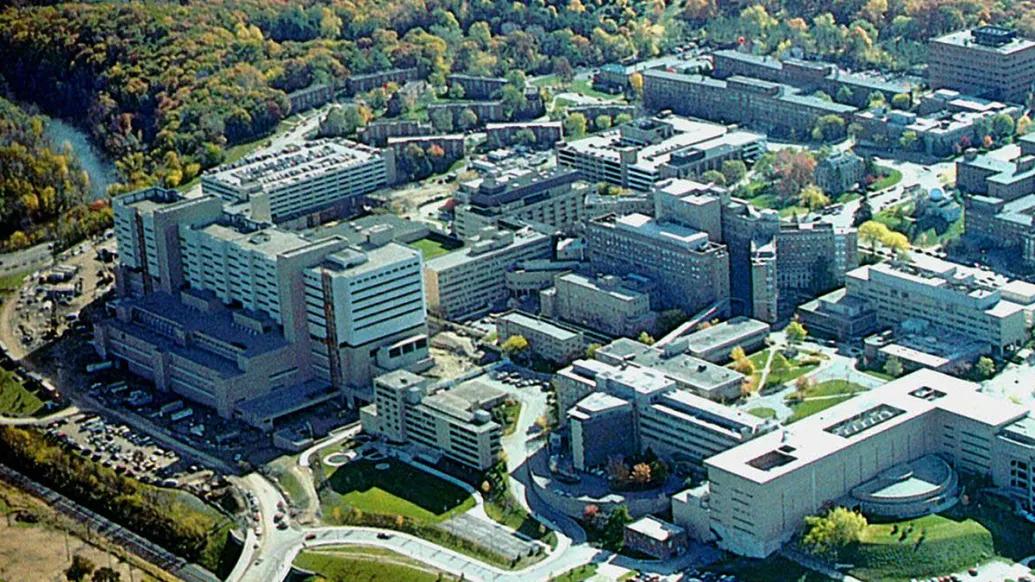
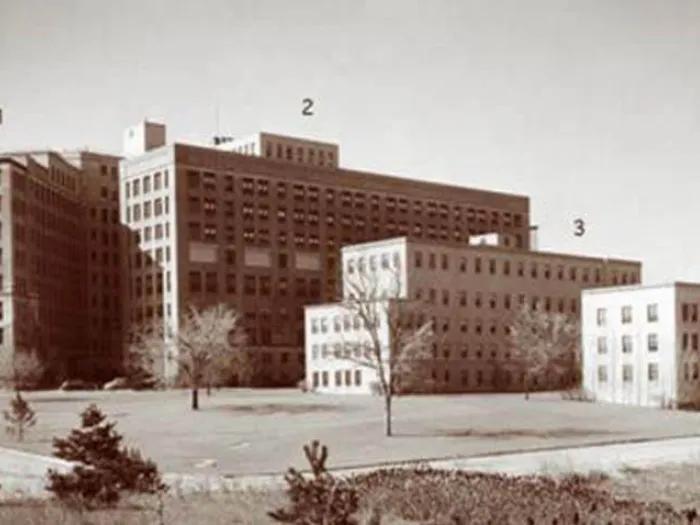
When it opened in 1925, the University of Michigan’s flagship University Hospital was one of the largest, most modern facilities of its kind in the world.
But by the 1970s, it was crowded, outdated, leaky and hard to keep clean.
It even had a fitting nickname: Old Main.
Its upper floors couldn’t handle the weight of modern medical equipment. Its 18-bed open wards had little privacy, and only two shared toilets each. There was no central air conditioning.
In other words, just like U-M’s previous main hospitals that had opened in 1869 and 1891, the University Hospital at the corner of Ann and Observatory Streets needed replacing.
Forty years ago this week, on Valentine's Day 1986, that replacement opened to patient care. It's today's University Hospital, known as UH for short.
The need grows urgent for a new U-M hospital
Even as Old Main grew more decrepit in the 1960s, the clinical care and education available on U-M’s medical campus continued to attract ever more patients, students and advanced trainees.
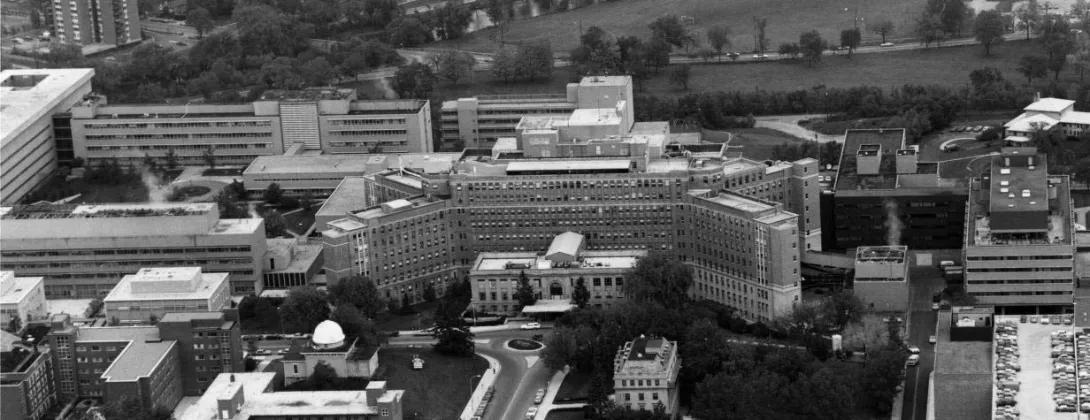
To make room for them, brand-new buildings had sprouted up since the 1950s, housing everything from children’s, women’s and specialty medical care to advanced biomedical research and health professions education.
Their sleek Mid-Century Modern design made the Art Deco-era Old Main look even more antiquated than it was.
After an independent report called Old Main’s condition “marginal” in 1971, the cries for a new hospital grew louder. The Medical School formed alliances with other hospitals to ensure that residents and fellows had enough opportunities to learn clinical skills, since Old Main couldn’t hold any more patients.
Finally, in December 1978, the university’s Board of Regents approved a plan to build not only a new general adult hospital, but also an adjoining ambulatory care facility and other clinical buildings, on the bluff at the northeast corner of the medical campus. To design it, they hired the same firm that had created Old Main, Detroit's legendary Albert Kahn Associates.
The state steps in to partially fund the new hospital
So great was the need, and so important was U-M’s advanced care to the people of Michigan, that the state government agreed to help foot the bill, to the tune of $173 million. That support, the equivalent of $854 million in today's dollars, came despite an economic recession and high unemployment.
The state’s new Building Authority, created by Governor William Milliken in a compromise with the state legislature, agreed to act as landlord. It would sell bonds to raise the state’s portion and lease the building to the university until it was paid off.
The university committed to pay the rest of the bill, another $112 million, from donations and university bonds based on hospital revenues. A. Alfred Taubman, a real estate mogul who had attended U-M, spearheaded the charge to raise funds.
And so began the journey to create what we now know as University Hospital and the Taubman Health Care Center, its adjoining outpatient building, as well as a parking structure to serve them both.
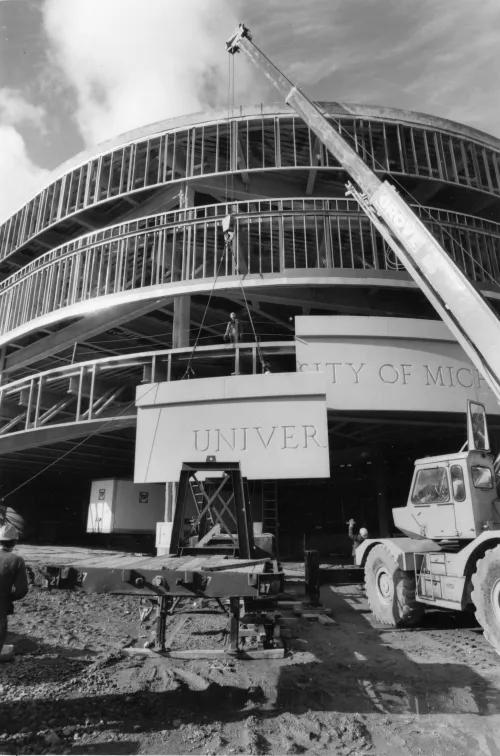
A massive hospital construction project
At the time, it was the largest construction project in the state, and the largest hospital project in the country. Leaders called it the Replacement Hospital Project, or RHP for short.
Even though the need was proven, the road wasn’t smooth. A regional planning board disputed the need for U-M to provided non-specialty care. A statewide ironworkers’ strike delayed construction.
But the state Department of Public Health, which had the final say, approved not only the initial budget in 1979, but also a 1982 increase to ensure that the project included future improvements for children’s, women’s and psychiatric services.
When it finally came time to break ground on October 15, 1981, U-M president Harold T. Shapiro called it “a joint project of the University of Michigan, the citizens of Michigan, and the city of Ann Arbor.”
Preparing for the hospital move
Even as construction was under way, the project expanded even further in 1984, with the decision to build a Burn Center unit for adults and children above the emergency care entrance. The number of inpatient beds actually went down, reflecting the growing trend of caring for more and more illnesses on an outpatient basis.
By December 1985, some of the offices and pathology labs in the new facility were ready to open. Hundreds of thousands of paper medical records were boxed and transported.
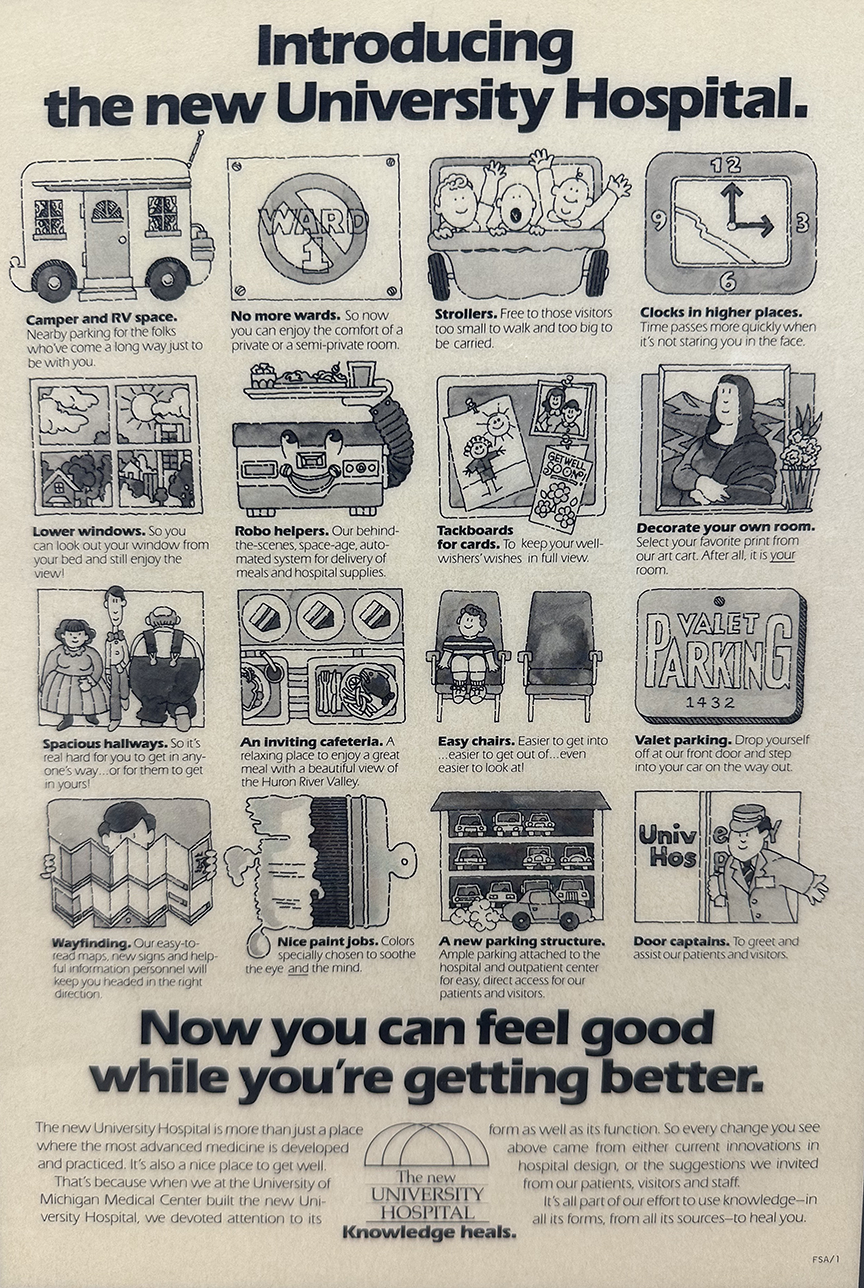
And the university began a marketing and public relations campaign to tout the advanced features of the new 11-story, 586-bed, nearly 1.8 million square foot building. (Click the image of the newspaper ad to see it larger.)
The campaign touted computer-based controls for fire detection, security and medical records, “robot” carts to ferry supplies around, and a modern patient food service. Advanced medical imaging equipment, 15 operating rooms and a large new pharmacy were readied for action.
Patients’ feedback had been invited, and their preferences taken into account, with single and double rooms replacing open wards, and windows built lower than in Old Main so that patients lying in bed could see outside. Ample covered parking in the adjoining structure, and central air conditioning, seemed like a dream compared to Old Main's conditions.
Hospital moving day arrives

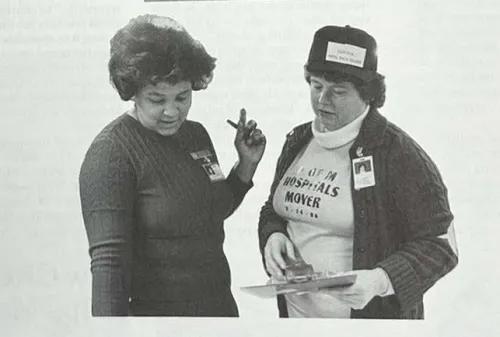
The day before the patient move, moving trucks made dozens of trips to ferry medical equipment and supplies from the old hospital to the new, and clinical teams bustled to put them all into place.
On Valentine’s Day 1986, it was time for a carefully choreographed effort to move 403 hospitalized patients over, wheeling them through the enclosed connectors built between the two generations of buildings.
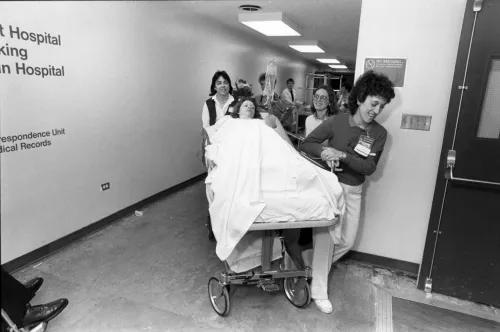
The move, made possible by 200 staff and volunteers, took far less time than predicted.
From the first intensive care patient to the last surgical patient, it went flawlessly.
None of the emergency care stations set up along the way were needed. One of the volunteers noted later that they had time to finish a novel.
A TV crew followed the final patient all the way to his new room.
Meanwhile, staff prepared for the opening of 120 outpatient clinics in the Taubman Center the next week.
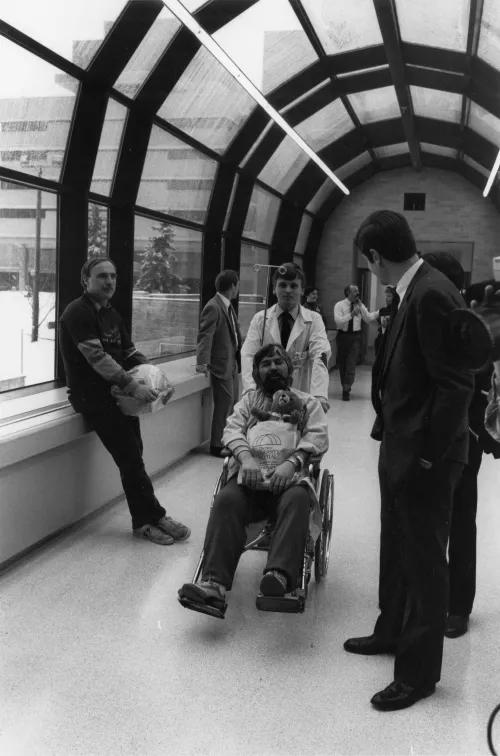
In a story written for the 30th anniversary of the opening, Sofia Merajver, M.D., Ph.D., remembered being a third-year medical student at the time of the move; she is now a Professor of Internal Medicine.
"I was moving those patients assigned to me along corridors connecting to the shiny new hospital. It was a very proud moment when the move in our ward ended and everyone was fine, as our patients were among the most frail," she said in 2016. "They understood they were part of history and it was very emotional to see how they rallied and how excited they were to be such pioneers."
The Hospital Star, the newspaper for employees, carried multiple pages of coverage about the move after it was over. Read the main story here as a PDF.
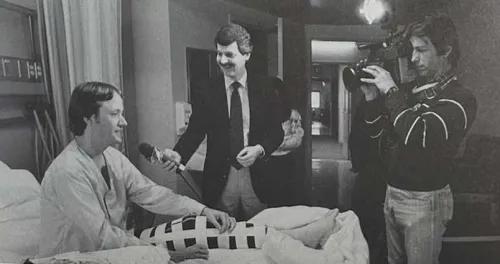
After the University Hospital opening
But even after the UH/Taubman complex opened, the Replacement Hospital Project wasn’t done.
In 1987, the Regents authorized an addition to the south end of the Taubman Center and the old Mott Hospital (now UH South) for a Maternal Child Health Center. Opened in 1990, it created new modern space and 'front door' for services for women and children, and paved the way for a new Birth Center in 1996 to replace the aging Women’s Hospital opened in 1950.
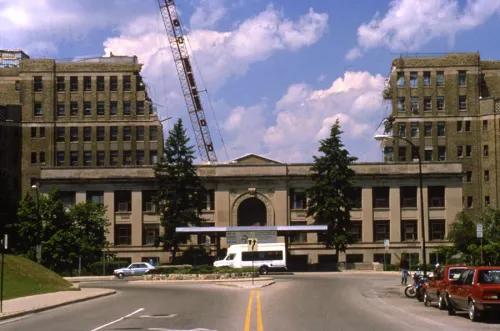
By 1989, Old Main and several of its connected 1930s-era buildings fell to the wrecking ball, after deliberations over repurposing them showed the cost would outweigh the benefit. The carved limestone arch from the front entrance was preserved, and remains in storage to this day.
A lone building from the 1930s, once used to house first-year residents called interns, remained as office space for a time. But the rest of Old Main's former footprint was converted to a parking lot. A historical plaque on Ann Street marked its passing.
Patient care moved on. The Rogel Cancer Center opened next to UH in 1997, also housing for a time the Geriatrics Center before it moved to the East Medical Campus.
In fall 2003, the Frankel Cardiovascular Center began to rise on the site where Old Main once stood. It opened in 2007, with its front entrance on the same traffic circle at the corner of Ann and Observatory that Model T's once navigated to get to Old Main in 1925.
On the other side of the UH-Taubman complex, the Children’s and Women’s facility housing C.S. Mott Children's Hospital and Von Voigtlander Women's Hospital opened in 2011. The former Mott building, now renamed UH South, today includes adult inpatient and short-stay care.
And in late 2025, another massive patient move operation brought patients from UH into the new D. Dan and Betty Kahn Healthcare Pavilion, just next door to Old Main's former site. The teams that helped move patients and guide their families even included a few veterans of the 1986 move from Old Main to UH.
The new inpatient facility, which adds to the adult inpatient care at UH and the Cardiovascular Center, has a name that hearkens back to the pavilion extension added to U-M's first hospital in 1876.
It also had its construction paused during the COVID-19 pandemic, echoing how Old Main's construction was paused during the influenza pandemic of 1918.
All told, the Ann Arbor medical campus today includes 1,043 licensed inpatient beds, with nearly 49,000 patient discharges and 41,000 surgical cases a year. U-M Health as a whole has 2,200 licensed beds across 12 hospitals when UM-Health West and UM-Health Sparrow are included.
And inpatient care is just part of the picture: U-M Health teams serve patients at dozens of locations, via millions of outpatient appointments, imaging services, clinical diagnostic tests, outpatient operations and community health services every year. And a statewide network of care made possible through affiliations and collaborations brings U-M clinical expertise to even more Michiganders.
Today: University Hospital 2.0 gets under way
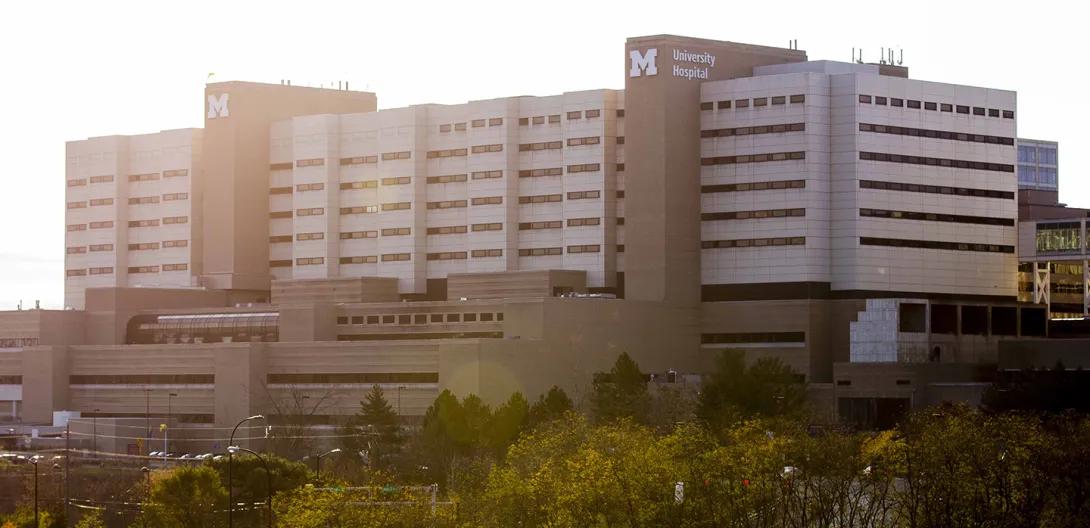
Now that the Pavilion has opened, a massive project to reimagine the 40-year-old University Hospital has begun after years of planning. It's dubbed the UH 2.0 Renovation Project.
Over the next six to seven years, it will expand access to medical and surgical inpatient care while converting as many of UH's semi-private rooms to private rooms as possible, and modernizing infrastructure and interiors. By relocating some adult services from the children's and women's facility, it will expand access to specialty pediatric care, too.
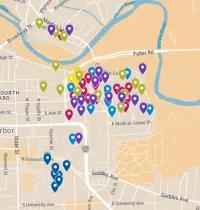
See every location where U-M medical care, education and research has occurred since the Medical School opened in 1850 on this interactive map - click the pins to learn more about each location.
Visit the museum exhibit about U-M medical history at the Museum on Main Street before it closes on April 30, 2026. It's open every Saturday and Sunday from 12-4 p.m., and private tours may be arranged. It is free and accessible to all.
Learn more about U-M medical history, including the hospitals and Medical School, at michmed.org/history.
Images in this article are mainly from the U-M Bentley Historical Library. Explore the Bentley Image Bank to see many more images from across U-M history. Learn how to do your own research on U-M history, or to ensure that papers, digital files, photos and audiovisual materials are preserved, at https://bentley.umich.edu/
Media Contact

Public Relations
Department of Communication at Michigan Medicine
Related
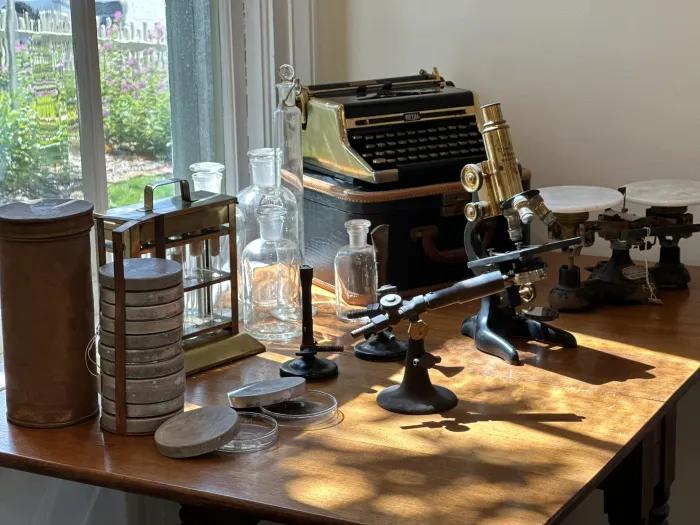
175 years of U-M medical history come alive in museum exhibit
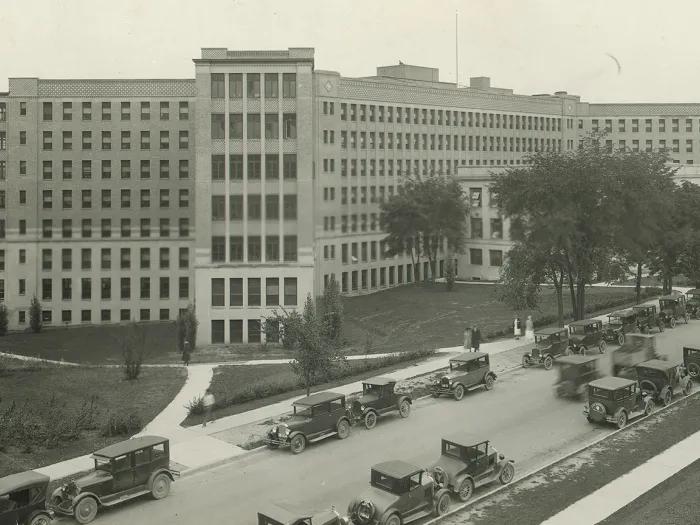
“Among the finest hospitals in the country”: The University Hospital of 1925
Featured News & Stories
“Among the finest hospitals in the country”: The University Hospital of 1925
Many hospitals still don’t do enough to prevent UTIs from catheters
University of Michigan Health named Michigan’s top hospital, earns spot on U.S. News honor roll
Doctors in the house: History of medical interns and residents at Michigan Medicine
How new care models, within a new building launch, are helping optimize patient care