Ljungman receives $500K from the Little Warrior Foundation for Ewing sarcoma gene-editing therapy

Author | Nicole Fawcett

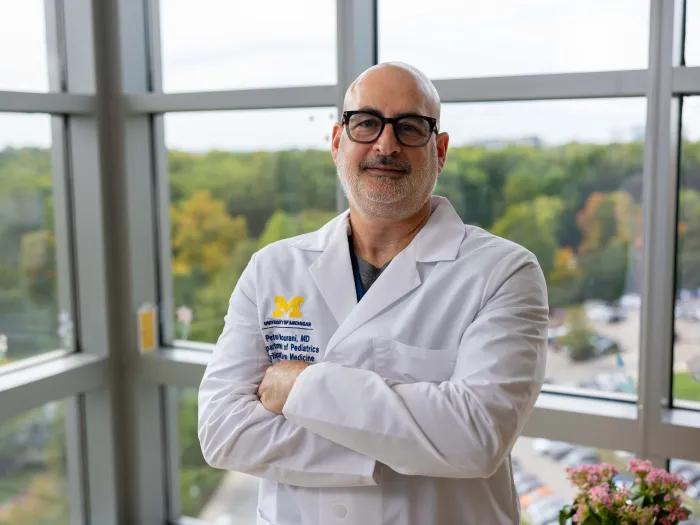
Dr Mats Ljungman KLIPP Targeting Cancer with CRISPR

Mats Ljungman, Ph.D., professor of radiation oncology and environmental health sciences at the University of Michigan, received a $528,728 award from the Little Warrior Foundation to further research using a gene editing system to target a gene fusion involved in Ewing sarcoma.

Ljungman and his laboratory have developed KLIPP (the Swedish word for “cut”), a next-generation CRISPR-based therapeutic platform designed to target cancer-specific structural variant junctions (gene fusions).

The fusion gene driving Ewing sarcoma, most commonly EWS::FLI1, is an ideal target for this strategy because it is a non-hereditary mutation found only in tumor cells, allowing for highly selective targeting.

KLIPP utilizes guide RNAs that bind to precise DNA sequences on both sides of the fusion breakpoint. Only when both guide RNAs bind in close proximity is the Fok1 enzyme activated, enabling highly selective cutting of the cancer-driving fusion DNA. Without this genetic blueprint intact, the corresponding oncogenic protein can no longer be produced.

The funding will support the development of a weaponized lipid nanoparticle delivery system to more efficiently deliver KLIPP to tumor cells, followed by validation of this therapeutic strategy in both in vitro and in vivo Ewing sarcoma models.

In This Story

Mats E. Ljungman

Mats Ljungman, PhD

Professor

Featured News & Stories

boy dressed as spiderman next to woman red hair smiling and man sitting on floor in playroom
Health Lab

Talent show brings joy to kids at children’s hospital 

A weekly talent show at University of Michigan Health C.S. Mott Children's Hospital helps pediatric cancer patients and families find support, healing and happiness through music, magic, and creative expression.
pink background faces facing eachother look accordian like and going bigger to smaller towards eachother
Health Lab

Psychedelics and anesthetics create mirror image patterns in the brain

A new study takes a data driven approach and reveals that psychedelics and anesthetics create “mirror image” patterns of large-scale brain organization, with opposite network features.
pills close up stock image
Health Lab

As probiotic use surges, microbiome-supportive food consumption stagnates

New research finds that probiotic supplement use has surged in the United States, while the consumption of microbiome-supportive foods has remained virtually unchanged.
Health Lab Podcast in brackets with a background with a dark blue translucent layers over cells
Health Lab Podcast

Caregiver Resources: Reduce the Risk of Burnout

If you are a caregiver, whether you’re helping a spouse, parent, another adult relative or a friend with a disability, health need or medical crisis, you don’t have to go it alone.
Health Lab

Prostate cancer and hereditary risk: A doctor explains the connection

Some genetic mutations linked to breast cancer also can affect men, but in a different way. A Michigan Medicine urologist explains the connection.
UMich Med Mosaic on blue background with colorful geometric shapes
UMich Med Mosaic

Beyond the White Coat: The Med Student Tradition Behind Michigan’s Smoker

In this episode of UMich Med Mosaic, host Mackenzie Kay sits down with graduating student Gareema Agarwal and MD/PhD student Mark Adame to explore the history, traditions and behind-the-scenes work that bring the University of Michigan Medical School’s annual Smoker production to life. As outgoing Smoker Czars, they share how they became involved in the beloved student-run comedy musical, the process of writing, casting and producing the show, and the challenges of balancing a major creative undertaking during their medical training.