
175 years of U-M medical history come alive in museum exhibit
Open through August 2026 at the Museum on Main Street, it includes artifacts, photos and more
8:00 AM
Author |

Originally published Sept. 15, updated Nov. 26, 2025, February 20, March 20, April 2, July 15 and August 6, 2026
In fall 1850, the first students arrived in the small frontier city of Ann Arbor to enroll in the University of Michigan’s new Medical School.
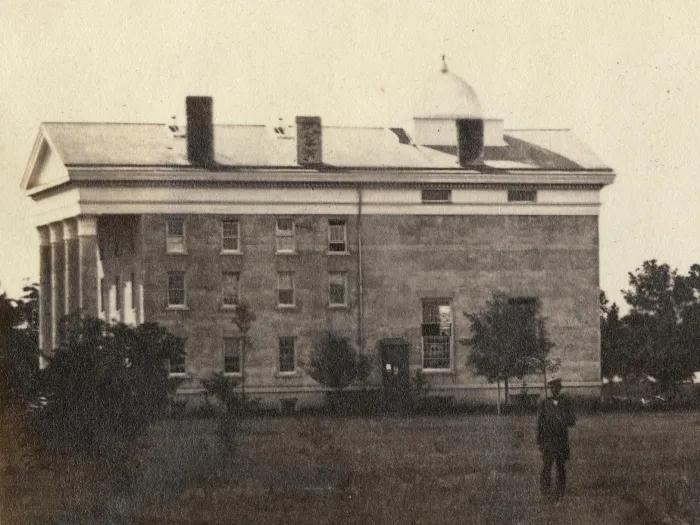
Today, 175 years later, what began in a single building on the U-M Diag has grown into one of the largest and highest-ranked academic medical centers in the world. Its biomedical education programs, patient care at hospitals and clinics statewide, and massive research community are all part of what’s now known as Michigan Medicine.
Now, a museum exhibit explores how that transformation took place, and its impact on society, through artifacts, photos and fascinating facts about U-M’s medical history.
The exhibit runs from September 20, 2025 through August 30, 2026 at the Museum on Main Street near downtown Ann Arbor, with free public hours from 12 p.m. to 4 p.m. Saturdays and Sundays, and private tours weekdays by reservation for groups of all ages.
The exhibit was originally slated to close in April but was extended due to the high number of visitors coming to see it.
Wednesday, Aug. 26-Friday, Aug. 28 - The museum will be open 12-4 p.m. In addition it will open early on Saturday, Aug. 29, at 10 a.m. (The nearby Ann Arbor Farmers Market is open until 3 p.m. Wednesday and Saturday.)
Note that Main Street is closed at Ann Street just south of the museum during August; information on the detour for northbound vehicles is here.
More about the exhibit
Titled “Creating the Future of Medicine for 175 Years,” the exhibit traces the roots and evolution of U-M medical education, biomedical research and patient care.
In addition to the 175th anniversary of the Medical School, 2025 also marks the 100th anniversary of the opening of the “Old Main” University Hospital that was U-M’s flagship for 60 years. It stood where today’s Frankel Cardiovascular Center and new D. Dan and Betty Kahn Health Care Pavilion now stand.
Among the artifacts on display:
- the handbell used to summon U-M’s first medical students to class
- microscopes and other instruments that U-M scientists used in discoveries about the roles of microbes and genes in disease
- medical and surgical equipment from the 19th and early 20th centuries, from scalpel sets and leech jars to early electronic heart and diabetes monitors
- life-size mannequins used to train early nursing students
- a scale reproduction of the carved stone arch through which generations of patients, faculty, staff and students entered Old Main. (A great backdrop for photos.)
- a flight suit and helmet worn by Survival Flight nurses as they deliver advanced life-saving care in the air aboard U-M’s helicopters and jet
The exhibit also includes dozens of photos of pioneers and pathbreakers from across U-M medical history; maps and images of the places where they worked and studied; and information about their contributions to biomedical progress and the care patients worldwide receive today.
Along the way, museumgoers can ponder questions on the walls about their own views and experiences related to medicine and science.
Young visitors can try on real medical student white coats, scout for clues in a scavenger hunt, and ring handbells like the original Medical School bellringer.
Dive deeper into U-M medical history:
Visitors to the exhibit can leaf through the pages of U-M medical history in the reading area, including decades of Medical School yearbooks, and the logbook of the World War II Army hospital that U-M doctors, nurses and dietitians staffed as it traveled across England, France and Belgium.
Much more information about U-M medical history is available through the Medical School’s web page for the 175th anniversary, https://medumi.ch/175th.
Other online offerings include:
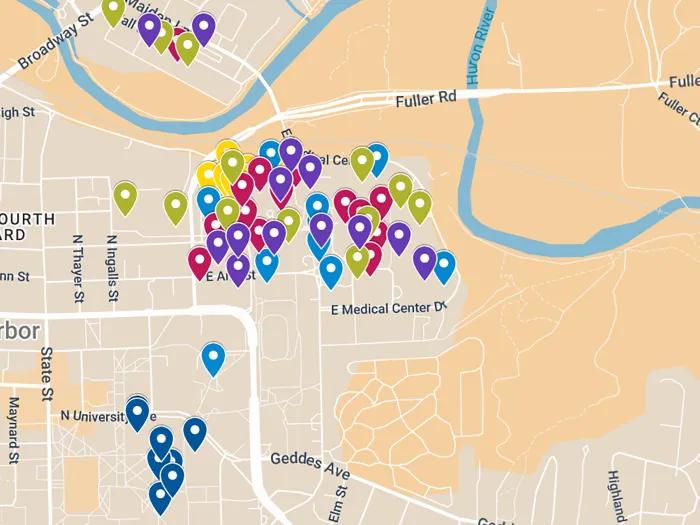
- an interactive map, timeline and stories of U-M medical history;
- a way to share memories of working at, studying at or receiving care at U-M medical locations;
- a special issue of Medicine at Michigan magazine, which is also available in printed form at the exhibit while supplies last
- a shop offering T-shirts and jackets with the 175th emblem, with proceeds going to an anniversary fund, and
- a link to give to the 175th anniversary fund directly.
Those who want to dive even deeper can buy a book available in hardcover or digital form through the U-M Press. It was written as part of the U-M bicentennial in 2017 by medical historians Joel Howell, M.D., Ph.D. and Dea Boster, Ph.D.
Visitor information:
While the exhibit is free, donations are accepted to benefit the Washtenaw County Historical Society, which runs the Museum on Main Street.
The museum is located at 500 North Main Street, Ann Arbor, with parking available on nearby streets or in the Kerrytown municipal lots and the West Ann Street parking structure. Parking at the museum is extremely limited; those with special need for on-site parking should contact the museum in advance.
The front door is on Main Street, but an accessible ramp is available at the back door.
To arrange a free group tour on any weekday between September and the end of April, or for questions about visiting, call 734-662-9092 or fill out this form.
The museum’s building even has a connection to U-M medical history. Built in the 1830s as a house on Wall Street, it traveled slowly on a flatbed truck to its current spot in 1990, after being saved from demolition when U-M expanded parking for the first location of the Turner Geriatric Clinic and the current Kellogg Eye Center. Read more about the move here: https://aadl.org/node/40590
Exhibit credits:
The exhibit was created by members of the Michigan Medicine Department of Communication and the Medical School’s Center for History, Humanities, Arts, Social Sciences and Ethics in Medicine. It includes photos and information from the U-M Bentley Historical Library, and artifacts from CHHASSEM, the U-M Nursing History Society and the Washtenaw County Historical Society.
Media Contact

Public Relations
Department of Communication at Michigan Medicine
Related
From the Diag to the world: 175 years of U-M medical history
“An example worthy of imitation”: U-M Medical School marks 175th anniversary
Featured News & Stories
Beyond the White Coat: Disability, Neurodiversity and Advocacy in Medical School

Antipsychotic Use in Nursing Homes: Balancing Medication Safety, Policy, and Dementia Care
Learning Together: Making Space for Growth at Work

Depression in OBGYN residents needs more attention, study suggests

Is the United States Lagging Behind Europe in Memory Improvement?
