12-year-old C.S. Mott Children’s Hospital patient heads to Washington to advocate for children’s health
Lansing family to meet with Congress during CHA Family Advocacy Day and share middle schooler’s journey with sickle cell disease
9:00 AM
Author |
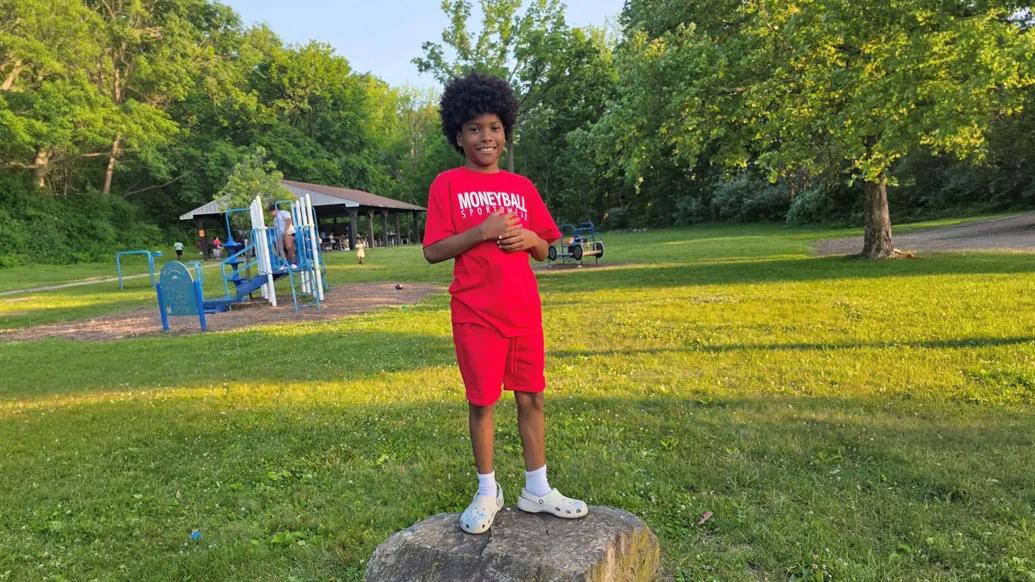
ANN ARBOR, Mich. – Since infancy, E’Shon Guy has lived with a severe form of sickle cell anemia that led to frequent illness and repeated hospitalizations.
Now 12, he’ll bring his personal story to Capitol Hill to help lawmakers understand how federal health policies affect children like him.
The Guy family will travel from their home in Lansing to Washington, D.C., to meet with members of Congress as part of the Children’s Hospital Association’s 21st annual Family Advocacy Day.
E’Shon underwent treatment at University of Michigan Health C.S. Mott Children’s Hospital in Ann Arbor and currently sees specialists at C.S. Mott Children’s Hospital at UM Health-Sparrow in Lansing.
“When policymakers hear from patients and families like E’Shon’s, it puts a human face on the decisions being made in Washington,” said Luanne Thomas Ewald, M.H.A., FACHE, Chief Operating Officer of U-M Health C.S. Mott Children’s Hospital and Von Voigtlander Women’s Hospital.
“We’re proud of E’Shon for sharing his story and helping leaders better understand the lasting impact that investing in children’s health care has on families and communities.”
During the visit, the Guy family will meet with members of Michigan’s congressional delegation to advocate for priorities like protecting and strengthening Medicaid and advancing children’s health care.
“I want them to understand that without the incredible care E’Shon received and the expert team that supported him, my son might not be here,” said E’Shon’s mother, Virona Guy.
“We always knew his care teams truly cared about E’Shon and our family and were committed to giving him the best care possible.”
E’Shon has Hemoglobin SS (HbSS), the most common and severe form of sickle cell disease. He inherited one sickle cell gene from each parent, who both carried the trait.
For years, his family lived with the uncertainty of not knowing when the next medical crisis would happen. E’Shon frequently experienced emergencies caused by sickle cells becoming trapped in his spleen, leading to dangerous drops in hemoglobin and blood volume. Each episode required at least a five-day hospital stay, his mother said.
When he was about eight years old, he underwent a partial splenectomy at Mott that involved removing part of his spleen to stop the recurrent blood trapping.
Since then, his emergency room visits have become rare. He’s been able to enjoy family vacations and favorite activities like playing basketball, riding his dirt bike and going fishing.
Family Advocacy Day brings together patients and parents from more than 50 children’s hospitals nationwide to encourage lawmakers to protect children’s health care. E’Shon will travel to the nation’s capital with his mom and dad, Eric Guy.
“I’m looking forward to meeting other families and reminding each other that we’re not alone,” Virona Guy said. “I also want government leaders to understand how grateful we are for E’Shon’s excellent medical care and the health coverage that made it possible for him to get the treatment he needed so he could just be a kid.”
Featured News & Stories

Can Your Voice Reveal Early Signs of Alzheimer’s?

Emergency room intervention pairs smartphone, telehealth counseling to reduce risky firearm behavior
A second chance at life
Exceptional response to immunotherapy gives patient with liver cancer more milestones to celebrate

A pediatric epilepsy fundraiser that changes lives