
News and Stories
Celebrate an incredible patient success story. Explore a clinical breakthrough. Discover news that shapes the future of health care.

Republishing and Subscribing
REPUBLISHING: Except where otherwise noted, all articles are published under a Creative Commons Attribution 3.0 license. You are free to copy, distribute, adapt, transmit, or make commercial use of this work as long as you attribute Michigan Medicine as the original creator and include a link to this article. Images from stock image sources such as Getty Images may ONLY be used by University of Michigan users.
SUBSCRIBING: We send out weekly email newsletters with stories from Michigan Health Lab; sign up here.
Want to get every story posted to this site, as soon as it appears? You can! We offer a free RSS feed with the most recent stories published on the Michigan Health Lab site. Its address is michiganmedicine.org/healthlab-feed.xml .
The feed will deliver a headline and link to you whenever something new is posted. You can choose to get RSS feeds delivered into your email program, into a web browser extension, or into an app on your phone or tablet. Or, you can “follow” a feed using a news service.
Email: If the email program you use is able to handle RSS subscriptions, you can add the address of an RSS feed into the appropriate place in the program and it will automatically get the subscription started. For instance, in Microsoft Outlook, follow these instructions. If your email program doesn’t support RSS feeds (for instance, Gmail) you can search for a free RSS-to-email service on the web and tell it to send you an email every time a new story is posted to an RSS feed you subscribe to.
Browser add-ons: Most modern web browsers allow you to use little programs called “extensions” or “add ons” to expand what the browser can do for you. Think of them like apps, but for your browser rather than your phone.
If you go to the settings menu of your browser, you should be able to get to a ‘store’ where you can search for extensions. Search in the store to find an RSS reader extension that will allow you to display the up-to-date stories from an RSS feed in a browser window. You may have to create a free account with the maker of the extension.
Apps and News aggregators: If you search the app store or market for your smartphone, you can find apps that let you pull in news from RSS feeds and see the latest posts every time you open the app. Some of them may be offered by a company that also makes a browser extension by the same name, so you can create an account once and get RSS feed stories fed to you on both your phone and your computer. You can also use news aggregator sites such as Google News and Apple News to follow Michigan Medicine as a news source.
From Health Lab

What’s changing in Medicaid and what can you do?
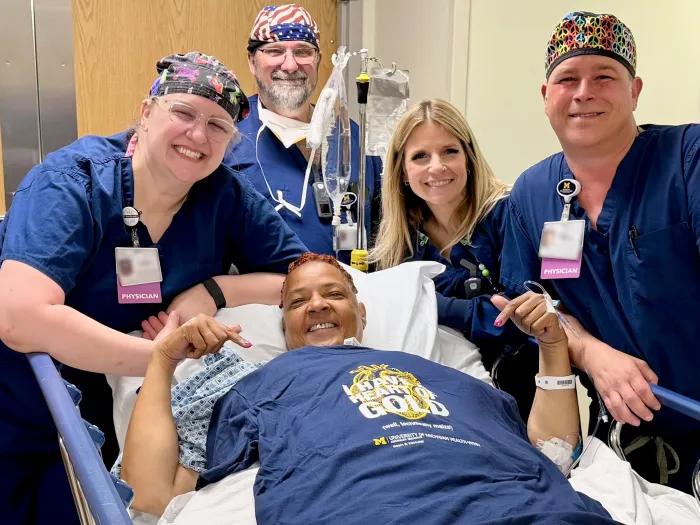
Heart of Gold: Rare metal allergy leads to a unique heart device

Small daily activities may help ease dementia caregivers’ stress
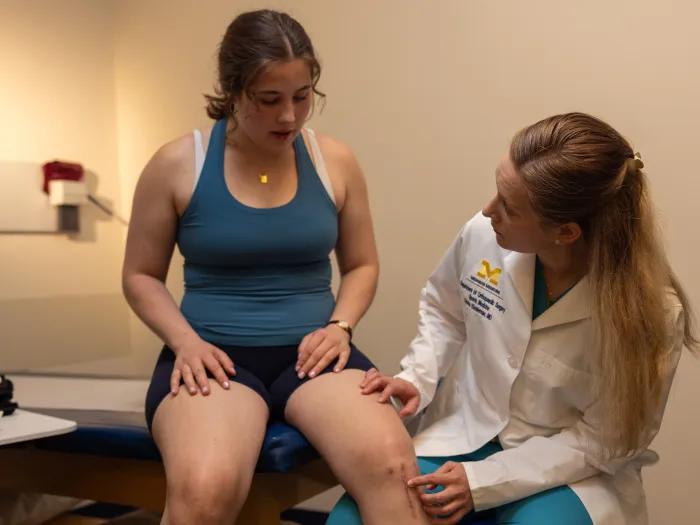
Second ACL tear brings star athlete back to trusted surgeon

Understanding family history key to early detection of pancreatic cancer

Patient with rare form of diabetes finds answers in genetic testing, clinical trials
From the Press Room
U-M launches national search for next executive vice president for medical affairs and CEO of Michigan Medicine

How have diagnostic and treatment decisions for prostate cancer changed in recent years?
Be A Hero returns to the Big House on Sunday, November 1
U-M-led consortium to receive up to $52 million in NIH funding to study why viral respiratory infections affect children differently
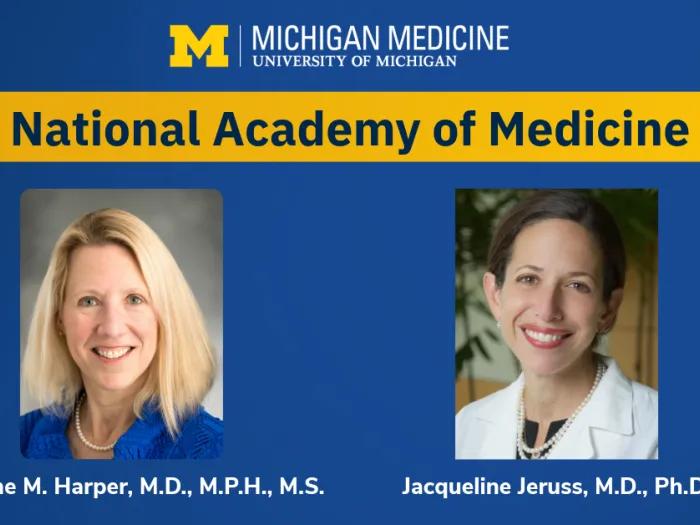
Two U-M Researchers Earn Election to National Academy of Medicine

U-M Board of Regents approves construction of Nathan and Catherine Forbes Sports Medicine Institute

Press Room
The latest from our media team, plus resources for members of the press.
Contact Us
2901 Hubbard Street
Suite 2400 SPC 2435
Ann Arbor, MI. 48109-2435
Stay Informed
Want top health & research news weekly? Sign up for Health Lab’s newsletters today!
Michigan Answers
Michigan Answers blend over a century of teaching, research, and patient care with a passion for transforming lives, pushing the limits of what's possible. They inspire confidence, hope, and the pathway to breakthroughs.

Bentley's Michigan Answer
Bentley's Michigan Answer
As Marguerita Booth had never heard of a child being born with their organs on the outside of their body. And yet as she lay in the darkened room of her first ultrasound of her first pregnancy, she was suddenly introduced to a condition that surprisingly affects 1 in every 3600 babies.

Kade's Michigan Answer
Kade's Michigan Answer
Alone. Scared. Never knowing who to trust or where to turn for help. That’s how Kade Fitzgerald of Jackson, Michigan lived the first 32 years of his life. Assigned female at birth, Kade knew at age 6 that he was meant to be a man.

Merriah and Melliah's Michigan Answer
Merriah and Melliah's Michigan Answer
Few moments eclipse the joy of discovering that you’re pregnant with twins. But for 37-year-old Merrick and 37-year-old Mychal, the news that they’d be having fraternal girls with an expected delivery date of Christmas Day 2020 made the news even more exciting.

Carter's Michigan Answer
Carter's Michigan Answer
Carter Hilton celebrated his sixth birthday by doing what he loves most: running around his backyard, dancing with his younger brother, and being chased throughout the house by his mom. It helps that Carter is a naturally exuberant child. It also helps that Michigan Medicine performed the first in-womb spina bifida surgery in Michigan nearly four months before Carter was born.

Sierra's Michigan Answer
Sierra's Michigan Answer
Imagine two patients. Both the same age and height. The same gender and race. Both have a similar medical history. Two people, almost identical in every way. So, why does one of them, seemingly at random, develop diabetes?

Dr. Valbuena's Michigan Answer
Dr. Valbuena's Michigan Answer
Most aspiring physicians study medicine with the hopes of saving lives, being on the cutting edge of research, or developing the latest therapies and technologies. For Dr. Valeria Valbuena, it was all of the above, plus one additional life-affirming goal.

Dr. Vydiswaran's Michigan Answer
Dr. Vydiswaran's Michigan Answer
What if the true power of social media isn’t found in a like, tweet or follow? For an emerging field of research taking place at Michigan Medicine, it’s the data inside social media that may have the power to give patients bigger answers and better outcomes.

Dr. Cunnane's Michigan Answer
Dr. Cunnane's Michigan Answer
Since 1958, millions of lives have been saved by what could arguably be considered as medicine’s biggest breakthrough – the pacemaker. And while its technology has dramatically improved over the last 63 years, chief concerns regarding the pacemaker have always been that it was too big and bulky and that the wires leading from it would sometimes break. But in February of 2020, Michigan Medicine helped change all of that.
