Intersectionality
The factors that drive discrimination and disadvantage are more complex than we realize—and they are often overlapping and interdependent.That’s where intersectionality comes in. What is it, and how does it relate to underrepresented and marginalized groups advancing in surgery specifically and medicine generally? We cap off the Michigan Women’s Surgical Collaborative mini-series with a robust and frank discussion about the role of intersectionality in making medicine a more diverse, equitable and inclusive place.
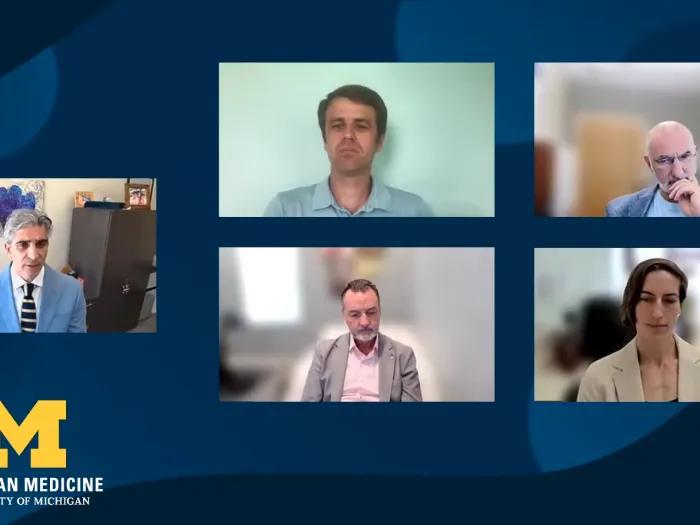
Featured speakers include:
Transcript
Narrator:
Welcome to Michigan Surgery Sessions, where we discuss the latest in clinical care education and surgery culture with faculty, residents, and medical students.
Dr. Gurjit Sandhu:
Welcome everyone to this episode of the Michigan Women's Surgical Collaborative of podcast, where we'll discuss the role of intersectionality in medicine. My name is Gurjit Sandhu and I'm an associate professor of surgery at the University of Michigan. And I'm joined today, but my esteemed colleague, Erica Newman, who is an associate professor and interim section chief of pediatric surgery also at the University of Michigan. So, we're going to talk about intersectionality today. And this is a concept that Kimberlé Crenshaw brought to the fore about 30 years ago in her effort to understand the journey of the whole self through social, political, economic, and health context. And, of course, our list could go on. Professor Crenshaw is a scholar of law at Columbia and also at UCLA. So, to this concept of intersectionality, she brings a deeper understanding of civil rights and human rights. So, I'm turn it back to my Erika now to our guest for today's conversation.
Dr. Erika Newman:
Thank you so much, Dr. Sandhu. This is a topic I think that we really have to continue to push ourselves to understand more in medicine and in healthcare, in all of our missions, how it impacts our patients and the communities in which we're serving, how it impacts us as learners and as faculty and in academics. I think it's a topic that deserves much more focus than we are currently giving it. And so, to that end, I'm really excited to introduce my friend and colleague, who's going to help us explore in intersectionality in healthcare. We're excited that Dr. Oluwaferanmi Okanlami, who is an assistant professor of family medicine, physical medicine, and rehabilitation and urology here at the University of Michigan. In addition, he is the director of services for students with disabilities and the director for adaptive sports and fitness. And he is the director of student accessibility and accommodation services. We are so pleased to have you join us, Oluwaferanmi.
Dr. Oluwaferanmi Okanlami
Dr. Sandhu and Dr. Newman, thank you so much for having me. It's a pleasure always to be in your esteemed company.
Dr. Gurjit Sandhu:
So, let's get started with this quote from the Columbia journalism review, where they quote Crenshaw saying, because the intersectional experience is greater than the sum of racism and sexism any analysis that does not take intersectionality into account cannot sufficiently address the particular manner in which Black women are subordinated. So, Crenshaw really started this understanding of this concept around the intersectionality of being Black and being a woman and how the two cannot be looked at independently, but as an intersection. And it's interesting, the Oxford English dictionary picked up on this, and it's a term that you can find in there now and they describe it as such, “the interconnected nature of social categorization such as race class, gender are regarded as creating overlapping and interdependent systems of discrimination and disadvantage.” I want to turn it over to you, Dr. Okanlami, for your understanding of intersectionality and how it plays into individual identities.
Dr. Oluwaferanmi Okanlami
I'm a very direct and honest person. And so, anyone that has heard me speak or has been in my presence when we talk about these things knows that I'm always going to be very, very straightforward. And I think in the past year and a half, a lot of people have started to pay more attention to issues of diversity, equity, and inclusion. And I think that the word intersectionality is thrown around a lot and unfortunately, I think most people, when they hear intersectionality, they actually conflate intersectionality with diversity. They think that they can say, oh, these are the various identities that I have, and I bring my full self to the table because of these identities and intersectionality is just great.
But they fail to recognize that there are many definitions, but... I had the opportunity to present something called Equity Matters and I actually partnered with my colleague as she's the sort of the chief diversity officer at Nationwide Children's and we partnered on the intersectionality module for the ACGME.
And so, we pulled the definition of intersectionality is actually a framework that allows us to describe how various systems of oppression affect marginalized individuals. In addition to it being something that categorizes how these marginalized identities cannot be separated, nor treated as additive or subtractive to each other. And so that is important to start with because intersectionality is not just saying, oh, I have various identities that I identify with, intersectionality is recognizing not just additive, but the exponential impact of discrimination when you'll have multiple marginalized identities. That is what it truly is. And so, it's trying to make sure that people recognize how that then forms within one's identity. Because we talked about not just intersectionality, but we talked about professional identity formation. And as individuals within this system are trying to then form their professional identity, but throughout different steps, along the way, you have different forms of discrimination that they are subjected to.
So, let's talk about it. We're talking about this collaborative right now, you are a Black woman applying for residency, the number of students that then I have mentored what they say to me, Dr. O, do you think it's going to be okay if I wear my natural hair during my interview? That is something that should never have to cross someone's mind, to wear their natural hair during an interview, but because of the systems of oppression in place and the stigmas about what hair means and what a certain hairstyle may say, individuals that know the system that we're going into have to then grapple with whether they're going to change who they are to fit our system. So, as people are trying to then form their professional identities and people are trying to then know whether they can be their true identity in this space, intersectionality is something we must understand exists because people cannot bring their full selves into a space that they know was not made for them. And quite frankly, doesn't want them there.
And so, it's a combination that then leads this conversation to be really interesting and unfortunately interesting at times, because intersectionality is not a good thing. And I want to make sure people understand that when we talk about it. Because people say it in a positive way, meaning that they don't actually recognize what intersectionality truly is and the impact it has on our learners and then on our colleagues as well.
Dr. Erika Newman:
You bring up such incredible points. And I guess one thing, could you expand a little bit because those questions and we're right in the midst of interview season. And I suspect when this podcast is released, we're going to have learners listening very intently to our messaging here. What advice, what do you tell those students that say, I have an interview next week at top academic medical center, A, B and C, should I wear my natural hair? How are you counseling them today?
Dr. Oluwaferanmi Okanlami
So going back and being a broken record, I will tell you what I say to them because I think that too often, we fail to give our learners the honest impression of what they're going to enter. So, honesty doesn't mean negativity and I think too often, when you are honest with people about the space that they're going to enter, people in that space think that you are being overly negative. I don't think it's being overly negative to be authentic and to tell people what they're signing up for and people are then allowed to decide what they choose to then sign up for. So, what I tell them is this, I say, "How much does your hair truly impact how you feel about your identity?" If I were to say, change your hair and you'd say no big deal, I change it every two days anyway. Then I would probably suggest that you adopt a hairstyle for your interview that is going to then be more regarded as mainstream.
Now, if your hair is a part of your identity, if we can all agree, looking at your hairstyle, that it is one that people tend to consider less than professional, braids, dreadlocks, big Afro, none of these things that should be seen as less professional, but that we can all say that for Black women, if they don't show up with straight, short, curly hair, if they show up in a cut that may make them look more masculine, If they show up in a cut that has dreads, this is something that we can say automatically, whether people intend to do it or not, people look at you differently. And so, if that is who you are, I tell people do not change who you are, because you will then get to a place that if you change who you are, once they find out who you are, when you get there, that's when you're going to really see that they didn't want you there in the first place.
So, I have to be honest with them. I say, if getting into a residency is more important to you than your hair, then you should absolutely change your hair because I can't promise you, they're going to then look at it favorably. But if this is part of your path, know that someone will want you somewhere and you may not want to end up at the program that needed you to change your hair in order for them to accept you because that is just one of the simple things that they can keep you out because of. Imagine all the other deeply rooted things that that program is going to do if they're going to be as blatant about criticizing you about your hair. And so that might be a good time for you to learn that. So, I give them the option, right? I never tell people what to do, but I'm honest with them about the fact that I can't guarantee that all of the insert specific specialty here at top-notch institution are going to be accepting of this.
But you have a choice because a lot of us make decisions about what we are willing to then put up with in order to, one of my phrases is you've got to stay in the system to get to the top of the system, to change the system. And if your goal is to change the system, you then will choose which things you are going to acquiesce to in order to remain in the system because I'll be honest with you, it's not during your residency interview that you're changing the system. At that point, you just need to then get into the system. And there's certain things that are worth fighting for, certain things that are not, but I can't tell anybody what's worth it to them and what is it? And I will never try to do that because everyone is entitled to their own fight. I just need to allow them to know what types of ammunition other people might be bringing to the fight.
Dr. Gurjit Sandhu:
Wow. So, I recognize that Dr. Newman is my host as well, but you two are to use your words, Dr. O, system changers. Both of you are in your own way. So, while we've been talking about the individual, I would love to hear from both of you, what are some small ways and what are some bigger ways that you have started to change the system now that you're in it? So, Dr. O, can we start with you?
Dr. Oluwaferanmi Okanlami
Not often, will you find me at a loss for words, but I will say, I can tell you how I have been trying to change the system, but I'm not quite sure that I can tell you how I have changed the system. I think I may defer first to Dr. Newman because I can say that in the positions that I've seen her in, she has been much more successful than I am being able to change things. I think I need to call out on this call. I know we said this, but the fact that she is a Black female pediatric surgeon, who is a section chief at a top institution, is something that needs to be mentioned.
To be a Black woman in medicine period, to then be a woman in surgery to then be a Black woman in surgery and to then be a Black female pediatric surgeon at the University of Michigan, most people will not understand what that must have taken to get there. I clearly can't say I understand what it took to get there. I know what I think it may have taken given my life and given the fact that I've got people near and dear to me that are pediatric surgeons. I was in the surgical fields myself. I have a Black female mother who is a pediatric and critical care attending. And so, what Dr. Newman has already done is much more significant than anything that I think I'm trying to do.
Dr. Erika Newman:
Certainly, what I have had to navigate and what I am navigating, certainly I have learned much from you. And so, I do appreciate you as a colleague and as a friend and every time I look up and see your face, I'm just happy to be... I've told you this before that I'm rocking with you. But I will say, it's hard out here and I tease my family because they don't get it. Sometimes I go, it's just rough in these pediatric surgery streets, rough in these streets in general. I think that we're fortunate that we are at the University of Michigan and particularly in our department of surgery which has been... We like to think that we are forward thinking in this space of providing opportunity for people that may not have traditionally been viewed upon as successful in academics and have not necessarily been viewed as leaders.
And I think one of the things that really is important, and I think, again, this is another word that gets thrown around a lot is culture. I believe that culture is so important in the success of us doing all the things that we want and need to do, including work in the DEI space. I view culture as aligning values with behavior and creating that throughout in everything we do all of our missions. So, our clinical missions, our education, and our research, how we recruit faculty, how we advance faculty, how we recruit residents, how we advance residents, all of that, building a culture in which that can be done in a space of aligning our values with our, so we can say, oh, we want a diverse residency class. Okay. That may be a value for us. But if we don't allow our behaviors, how are we reviewing those applications?
How are we going out into the community? How are we going out to SMA and getting to know diverse candidates? And then how are we creating our interview structure such that diverse candidates would want to take a look at us. Ultimately, how are we ranking diverse candidates and what metrics are we using? So, if we are not aligning our behavior with our value, then we are not shifting the culture and we're not impacting change. And so, I really think that culture is sort of the foundation of sustainable change, more so than strategy. We can strategize all the things, but if we are not shifting the culture such that we are all aligned with the values and the behavior changes, then big scale changes can't come to be. And so, if there's a secret sauce, I think is that getting us as an organization aligned from a cultural standpoint, such that these values are shared, and then we can align the behavior with the values.
Dr. Oluwaferanmi Okanlami
I'll jump in and I'll add because as we talk about intersectionality, once again, as this podcast, I did not disclose that I identify as an individual with a disability. So, I'm a wheelchair user. I had a spinal cord injury in my third year of orthopedic surgery residency, and I'm also a Black man in medicine. And so, some of the sort of the intersectional identities that impact me as a Black man, as a disabled Black man. And so, I think what Michigan has allowed us to do here as Dr. Neman was bringing up, is we actually have a significant number of disabled physicians and clinicians and researchers and individuals of different walks of life in our system here. And so, we have tried to do a better job of identifying the fact that while we talk about racism in our system, and that racism is a public health crisis, and it's a systemic thing, ableism is the same in fact.
We have the Americans with Disabilities Act, which is now 31 years old. However, we still do not have accessible practices even in our healthcare system. And so, one of the things to try to change our culture as Dr. Newman was talking about here is first identifying the problems that exist because medicine in and of itself is historically a very ableist framework, because we operate from this sort of deficit mindset of disability being a pathology that needs to be rectified rather than seeing that disability can also be identity. And as a disabled physician, I have to sort of walk this line carefully because I do not want to seem as though we're saying people should not strive for whatever top physical function they can have, or people should not want to then have rehabilitation to regain some function that they lost. But if we create a society that only sees the completely non-disabled body mind as normal or right, we're always going to make people who are disabled, feel like something is wrong with them.
And there's nothing wrong with someone with a disability. What is wrong is the society that we have that is not accessible to them. And so, we tell people that by providing the appropriate accommodation, an individual with a disability will not feel as though there's something wrong with them. And within the healthcare system we are trying to do that to change that here at Michigan, by the work that many, many colleagues are doing to be more inclusive in our practices as Dr. Neman said, if we are not creating providers that are going to reflect the population that they serve, we are not going to be as well served in providing people with the resources. So, people often talk about how you can't be what you can't see. People also talk about how representation matters. Now I tell people, I agree with both of those statements, but unfortunately there are times that you have to be the thing that others will see because someone has to be that first.
And if we are trying to encourage individuals for minoritized populations to go into medicine, but they can't see someone like them in those spaces, that does not mean that they can't be that. And so here disability is sort of that opportunity that I think we have to show the rest of the country and the world, because we've got Dr. Muraszko outgoing chair of neurosurgery, female neurosurgery chair with a disability. We've got Dr. Philip Zazove, outgoing chair of family medicine, family medicine physician who identifies as deaf. We have Dr. Mike McKee in family medicine. We have Dr. Carrie Pilarski in physical medicine and rehabilitation. We have providers, practitioners, researchers here that are trying to demonstrate that individuals with disabilities can and will and should be able to be included, involved, and participate. And they contribute just as well.
But when we talk about the intersectionality, we need to see the fact that individuals with disabilities are not welcome here, are not invited here. And when they get here, they don't always the accessibility that is needed. So, we are trying to change that because as I started by saying, you have to identify the problem, but too often, when you identify problems, people think that you are saying they are the problem. And I tell people that while the past may not be your fault, the future will be. So, if we have people that are standing in the way of change, then you are the problem. But in order to make our place accessible to individuals with disabilities, to women, to people of color, to any minoritized population, this intersectional framework will allow us to see what barriers are there that make it such that this individual will have a much more difficult path to get into the same place.
My colleague, Dr. Walker used this beautiful image that I wish I could show, which has two people at the starting line of a race. One is a white man, the other is a Black woman. And then there's a finish line in the distance. There's a clear path to the finish line for the white man, that Black woman, she is being chained to the starting line. And there are alligators and crocodiles and holes and meteors and all sorts of things that are before she gets to the finish line. And the caption says, but the distance is the same.
That is what intersectionality is.
And then we all have an opportunity to do something within our spheres of influence to try to then address that. And what I hope to be trying to change in our system is the fact that disability is an aspect of diversity that we need to embrace, that we need to make sure that our system has the appropriate accommodations to allow an individual with whatever disability it may be, visible, invisible, apparent, not apparent to know that this is a place for them, and that they have just as much of a right to be here as anybody else.
Dr. Gurjit Sandhu:
Wow. That was incredibly powerful and enlightening, Dr. O and you make me think of a question for Dr. Newman. The year is 2021. Dr. Newman, am I correct that you were only the fifth trained female Black pediatric surgeon in the United States? Fourth, I'm even wrong about that, fourth. I think that we need to take pause and think about that and think about Dr. O's words in terms of you can't be what you can't see and understanding what that means for the future of healthcare and thinking about intersectionality and that beautiful visual that you painted for us. So, Dr. O and Dr. Newman, could you share a little bit with us in terms of your role as physicians and what this means in terms of presenting intersectionality, but also that awareness of it and what it means for your patients and what it means for learners.
Dr. Erika Newman:
When we are counseling and mentoring learners and students, and even junior faculty on careers in academics. And particularly as Dr. O pointed out some of the surgical specialties, we're asking them to devote time and energy, and they are not... I mean, what evidence do we have of success? Particularly when you look in the C-suite, when you look in the deans and chairs and division chiefs, Black women don't exist in those spaces. And I would ask Dr. O the same question about the identities in which he carries. And so how can we be so exclusive in our spaces of power and privilege, because ultimately it does come down to that and I can tell you, I am keenly focused on bringing others along with me. I've been... In my head the past several months is lift as you rise, because I really think that we have to, not just me going through these doors, but I'm bringing others along with me. We're not coming in singles. We're coming in pairs and triplets and quads.
Dr. Oluwaferanmi Okanlami
That makes me think of another phrase that people throw around, which is the minority tax. So, minority tax of the fact that while you can't be what you can't see while representation matters, what that ends up doing is it makes certain people either intentionally or unintentionally shoulder the burden of them representing whatever demographic it is that then they are in. I don't ever want to seem like white men are the problem, but since in many of our spaces, it's the majority. It's the example that I use, is that when you meet one white man, you meet one white man, and you just think that that might be that white man. And you have other examples of other white men with other ideas and opinions of things. But when you meet a disabled Black man, when you meet a Black female surgeon, when you meet a Southeast Asian, people then if you don't have any other person that you've seen that looks like them, or fits that demographic, you unintentionally will then assign that person's thoughts, beliefs, opinions, actions to that entire group.
And so, minority tax, those of us that are in these spaces have this additional burden of being the representatives for this entire demographic. Because if we don't do well, we are then seen as the reason why we're not going to bring more people like that in. If one white man does poorly on his endocrinology exam as a student, the institution doesn't then turn around and question, whether should have been accepting white men. But I can tell you that in spaces that we have been in, when a Black student struggles, we look at the school that Black student came from and say, well, maybe they weren't prepared enough before, we start asking questions about their home life. We start wondering if perhaps we just... They were in here too soon. Maybe we didn't support them enough and we should have let them get to another school.
We start asking so many questions about why that student failed and perhaps they weren't good enough to be here. And so, the minority tax is something that then makes each of us have to be 10 times better to be seen as half as good. And we need to then be honest with our learners about that, because I want that to change but the way that I mentor people is, this is a tough thing to say, because I'm hard on all of my students, hard on them in a way of saying that there are expectations of what you must be able to do to be successful in this system and I need to make sure you know those expectations. Some of those expectations are unreasonable, but that's the system we're in currently, and we're striving to change it, but you need to know this.
And you also need to know that I need you to not have any margin of error and you to understand that because they're going to be judging you more critically than others and if you're unaware of that, then I'm sending you into the lions' den without the knowledge that there are lions in there that are hungry. And this is what I mean about making it sound like I'm negative, but I'm not negative because I am still very, very optimistic about what we can see in the future but I'm realistic about the experiences that you're going to have today.
And if you recognize those things and you go into them armed with the appropriate tools, you will have a better chance of then surviving in this system and not being one of the casualties that allows them to continue to say, the reason we're not here is because for whatever reason, and we're not good enough, and they will continue to then add on the justifications for why we do not belong to be here by looking at the numbers and the metrics and the things that this game, that was not created by us, that we are now forced to play.
The rules of engagement for that game that are still stacked up against certain minoritized populations, once you learn the rules of the game, you can then get to the top of the game and change those rules. But it's really, really difficult as a trainee. It's really, really difficult in terms of my patient care, because I might not have the resources right now to then make sure that at the health disparities that I see in my populations are changed immediately. But if I at least can work within the system to then capitalize on what does exist. And I make sure that my patients, I make sure that my students, I make sure that my colleagues all know that we're doing that as Dr. Neman says, you can then lift as you rise and bring people with you because none of us can do this alone.
I am not doing this alone, Dr. Newman's not doing it alone. And as long as we make sure that we are not exclusive in what that team looks like. Because the other thing that I say to people is, I'm not just looking to work with minoritized populations. I want the majority to be right there, hand in hand, working together just because the work we're doing does not just benefit the minority populations, the work that people do, doesn't just benefit the majority. And if we feel as though we are pushing the majority away to say, it's your fault, we're never going to be able to get the system to change. And it's not just being opportunistic and saying, I want to work with them because they're the ones in power, it's saying I want to work with them because I truly believe that every single person's voice should count. And so I'm not trying to then tear down the majority.
I'm just trying to make sure that the majority recognizes that they need to also work to lift up the minority. And if we're all doing that and we're lifting everyone up, then we're fine. Having had DEI conversations in plenty of places outside of medicine, you may be surprised how easily people can say, I understand all this diversity stuff that you talk about, but our business is doing just fine. So, I don't know why we need to diversify our employees. I don't know what we need to diversify our customers because we're doing just fine.
And even though there's still a business case for them, it's something that we should not be able to deny in healthcare that our business is not doing fine, when you know that we have health disparities that exist because people don't recognize the minoritized populations that have worse outcomes. Because when we talk about intersectionality, we're talking about that from the framework of two faculty members right now. But when you look at your patients and then we wonder why our patients have poor outcomes and you don't then understand how intersectionality plays into their experience in healthcare as well, you fail to recognize why those health disparities continue to be perpetuated.
Dr. Erika Newman:
Thank you so much, Dr. O, I appreciate your wisdom. I will say that this work is a journey and I think we have to look at it as a journey. There are... Yes, we have our strategies. We have our projects, our initiatives, we have the work that we're doing every day, but this is a lifetime process until there is parody, we will not consider our jobs complete. And so, I'm so thankful for Dr. Sandhu and for you, Dr. O for your partnership. And again, it's just an honor to rock alongside you all.
Dr. Oluwaferanmi Okanlami
Thank you both very much for having me. I know that Dr. Newman and I were the ones that spoke primarily, but I also want to make sure that we don't leave this without giving credit to Dr. Sandhu and everything that she has done within this department and within this institution, to talk about parody and to make sure that we don't fail to acknowledge that in this system, we elevate MDs and MD PhDs, but we don't elevate PhDs and other people that have been actively making changes as well. I know I've had the opportunity to work with her, and I know many students that have had the opportunity to work with her.
And so, without Dr. Sandhu's presence here as an Asian woman, and I don't know if she identifies as Southeast Asian or what she... I'm asking questions, but I don't want to make assumptions. But that when I see her and I know what identities I can see, I don't know all the other identities you may have, but that is also something that makes this collaborative, this work, and the University of Michigan in terms of what it is trying to demonstrate, a very special place. So, I am honored to have been a guest here and I look forward to seeing more from the work that you both do. Go Blue.
Michigan Surgery Sessions
Listen to more Michigan Surgery Sessions podcasts - a part of the Michigan Medicine Podcast Network.
Featured News & Stories

E-bikes are faster than ever. Are families prepared for the risks?

Scientists discover that bacteria use an understudied polymer found in all life to protect cell functions during stress
Gratitude inspires gift to improve survivorship care
Beyond the White Coat: Global & Local Health Experiences
Aortic valve replacement: Understanding TAVR and SAVR